• The move to the new server is done. There are some software and database maintenance updates in process. This has us passing the hat around to help out. We appreciate any donations. Seriously, even a dollar helps. The payment page may be found here - https://www.audiokarma.org/support.html

Broadcast turntables?

I did not know that this photo would trigger so much interest on these French grannies, that makes you feel good!

Here are the two best threads I found discussing these machines,

And more generally the equipment in use at RTF (before april 1964) and ORTF (the name from april 1964 on, before in was split in january 1975, at which point the radios became Radio France):


Obviously they are in French, but I found that Google Translate usually works fairly well between French and English.

I haven't found documentation on the TD56/3, but I have the service manual of the TD31 which is the equivalent made by Belin. Unfortunately Audiokarma complains that the file is too large to upload. If someone knows how to overcome this...

And also a video showing the dual platter in action - needless to say, in normal operation they did not start the platter by hand, they used the fader start.

.
 
I want one! I really want one.
Good luck on finding one, hen's teeth are plentiful in comparison

Time to bring back the Guillotine, I say.
Yes, we are quite a few thinking alike :mad:

Is it possible that any export models would have been under a different nomenclature?
Unfortunately, no. You have to understand how the ORTF bought their equipment. They worked in much the same way as the BBC, in that they did not buy off the shelf, but established extensive technical requirements that they sent to their various manufacturers, who then built prototypes based on these requirements. Once a prototype was approved, the order was placed for the needed quantities and no more. Usually the same design (let's say SN312) was made by several companies.

You also have to understand that the ORTF, as a large organisation with enough budget to afford it, was free to set the standards they wanted. They had their own connectors (military Socapex, but often in other configurations than those the military used), their own line levels (a choice of -22dBu or +12dBu), their own load impedance (200 ohms instead of 600), their own tape equalization (same as CCIR at 38 cm/s, but at 19 it was 50µs instead of 70), even their own rack width and backplane connectors. The manufacturers were happy to indulge all those pecularities and they made enough money from their business with ORTF (and often the military, SNCF and RATP) not to bother trying to sell variants to other standards - for instance, for other countries. That was fine while there was enough money to buy taylor-made equipment, and the French industry provided excellent engineering indeed.The turntable in question was a product of this era, and this is why you will not see one sold to another broadcasting company: they were simply not compatible. Many BBC designs were like this too.

But then the budgets dwindled and the lack of interest of these companies to their sales department started to be a problem, as radio and television companies progressively adopted international standards and started reading the price tags. The British manufacturers, as well as some French companies like Elipson, Cabasse, FRB, Thomson or Schlumberger/Enertec (later acquired by Studer) survived thanks to their interest in the international markets - and consumer markets when possible.

I personally witnessed the fall of such a small company that produced very high end, specific video equipment for essentially two customers, both ex-ORTF: the SFP (specialized in producing high end TV programmes, eg. the Tour de France) and TDF (in charge of all the radio transmissions in the country). When the SFP finally died and TDF was purchased by a bigger company, the orders dried up and it was too late to find other activities. A sad ending indeed.

I'd also love to see a picture of your tape machine if you have any. Thanks again for providing me with my latest obsession!
So you want more, huh? Now you want broadcast recorder porn :whip:

OK, allow me a little time to prepare the shots and I'll satisfy your new obsession ;)
 
Last edited:

Now Andy, I thought you were a friend. You know I have an issue with turntable porn. And talk about un-attainable. There is a good possibility that none exist in the US and it sounds like few exist in the world.
I wonder what they were thinking when they decided to smash most of these up.
I'm gonna go with these tables really, really sucked and they didn't want them in the hands of anyone who could ruin the company's reputation and we really wouldn't want one anyway.
I'm starting to feel better already............

BillWojo
 
I wonder what they were thinking when they decided to smash most of these up.
I can answer to this. According to the links I posted above, Radio France's managers of the time (around 1990) were obsessed by the idea of not helping the "free radios" - a nickname for small private radios, either community or commercial, that bloomed in France after the monopoly was essentially dropped in 1981. In nine years the mindset of many senior civil servants had not changed yet. Now things have evolved and they organize auction sales for their obsolete stuff. But the equipment they sell now is much more recent than those.

I'm gonna go with these tables really, really sucked and they didn't want them in the hands of anyone who could ruin the company's reputation and we really wouldn't want one anyway.
I'm starting to feel better already............
Yes, exactly! They sucked big time, and if by bad luck you find one, you can always dump it on my doorstep. I'll dispose of it for you, free of charge.
 
I knew from past experience at the radio stations that puck driven broadcast turn tables were noisy. We had high pass filters on all them usually built into the phono pre-amps near the tone arms. When working for a professional sound company and disco became a big part of our business even though the DJ's wanted puck driven tables for their fast acceleration, dependability , slip cuing etc, we all discovered they were to noisy. High pass filters cut off the bass they wanted, too. Solution, SP 10 and then the sL1200. They didn't come up to speed as fast and didn't have the torque, but they were very quiet and we didn't need any filters so the bass could be pushed further and further and they seemed to last and last. I will admit the SL 1200 mk 3 was a leap in performance, too.

Do I own a DD table, no. Should I? Possibly. But I doubt it. Main reason is I don't like the arms that come with most Technics tables, and the new SL1000R even with out a tone arm is just to pricey for me. If I had big money I would want the SME 60 or the Big Bergmann. Or possibly the latest new Clear Audio with a Linear tone arm.
 
Now Andy, I thought you were a friend. You know I have an issue with turntable porn. And talk about un-attainable. There is a good possibility that none exist in the US and it sounds like few exist in the world.
I wonder what they were thinking when they decided to smash most of these up.
I'm gonna go with these tables really, really sucked and they didn't want them in the hands of anyone who could ruin the company's reputation and we really wouldn't want one anyway.
I'm starting to feel better already............

BillWojo

You should have told me you wanted a flip top, that could have been done, but it would have required removal of all that constrained layering o_O

Not to worry, it would have expanded your specified footprint so it couldn’t be done without hydraulic lifts :bs:

What I’ve always wanted was a Fairchild 750, but alas I’d have to sell way too much stuff to fund one, dreaming a little dream…..

VR
Andy
 
Six pages, and no mention of the world leader in radio broadcast gear from the 1920's -> late 50's?
Presto Recording Corporation of Paramus NJ

Presto Recording Corp 15G2 (early-mid 50's)
General Electric A1-500 broadcast arm (early-mid 50's)

Her name is Audrey. She drives the GE A1-500 coaxial corner speakers (only top speaker is hooked up)
ink-spots_mono-rig_zpsa93ba539.jpg
DSCN5416.jpg DSCN5417.jpg DSCN5418.jpg DSCN5419.jpg DSCN5420.jpg DSCN5421.jpg DSCN5422.jpg DSCN5423.jpg
 
Last edited:
Six pages, and no mention of the world leader in radio broadcast gear from the 1920's -> late 50's?
Presto Recording Corporation of Paramus NJ

Presto Recording Corp 15G2 (early-mid 50's)
General Electric A1-500 broadcast arm (early-mid 50's)

Her name is Audrey.
View attachment 2637633 View attachment 2637634 View attachment 2637635 View attachment 2637636 View attachment 2637637 View attachment 2637638 View attachment 2637639 View attachment 2637640


Very nice :trebon:

Andy
 
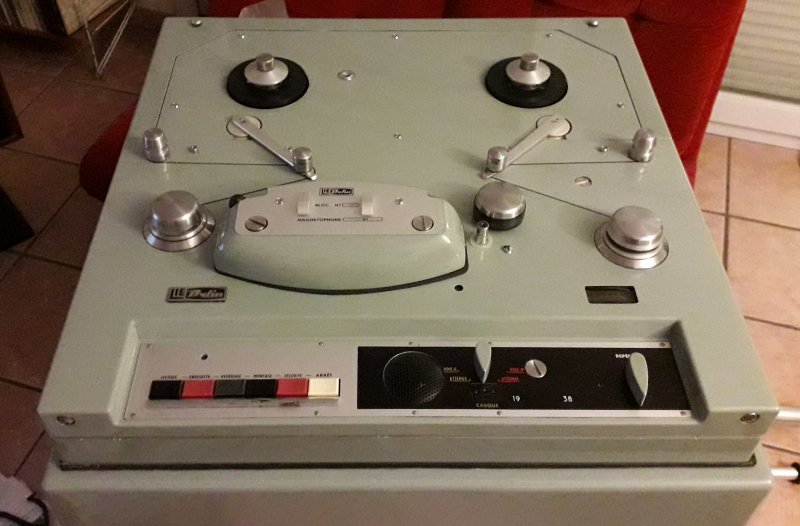
I'd also love to see a picture of your tape machine if you have any. Thanks again for providing me with my latest obsession!
OK, there you go:

Top view :

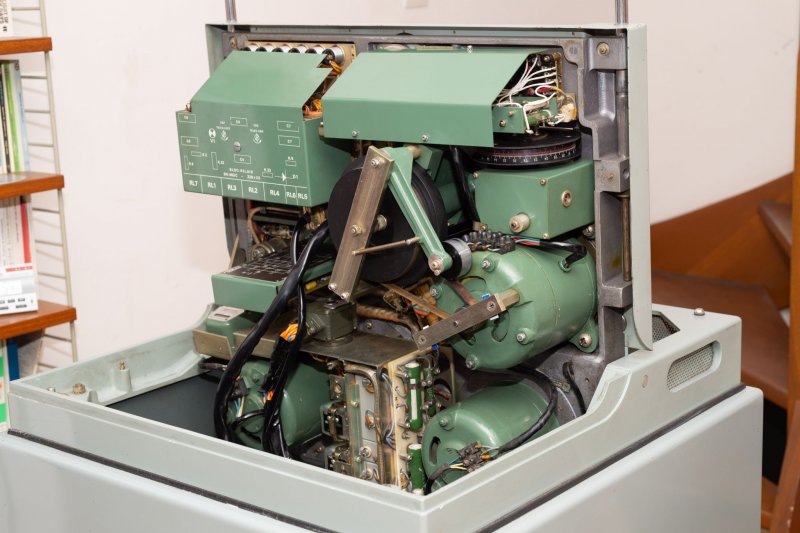
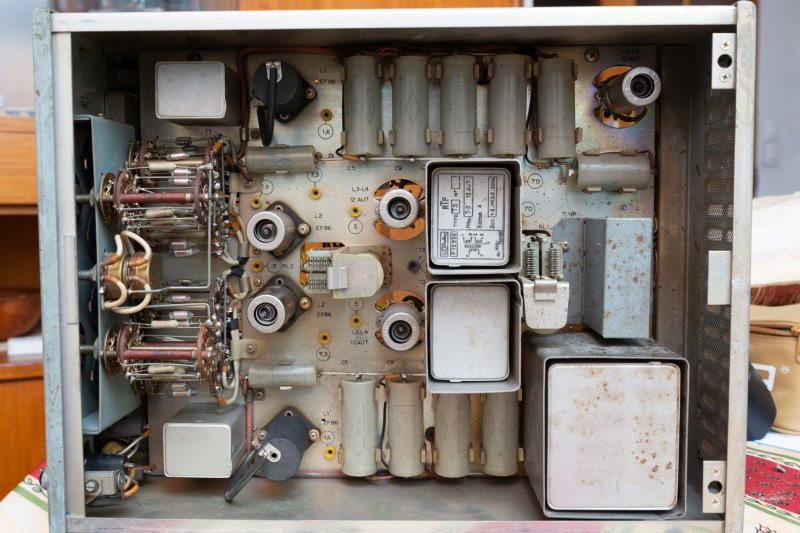
The innards:

The playback drawer. They managed to make a complete recorder using only 14 tubes of just 3 different types for easy maintenance:
 
But does she have fader start? :D

If you start her from a dead stop, it will cause the cabinet to lift on one leg; not literally, but, there is a massive torque twist to the cabinet.
To start her, you first need to give the platter a slight push to reduce the massive torque flex.
I use that deck to play my fairly large 78rpm collection, and occasionally, some other mono LP's.

And, seeing some of these electronic nightmares,... This is a study in simplicity; her underside:
presto15G2e.jpg presto15G2g.jpg presto15G2h.jpg presto15G2j.jpg presto15G2k.jpg presto15G2l.jpg

I like her speed control simplicity the most. I'm reminded of the Jetsons condo tower. It is the stacked slots that hold the idler arm. Each speed has its slot in the tower.
DSCN5416.jpg DSCN5418.jpg
 
Last edited:
I love all the brass parts on there, very steampunk :D

What I also think is interesting is that there are already inner hex set screws (maggot screws) in there.
At that age I'd still expect slotted set screws.
Could be later installed with a service of course.
 
@mr_petit
It was in really rough shape when it arrived here.
I replaced the rubber motor mounts, and likely the screws perhaps explaining that? I see now that you were referring to the hex heads, Allen screws. Yes, those are original.
I also had Terry's Rubber Rollers rebuild the idler wheel, as the old one was like a dangling loose loop around the hub. I cracked the motor case, and, cleaned and relubed.
The brass washers on top of the rubber mounts made a big difference in damping out motor vibrations! I added those in the overhaul.

I bagged the tonearm from another Presto deck that I have.
That one is a massive study in repowering an old deck to new DC powering. I can expand if folks want, or, add an AK link, or at LencoHeaven: https://www.lencoheaven.net/forum/index.php?topic=1087.0 This is the original long real time build thread!

The cabinet for that Presto 15G2 deck is an original finish Art-Deco Radio cabinet from 1928. It had a fire scorched radio and tube amp that I scrapped out of it, and, and old wind-up TT, and, electronic steel needle tonearm, that was truly a record killer; an awful thing!
The cabinet lived in a sketch-heads home, and he advertised it on Craigslist. I bought it, and, found it to have been a cat den/box, full of hair, kibble, and, urine stink.
So, it all got stripped out, destunk'd, and, some "new" mid-50's appliances added to get it back to playable, and not a record killer.

The Presto TT is sitting on a custom multi-layer birch ply plinth (at least 6 layers?), of solid massive construction. It is fitted within the cabinet, in the open area above where the amplifier is mounted in the face.
The amp is a HK integrated amp, with lots of old school phono curve selections available.
Shes named Audrey, because all my wife saw of me, for a few months, was my butt sticking up, and my body being drawn into the turntable plinth hole. She was reminded of Audrey, the human eating flower from Little Shop of Horrors.
Audrey was born.
 
Last edited:
Six pages, and no mention of the world leader in radio broadcast gear from the 1920's -> late 50's?
Presto Recording Corporation of Paramus NJ

Presto Recording Corp 15G2 (early-mid 50's)
General Electric A1-500 broadcast arm (early-mid 50's)

Her name is Audrey. She drives the GE A1-500 coaxial corner speakers (only top speaker is hooked up)
View attachment 2637782
View attachment 2637633 View attachment 2637634 View attachment 2637635 View attachment 2637636 View attachment 2637637 View attachment 2637638 View attachment 2637639 View attachment 2637640
That idler set up looks a lot like my Musicmaster.

IMG_2333.JPG IMG_2334.JPG
 
Last edited:
Beautiful machine jlb2! Thanks for posting the pics.
My pleasure :) BTW I have finally found again this rare photo of these machines in their habitat at the Maison de la Radio, before the Great Slaughter began. This is the ordinary layout of the control rooms in European mainstream radios, and you can easily see why remote start was a basic requirement for broadcast machines: they could not find engineers with 3 metre long arms.
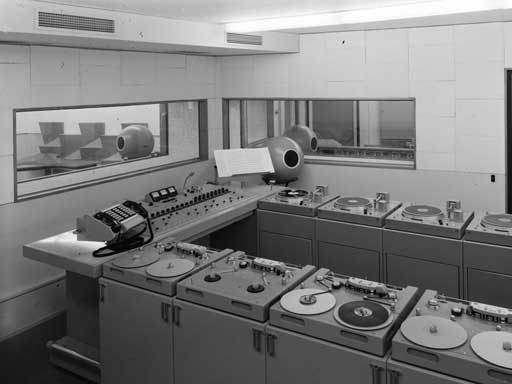
 
My pleasure :) BTW I have finally found again this rare photo of these machines in their habitat at the Maison de la Radio, before the Great Slaughter began. This is the ordinary layout of the control rooms in European mainstream radios, and you can easily see why remote start was a basic requirement for broadcast machines: they could not find engineers with 3 metre long arms.


Fantastic photo! I'm certainly no expert when it comes to broadcast equipment, but I know "impressive" when I see it! Thanks for posting.
 
There is no such thing as "ordinairy layout of control rooms in European mainstream radios"
Every studio is different.
page28_25.jpg

page28_12.jpg

876129696_HermanEMT.jpg.768ec2c4d69c8545d5fa9cc7b59166a8.jpg

(some old examples of different dutch national radio studio's)
(as you can see NOB probably had a contract with EMT :D)
 
Back
Top Bottom