You are using an out of date browser. It may not display this or other websites correctly.
You should upgrade or use an alternative browser.
You should upgrade or use an alternative browser.
Broadcast turntables?
- Thread starter Taketheflame
- Start date


Pio1980
AK Member
Similar, but the transcription tables were broadcast grade 16 inch platter equipped with arms to accommodate the larger discs that were commonly used for recorded broadcast programs before magnetic tape became standard.What is the difference between a broadcast & transcription table, anyway?
https://en.m.wikipedia.org/wiki/Electrical_transcription
Last edited:

Thanks. And I found this. https://usbturntable.net/what-is-a-transcription-turntable/Similar, but the transcription tables were broadcast grade 16 inch platter equipped with arms to accommodate the larger discs that were commonly used for recorded broadcast programs before magnetic tape became standard.
https://en.m.wikipedia.org/wiki/Electrical_transcription
So the tables in the 50's & later that were called transcription that played up to 12" are just Hi-Fi tables, they just adopted the name.Similar, but the transcription tables were broadcast grade 16 inch platter equipped with arms to accommodate the larger discs that were commonly used for recorded broadcast programs before magnetic tape became standard.
https://en.m.wikipedia.org/wiki/Electrical_transcription
Pio1980
AK Member
Pretty much, yes.
So the tables in the 50's & later that were called transcription that played up to 12" are just Hi-Fi tables, they just adopted the name.

adnick
Addicted Member
Glad somebody mentioned the Rek O Kut Broadcast tables. I've got a relatively rare B-16H which is still in the rolling Cabinet (which were usually tossed) which I hope to start the resto process this winter. You don't see the 16" TT's very often. Plays all sizes from 45 to 78. I don't care for the industrial gray paint but I will change that.
View attachment 2649617
Excellent, very nice example, it was certainly meant for the broadcast world.
Thanks for sharing,
Andy
I'm afraid not, unfortunately, although there was some great consumer equipment. Of course there were Elipson and Cabasse, whose broadcast/pro and consumer ranges were so close that some speakers were really the same. Cabasse also made some serious amplifiers. LEM, who have made the iconic French microphones from the '60s on, and also made headphones for the ORTF and telecom, also had a small consumer range at a point but that was mostly stuff that they imported from Japan. Schlumberger took over Pierre Clément's company after his demise, and made the A1B which was a belt-drive turntable with a tangential tonearm, and seems to be highly sought-after - this was Schlumberger's only attempt in the consumer market AFAIK. Other than than that there was ERA, a manufacturer of turntables that still have a number of afficionados (https://www.audiovintage.fr/leforum/viewtopic.php?t=2720).Thnx!
Fascinating to see French broadcast pro grade gear.
Was the general run of French commercial audio gear as well made, but scaled down?
The best-selling French makes were Radiola (affiliated to Philips after 1947 if memory serves) and Thomson. However there was no connection between the consumer and professional divisions of these companies, so they did not share their know-how. Sadly, there was no synergetic company able to achieve something similar to Studer/Revox in France. Other mainstream companies which only aimed the general consumer market (Pathé Marconi, Grandin, etc.) also did not make anything to write home about. The audio products of these companies were "remarkably unremarkable" AFAIK, and very plasticky, with possibly a couple of exceptions that I am unable to remember.
Some French consumer electronics of the time was surprisingly well engineered, though. A few years ago, I was hired to restore some radio & TV artefacts to working condition for a TV series, the action of which took place in the '60s. The Belin F14 I showed above was one of them, and another was a Pizon Bros Portaviseur 28, a mere 10" TV set not at all aimed at the professional market - the one shown below. It litterally opens like a book in a few seconds to gain direct access to all the circuits. It is one of the very best designs I've ever seen, miles ahead of the similar Japanese designs. Restoring this one was a breeze.

Then there were many very small companies, mostly aiming the audiophile market. Their sales were confidential, but some of their products are still kind of legendary in the audiophile circles, at least here.



.nilo.
Active Member
what about broadcasting phono preamps like the Russco fidelity pro? Are they any good? Was wondering of getting one for MM cartridges do they have narrower frequencies though? As some one stated wasnt shure if that was regarding the preamps
sorry if this strictly TT discussion but there is almost no info on the board about them
sorry if this strictly TT discussion but there is almost no info on the board about them
KentTeffeteller
Gimpus Stereophilus!
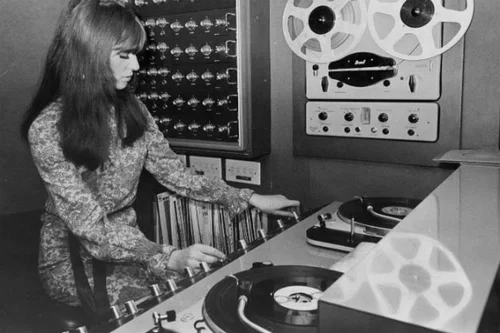
Maybe it was a photo shoot with a model and not of an engineer in action. Another puzzle—U.S. style large hole 45 singles in a setting that probably is not in the U.S.A.
This is English in terms of most of the equipment. Note, US broadcast turntables could be ordered without recessed centers and built in 45 adapters, a usually no charge optional when purchased new. This applied to QRK and Russco, and I seem to recall Gates Radio Company also did so.

BillWojo
Addicted Member
Note, US broadcast turntables could be ordered without recessed centers and built in 45 adapters, a usually no charge optional when purchased new. This applied to QRK and Russco, and I seem to recall Gates Radio Company also did so.
Kent, any chance you have a picture of a Russco without the dished platter? That would be interesting to see.
BillWojo
KentTeffeteller
Gimpus Stereophilus!
Kent, any chance you have a picture of a Russco without the dished platter? That would be interesting to see.
BillWojo
Don't have a photo. But the documentation is in broadcast equipment catalogs in the era.


HamboneF18
Super Member


. Main reason is I don't like the arms that come with most Technics tables, .
The Technics MK2 arm for sure is versatile but not very good sounding. I do a ton of structural mods on the arm and surrounding area and it sounds quite good when completed. Not pretty looking but functional. I dont sweat cosmetics but also refuse to pay the cost of a car to have dynamic, open, natural, clean, organic and harmonically rich sound from vinyl, hence my DIY approach.
Your struggle is real.
Pat
That looks like the speed selector/power switch on my KS Musicmaster. Mine also has a pitch control to the right.I like her speed control simplicity the most. I'm reminded of the Jetsons condo tower. It is the stacked slots that hold the idler arm. Each speed has its slot in the tower.
View attachment 2637714 View attachment 2637715