• The move to the new server is done. There are some software and database maintenance updates in process. This has us passing the hat around to help out. We appreciate any donations. Seriously, even a dollar helps. The payment page may be found here - https://www.audiokarma.org/support.html

Building a poor mans variac (Dim Bulb Tester or DBT)

Is this type of DIY feature usefull?

  • Yes

    Votes: 21 100.0%
  • No

    Votes: 0 0.0%

  • Total voters
    21
  • Poll closed .
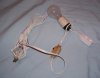
With apologies for the lousy image; my digital cam doesn't do macro very well.

Now that I look at it, it seems as though I was a little more elaborate than I needed to be. I broke the brass tabs on both sides of the receptacle, then wired it as shown: one connection from the power cord to one side (call it side 'A') of one socket, a wire to connect side B of that socket to side A of the second socket, then a last connection from side B of the second socket back to the power cord.

For some reason I wanted the current flow across the two sockets to be in-phase rather than reversed-phase (well, it seemed like a good idea at the time), which is why the elaboration. But if one of the loads is just a lightbulb then breaking only one of the tabs and connecting the two power cord wires to the side the broken tab is on (one wire to each side of the break!) should do just as well.

He's got it exactly right.

If you are concerned about being "In Phase" then break one side or the other and on that side, the receptical side that gets it's "matching" color wire, (Black to Gold/brass, white to Silver and you are always good) is the one you mark for the plug of the device you are protecting, the odd matched side gets the plug in light bulb.

(BTW I'm the guy that first posted the setup that used the plug in resistor bulb into a duplex receptical, glad to see someone got good use out of the info...)

Another handy way ito set one up s to get an old fashioned screw in fuse holder (Yes they still srll them) and you can use that in series with a duplex receptical.
 
can anyone give me the (expected/approx) values for 220v? i have an idea or two bouncing around in my head but i'd need to know this before i start doing/building anything. thanks.

Sorry, I don't have 220v bulbs, or devices to test.

But if you meassured the resistance of your bulbs, and applied Ohms law, you should be able to calculate the results I'd think.
 
Sorry, I don't have 220v bulbs, or devices to test.

But if you meassured the resistance of your bulbs, and applied Ohms law, you should be able to calculate the results I'd think.

for some reason i figured it was more complicated then that... thanks outlawmws, i'll jump on that as soon as i get a new multimeter, i broke my last one trying to change the battery :sigh:
 
The problem is that the bulb filament is very non-linear with regard to current draw vs. temperature. The cold resistance will read very low, but once the filament gets hot its resistance goes way up...so the DC reading with an ohmmeter doesn't do you much good.
 
Just an FYI, I bought a 10 amp variac on ebay for under 40 shipped. Search for Powerstat or superior electric.

The bulb trick works great though.

Evan
 
Here is what I did with the ideas.

Extension Cord - $2
Lamp socket - $2
Switch - Free off old lamp
 

Attachments

  • poor man variac.jpg
    poor man variac.jpg
    82.2 KB · Views: 435
He's got it exactly right.

(BTW I'm the guy that first posted the setup that used the plug in resistor bulb into a duplex receptical, glad to see someone got good use out of the info...)

Handy and simple variation outlawmws, many thanks.
Mfporlock, the extra detail came in handy.
Very useful thread thanks for the re-build.

Mine is keeping a 340-B company and so far they seem quite happy together. Works well and oh so cheap.
 
In terms of 'protecting' untested gear, I'd favor a fuse. When your bulb glows, current is continuing to pass through the shorted component(s) in the deranged unit, which I would prefer not to happen. Someone can correct me if I am wrong, but I believe a 'fast-acting' fuse is also much faster reacting to a short than a bulb (for the reasons sited in EW's post a few pages back).
 
In terms of 'protecting' untested gear, I'd favor a fuse. When your bulb glows, current is continuing to pass through the shorted component(s) in the deranged unit, which I would prefer not to happen. Someone can correct me if I am wrong, but I believe a 'fast-acting' fuse is also much faster reacting to a short than a bulb (for the reasons sited in EW's post a few pages back).

If a VariAc is involved, I'd prefer the lamp. If the part is already shorted, who cares if it gets more damaged. The shorted part, in conjunction with the lamp, should help divert dangerous currents away from any good parts. You just want to make an appropriate lamp selection. Fuses may allow more danger until the fuse blows. A lamp gives you some warning as in "uh oh, the lamps starting to come on. I'd better turn down the VariAc".
 
Light bulb limits current, fuse doesn't (until it blows, of course). There CAN'T be any more current flowing than the bulb alone would take (1.3A for a 150W bulb, for instance...). The fuse might let through 100 Amps for 10 milliseconds... The "Poor man's variac" is better than the REAL Variac in this respect. If you use a variac to start up unknown equipment, be sure you have spare fuses for it... if it doesn't have a fuse, you're playing with FIRE...
 
I've used this sort of system for quite a few years. Only one trouble in the UK, ordinary (incandescent) lamps are being phased out of the shops here. I think it may already be illegal for a shop to sell a 150W bulb. I heard on the radio 100W next.
 
I've used this sort of system for quite a few years. Only one trouble in the UK, ordinary (incandescent) lamps are being phased out of the shops here. I think it may already be illegal for a shop to sell a 150W bulb. I heard on the radio 100W next.

oh oh, sounds like banks of 3W lamps are in our future. We might have to decorate our benches with Christmas lights
 
I picked up some random bits and pieces at the Habitat Re-Store today. From everything I've read in this thread, it seems that the goal is simply to wire the bulb in series with the load outlet on the hot side?
 
personally, I use both. I've got a lamp in series after the VariAc. I have a 'bypass' switch that shorts across the lamp when I want full tilt boogie.
 
I agree totally with Tom on this. This may be drifting of topic a bit but in terms of bringing unknown gear up slowly I find it nessessery to have a current meter in the circuit as well and not wait till something gets hot or blows before I see that there is a problem. Monitoring the current draw is very helpful in trouble shooting. I would recommend a sencore powerite as an excelent investment. It combines a variac, isolation tranny, current voltage monitoring, circuit breaker, and even leakage detection all in one unit. If your patient you can snag them on ebay for less than a C note (I think I gave $75 for mine). Considering its basically an all in one unit not a bad deal.

DATA4963.JPG


Light bulb limits current, fuse doesn't (until it blows, of course). There CAN'T be any more current flowing than the bulb alone would take (1.3A for a 150W bulb, for instance...). The fuse might let through 100 Amps for 10 milliseconds... The "Poor man's variac" is better than the REAL Variac in this respect. If you use a variac to start up unknown equipment, be sure you have spare fuses for it... if it doesn't have a fuse, you're playing with FIRE...
 
Right now, I have a light bulb on a ceramic base and a double box with a switch and an outlet. I want to use the switch as a simple on-off for the whole device, one side of the outlet wired in series with the bulb for variable AC, and the other side of the outlet wired directly to the switch for full voltage. I need to break the hot side of the outlet to separate the two sockets, but can I keep the outlet wired together on a common neutral, or do I need to break that tab and run two wires?
 
....you can keep the neutral on the receptacle in-tact. In fact, when you break the hot wire you can bridge the gap with your lamp. It'll make handy screw terminals. ...no need for twist loks
 
....you can keep the neutral on the receptacle in-tact. In fact, when you break the hot wire you can bridge the gap with your lamp. It'll make handy screw terminals. ...no need for twist loks

I didn't even think of that, but it's certainly an easier way to wire it up than what I was thinking. :thmbsp:
 
Back
Top Bottom