• The move to the new server is done. There are some software and database maintenance updates in process. This has us passing the hat around to help out. We appreciate any donations. Seriously, even a dollar helps. The payment page may be found here - https://www.audiokarma.org/support.html

Building a scratch version of Dave Gillespie's 8600 mod

I would recommend that you start your own build thread so we can have an in-depth conversation and help you to debug problem without hijacking @scootsity5's build thread.

Clearly something after the 820 ohm. Start a build thread and I can provide a list of resistance measurements to quickly find the short.
 
I would recommend that you start your own build thread so we can have an in-depth conversation and help you to debug problem without hijacking @scootsity5's build thread.

Clearly something after the 820 ohm. Start a build thread and I can provide a list of resistance measurements to quickly find the short.
I mean, I'm fine with it.... I'm happy to help debug. I can always make a new thread when I finally build mine!
 
Last edited:
OK, I'm circling back to this build soon. I got the transformers all spec'd with Matt at MPP.

I'm going to use standard diodes, and have most of the ps mods figured out (save the extra resistor to drop a few volts, I'll get a few values and figure that out later).

I'm also going to add a ground breaker between the signal and mains ground.

I'm not great at metal work, so I'm currently figuring out how fancy I want to get for power entry and am leaning toward a hole with a wire through it (and some strain relief).

I'll probably place my order with Matt next week, and digikey around the same time.
 
Oh, Matt recommended the HF version of his transformers (simplified to just 5k primary/8z secondary). I'm leaning that way unless there's truly no reason to not just use the guitar amp version. I'm assuming I'll get slightly better low end extension with the HF version.
 
You will get better HF extension too. I've used Matt's transformers in several builds with great results.

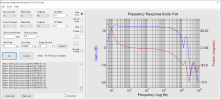
Here's from a 6V6 SE build at 1Vp-p input. -3dB at about 60kHz.
Sakuma Schade 6V6 MPS OPT FR 8ohm 1Vp-p input.png
 
Was curious about a comment you made in this earlier post I may have misunderstood:
The rectified voltage off the telefunken transformer in the schematic is 252mA at 108mA.
I tried a few different taps on the primary and I'm pretty sure with 120v on one of them, I got into the 220-230 range.
When you got the 220-230V range, was that AC rms, or was that DC after a rectifier? You said when you tried a different primary to get rectified voltage closer to 270 you had a sizzle- And the telefunken schematic lists the rectified output as 252V @ 108mA. If the 220-230V was DC after the rectifier, that's going to be disappointingly low- if it's 220-230V ACrms, it's going to be great.

1N4007 is the go-to diode most often used in this type of high voltage bridge rectifier. There are fancier/better, but these are cheap and work great.

I'm also going to add a ground breaker between the signal and mains ground.
What do you mean by a "ground breaker"?

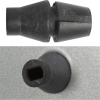
For cord entry, since I always use only 2-wire thin vintage style cords (no earth ground) I often just use a very simple rubber strain relief like this one from Amplified Parts. They also carry a bunch of the plastic pinch style too but they use a bigger hole and are a PITA.


1782522293194.png
 
Was curious about a comment you made in this earlier post I may have misunderstood:

When you got the 220-230V range, was that AC rms, or was that DC after a rectifier? You said when you tried a different primary to get rectified voltage closer to 270 you had a sizzle- And the telefunken schematic lists the rectified output as 252V @ 108mA. If the 220-230V was DC after the rectifier, that's going to be disappointingly low- if it's 220-230V ACrms, it's going to be great.

1N4007 is the go-to diode most often used in this type of high voltage bridge rectifier. There are fancier/better, but these are cheap and work great.


What do you mean by a "ground breaker"?

For cord entry, since I always use only 2-wire thin vintage style cords (no earth ground) I often just use a very simple rubber strain relief like this one from Amplified Parts. They also carry a bunch of the plastic pinch style too but they use a bigger hole and are a PITA.


View attachment 3790407

It was not rectified. It was AC RMS.
I basically just started connecting different primary wires on the transformer and was trying to get a little above 190 or 380. Unfortunately, I ended up connecting two primary taps to mains that were close together and got a sizzle. As I think I'll likely install this amp in the back of a console, so I'm leery of using a transformer that's ever sizzled. I'll likely hang onto it for a later build.

For power entry, I'll definitely ground the chassis to mains ground. That will also ground the transformers. A ground breaker connects the grounds via a diode or two, such that if there's voltage on ground in excess of the drop of the diode, then it conducts to mains/chassis ground. So, my signal ground will be isolated from mains ground.

That old telefunken console I'm canibalizing also has a choke in it, so I may try to repurpose that. I think it's a 3.7H inductor, but the label on it is super hard to read and it's hard to tell from the schematic. But I'm thinking it might be a good replacement for the Hammond. I need to do a little more testing on it.
 
Oh, Matt recommended the HF version of his transformers (simplified to just 5k primary/8z secondary). I'm leaning that way unless there's truly no reason to not just use the guitar amp version. I'm assuming I'll get slightly better low end extension with the HF version.
Hey Just curious - What is the designation ( NUMBER ) of the OP transformers your looking at ? -
D.G. posted once that most new transformers looked nice but - were - not up to the standard of the vintage units ! - performance wise - though they LOOK better - - Making the claim that most are comparable to --
Or no better Than--GUITAR specific transformers . He is --the guru -- so ought to know -- At least in part this was --A AS MEASURED critique , Having said that I have Matt's SE 5k outputs - ( the HF 4ohm 8 ohm version )and find them to be quite enjoyable - And a step up from the PT- 31's - that;s for sure --- I guess it's a pick your pisun choice - OH- Very nice ones can be Had -- that is for - THEM - The guys and Gals --with DEEEP pockets. Personally I am of the mind of ---What gets me 90% there-- for reasonable coin
 
Was curious about a comment you made in this earlier post I may have misunderstood:

When you got the 220-230V range, was that AC rms, or was that DC after a rectifier? You said when you tried a different primary to get rectified voltage closer to 270 you had a sizzle- And the telefunken schematic lists the rectified output as 252V @ 108mA. If the 220-230V was DC after the rectifier, that's going to be disappointingly low- if it's 220-230V ACrms, it's going to be great.

1N4007 is the go-to diode most often used in this type of high voltage bridge rectifier. There are fancier/better, but these are cheap and work great.


What do you mean by a "ground breaker"?

For cord entry, since I always use only 2-wire thin vintage style cords (no earth ground) I often just use a very simple rubber strain relief like this one from Amplified Parts. They also carry a bunch of the plastic pinch style too but they use a bigger hole and are a PITA.


View attachment 3790407
Yea - Save the plastic one's for when you are in a masochistic Mood
 
Hey Just curious - What is the designation ( NUMBER ) of the OP transformers your looking at ? -
D.G. posted once that most new transformers looked nice but - were - not up to the standard of the vintage units ! - performance wise - though they LOOK better - - Making the claim that most are comparable to --
Or no better Than--GUITAR specific transformers . He is --the guru -- so ought to know -- At least in part this was --A AS MEASURED critique , Having said that I have Matt's SE 5k outputs - ( the HF 4ohm 8 ohm version )and find them to be quite enjoyable - And a step up from the PT- 31's - that;s for sure --- I guess it's a pick your pisun choice - OH- Very nice ones can be Had -- that is for - THEM - The guys and Gals --with DEEEP pockets. Personally I am of the mind of ---What gets me 90% there-- for reasonable coin
It's the same you're talking about. He just said he could make them without the 4ohm tap for a few dollars less.

I've used Matt's p-p transformers in some other amps, too. I know he's built some transformers for DG, but can't speak to anything beyond that.

I also don't have much to compare it to. I used Matt's transformers in Pete Millet's DCPP.

Matt's prices are reasonable and he makes solid transformers. He's sent me some interesting resources about transformer design.
 
Oh, Matt recommended the HF version of his transformers (simplified to just 5k primary/8z secondary).
They have rather good midrange to my ears in a 45 DHT breadboard circuit. They'll be the ones I'll use in the completed amplifier.
The OT10SE HF 5K output transformers are also used in a 6V6/6V6 SE amplifier of mine. (similar to nerdorama's 6V6 SE amp)
Same deal...good, nice midrange and bandwidth for the power used.
 
It's the same you're talking about. He just said he could make them without the 4ohm tap for a few dollars less.

I've used Matt's p-p transformers in some other amps, too. I know he's built some transformers for DG, but can't speak to anything beyond that.

I also don't have much to compare it to. I used Matt's transformers in Pete Millet's DCPP.

Matt's prices are reasonable and he makes solid transformers. He's sent me some interesting resources about transformer design.
I've heard from a few folks that they find that the pacific magnetic output transformers sound very good, too. Perhaps slightly edging out MPPs. I've never heard them.

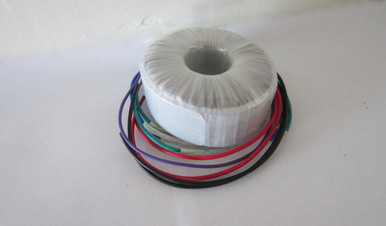
For power transformers, I sometimes forget about antek's torroidals, which are super reasonably priced. I may even use one on this build.
 
I ended up connecting two primary taps to mains that were close together and got a sizzle. As I think I'll likely install this amp in the back of a console, so I'm leery of using a transformer that's ever sizzled. I'll likely hang onto it for a later build.
That would do it. I don't blame you. So . . . what are you using for a power transformer?

A ground breaker connects the grounds via a diode or two, such that if there's voltage on ground in excess of the drop of the diode, then it conducts to mains/chassis ground.
I have no idea why you would do that. There will be lots of frothing and consternation from some at this statement, however: Earth ground on a chassis really only makes sense in the guitar/PA world where you have fingers and lips touching all sorts of different equipment all interconnected. (Been zapped.) For home stereo/console equipment, the power transformer completely isolates the amplifier from the line power, and earth ground never came into the original design, and is not really even needed on a stand alone modern amp. The chassis is connected directly to signal ground at one and only one place, so there is no current allowed to flow through the chassis, and when you connect a cable between the amp and a source/pre-amp the ground of the two devices are brought to the same potential as it should be.

That old telefunken console I'm canibalizing also has a choke in it, so I may try to repurpose that. I think it's a 3.7H inductor, but the label on it is super hard to read and it's hard to tell from the schematic. But I'm thinking it might be a good replacement for the Hammond. I need to do a little more testing on it.
Was that used as the B+ filtering choke, passing 100mA? Fair bet it was, so should work, give or take the DC resistance. Lower the better. What does it measure?

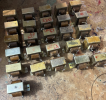
As far as output transformers- you indicated in an earlier post that you wanted to keep the project as "cheap as you can"- Please keep in mind that even in it's most glorious Dave Gillespie upgraded state it's just a 4W per channel amplifier. Even with the best transformers in the world it's not going to make the windows rattle. Many many people have built this with the cheap lowly P-T31 transformer, (or worse), have been tickled pink, lived with the roll-off below 90Hz, and used a sub. Even Matt's "guitar" transformers are a big step up from those, and with the 17dB of negative feedback either transformer will perform very well I can assure you. If you are looking for something even sweeter still, for an unbelievably screaming deal, there are 25 legendary Akai M6/M7/M8 Japanese reel to reel output transformers (SE, 5K : 8 ohm) for sale on a particular auction site I shall not mention, under item # 398088155503 . (no affiliation yada yada ) The seller offered me $15 per and combined shipping for quantity purchase. If I had some extra cash right now I would be screaming "shut up and take my money" while trying to jam it though the monitor screen. (The only down side with these is they have exposed terminals, so you have to hide them under the chassis, in a box (203238836217), or otherwise insulate them.)

1782552058847.png
 
Normally with a ground breaker setup you have your signal grounds not tied to chassis, the earth ground straight to chassis, and the diode/cap setup connecting the two. Prevents ground loops from other signal things while still having a path to a grounded cord. Useful if your source also is grounded. Also allows for things to dump to ground if the source is screwed up somehow or if your power transformer shorts to the frame or whatever.


as an example.

not particularly difficult to implement if building something with a buss or star ground, basically you just insert that in place of the single connection to chassis. Its effectively impossible to do with common chassis grounding unless you re-design the entire thing though.
 
Normally with a ground breaker setup you have your signal grounds not tied to chassis, the earth ground straight to chassis, and the diode/cap setup connecting the two. Prevents ground loops from other signal things while still having a path to a grounded cord. Useful if your source also is grounded. Also allows for things to dump to ground if the source is screwed up somehow or if your power transformer shorts to the frame or whatever.


as an example.

not particularly difficult to implement if building something with a buss or star ground, basically you just insert that in place of the single connection to chassis. Its effectively impossible to do with common chassis grounding unless you re-design the entire thing though.
That's the plan. Since I'm building from scratch, I don't imagine it'll be all that difficult. In the original design, moding from an existing amp, I'm sure it would be difficult.
 
Last edited:
Back
Top Bottom