• The move to the new server is done. There are some software and database maintenance updates in process. This has us passing the hat around to help out. We appreciate any donations. Seriously, even a dollar helps. The payment page may be found here - https://www.audiokarma.org/support.html

Building Again--Marblewood 6V6 SEUL

Not yet--just noticed that had to raise the 8903B output slightly to get 1W output with the level control full on. I will measure it as I start to get more granular with the feedback. Is a 12AX7 in our future?

THD+N, these are the GXSE10-5K-8, so should be similar performance? What you show is more like what I was expecting to see with this little amp.
 
Matt, the designer, lists these as compatible drivers with this circuit: 12BH7, 12AV7, 12AY7, 12AT7, 12AZ7, and 12AX7
 
The GXSE are very underrated for bandwidth. Other people have reported good results exceeding 18kHz too.

Well, Edcor doesn't give the delta that's needed to actually assess the specification (±1dB, ±3dB, etc). They could just as easily specify it as DC to light without that. It's also not clear what power level "<1dBu" represents in this context. Are they referencing the voltage of that particular standard (0dBu = 0.775V) or the power (1mW)? It's my understanding that dBu is a 600Ω standard. On that basis, if we choose to go with 1mW, that's only about 0.09V at 8Ω. Alternately, using 0.775V across 8Ω gives us roughly 75mW. The bottom line I think is that the published specifications are pretty meaningless.

Jack
 
The AT7 would give you more gain and more drive. The plate to plate feedback puts more of a load on the driver stage as it sees its plate resistance in parallel with the grid to ground resistance of the next stage in parallel with the Schade resistance or something close to this (the power tube being driven also has an effect on the load, I don't fully understand it) in parallel with the plate resistance of the driver triode. It can become a pretty low total load resistance which I why some people use a pentode, even a power pentode, for the driver too since the high plate impedance doesn't result is as much loading.
 
Well, Edcor doesn't give the delta that's needed to actually assess the specification (±1dB, ±3dB, etc). They could just as easily specify it as DC to light without that. It's also not clear what power level "<1dBu" represents in this context. Are they referencing the voltage of that particular standard (0dBu = 0.775V) or the power (1mW)? It's my understanding that dBu is a 600Ω standard. On that basis, if we choose to go with 1mW, that's only about 0.09V at 8Ω. Alternately, using 0.775V across 8Ω gives us roughly 75mW. The bottom line I think is that the published specifications are pretty meaningless.

Jack
I agree, which is why I posted real world data.
 
Here is the same Edcor GXSE-15-5k (6 Ohm tap though) in a 2A3 amp. (20Hz~40kHz @ 1 watt)

1717931640320.jpeg

@Dave451, the GXSE10 should be similar, but a triode load is slightly different than a UL connected pentode or beam (6V6) so the frequency response will be different.
 
Last edited:
Just my pet peave for project schematics. I really would like to ban the notion of “B+”. Why not call it what it is in volts? In this case you are good by providing the PS that shows 300Vdc going to the marked “B+” in the schematic, but so often it does not.
My pet peeve is people building amp projects and opining they sound good with NO data or measurements of any kind, just their ear(s).
 
I grounded my Lacewood build. No difference in sound that I could detect. I was having problems measuring output power. I asked about it here. It was quickly pointed out the ungrounded secondary was the cause. Also noted was the potential safety concerns if a transformer were to fail.
An ungrounded OPT secondary will cause issues sometimes so it is best to just ground the common as you discovered. If done properly, there is no noise penalty. Unless specifically designed for a special purpose, "things" that are left floating become an issue.
 
@Dave451, if you have enough current capacity in the power supply, you could always use a 6AV5GA triode wired. It bias's up very similar to a 2A3 and they are fairly cheap.
 
APPLYING FEEDBACK MAKES THINGS BETTER!

I added a 300K "Schade" plate-to-plate feedback resistor between the 6V6GT and the 12AU7 driver and removed the 47uF cathode bypass capacitor from each of the cathodes of the 12AU7 (mu 20). Some initial measurement showed significantly improved frequency response, particularly at the low end and a quite significant reduction in overall distortion. The added plate-to-plate resistor raised the 12AU7 plate voltage from 85VDC to 115VDC.

The feedback also reduced the amplifier gain and sensitivity, of course; so much so that it was taking 2VRMS+ of signal to reach the clipping threshold, so I decided to change the driver to a 12AX7 (mu 100) after trying a 12AT7 (mu 60). I left the cathode resistor value at 1.2K for the driver (still unbypassed). At these conditions, the 12AX7 plate voltage was 210VDC and cathode voltage 1.5VDC, indication 1.3mA current draw for each 12AX7 section. Switching the driver tube reduced the overall B+ current draw by around 5 mA compared to that with the 12AU7 driver.

At these conditions, output power remained pretty much the same at the first sign of clipping at 3.25W into 8 ohms, 1 kHz single channel driven. Amplifier gain with the 12AX7 driver and was reduced from 16 dB to 12dB compared with the original design with the 12AU7 and no FB. In the new set up, the amplifier needed 1.3VRMS to achieve max output at 1 kHz, so the added gain from the 12AX7 got the amp back to a reasonable sensitivity level with the feedback applied.

Measurements were made and the following improvements were noted:

1. Low end frequency response improved considerably. 20 Hz response went from -7dB to -2.5dB and the rise to 100 Hz was more rapid with the 100 Hz response rising from -1dB to 0 dB. High frequency extension was also improved noticeably as well (see chart).
2. Distortion levels (THD+N) were greatly reduced across the spectrum, except for the very low end which rose a bit, presumably because of OP transformer limitations with the higher output at the lower frequencies. At 1W out, THD+N dropped at 1 kHz from around 2.7% to 0.3%, a reduction of 89%. I was pleasantly surprised to see figures well under 1% for this type of amplifier above 200 Hz at 1 W output.

Interestingly, one of the commenters on the Cascade Tubes page for his Marblewood build noted the identical 20 Hz response at -7 dB. He resolved the issue mainly by replacing the 10W 5K Edcor OP transformer with the 15W version (see above for the scan of the latter unit by THD+N).

I think the 12AX7 driver is happy at the operating conditions noted above; perhaps more so than the 12AU7, which was biased fairly cold in the original design, so I don't know if I need to fiddle with the 1.2K cathode resistors. Things look so good at 300K FB resistor value that I am not motivated to fiddle with this value further, either. Any thoughts?

SOUND
The amp retained good detail and sound stage without being harsh and the low end was definitely fuller with significantly tighter bass with 'blooming/tubbiness' reduced considerably. Listening continues to be very pleasant with various input sources and driven by my Fisher 400CX-2 pre-amp through my Klipsch Cornwall I's.

Here are the charts with the original 12AU7 driver/no FB compared to 12AX7 driver with 300K Schade resistor. Pay attention to the vertical axis scales, as they aren't same because of difficulty zooming the charts for the whole range of results. The frequency response looks much more like what I wanted/expected with the build.

Dave
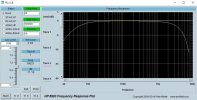
MW Freq Resp 1W LEFT.jpg

MW Freq Resp 1W LEFT SCHADE 12AX7.jpg

MW THD+N v Freq 1W LEFT.jpg

MW THD+N v Freq 1W LEFT SCHADE 12AX7.jpg

Here's the THD+N vs Output Power post-Schade FB
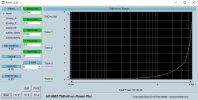
MW THD+N v Power LEFT SCHADE 12AX7.jpg
 
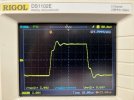
Perhaps it's true! Now to do some more listening. But first.....a square wave!

IMG_3499.jpg

Actually looks pretty good. Interesting little 'hitch' on the rise, but good damping of the initial overshoot.
 
That's just fine for a SEP amplifier. I've seen much worse 10 kHz in amps that sounded very good.
 
Back
Top Bottom