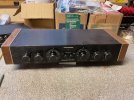
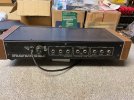
• The move to the new server is done. There are some software and database maintenance updates in process. This has us passing the hat around to help out. We appreciate any donations. Seriously, even a dollar helps. The payment page may be found here - https://www.audiokarma.org/support.html

Buzzy MC2300 In Bi-Amp Set-Up

@whoaru99 makes an excellent point that many with adjustable gain amplifiers don’t often know and practice. Pro-audio amps typically have adjustable gain, home-audio amps typically do not. There is still an underlying problem that hopefully will eventually be found and addressed.

The C220 should be quiet, very quiet. It is a reasonably contemporary piece with good specs and modern shielding. If you’re using the Unbalanced (RCA) MAIN outputs and nothing else is hooked to the C220 inputs and outputs, C220 VOLUME turned to minimum and AUX selected, it should be silent. If this is how you’re configured and there is noise it is likely that there is a problem.
The MC2300 isn’t a quiet amp by today’s standards (even in as-new condition): 0.25%THD and more importantly Noise and Hum: 90dB below rated output.

However with the rated output being 200WPC and the JBL B380s at 90dB sensitivity, you should be pretty well matched. You’re running stereo mode with two inputs and using both outputs for the two subwoofers?

The telling thing (IMO) is that the gain knobs change your noise level. The gain pots on (most McIntosh amps) the MC2300 are pretty much moving the amplifier’s input (internal) between the RCA signal and shield. The gain knobs are the first thing that the signal sees. The amplifier is amplifying the differential between the shield and signal on the input RCA jack. At full gain it is getting all of its input from the RCA signal, at minimum gain the input is connected (shorted) to the shield/ground of your RCA. The shield on the RCA input jack is also tied to electrical ground in the MC2300.

So the troubleshooting follows that no input connected is no hum, not coming from the MC2300 internal circuitry*.
With the C220 connected and GAIN turned to minimum, no hum so again not MC2300 internal circuitry*.
C220 connected and GAIN at max., hum occurs. This indicates that the amplifier is seeing a hum/signal between the shield/ground and signal wire. This can be a result of a ground mismatch between the units, or signal generated in the MC220. The hum being 60Hz would also indicate either bad RCA cables, a ground mismatch (aka: ground loop), or a hum present in the MC220.

You have tried a different amplifier of similar power output / gain, on the same RCA cables, same subwoofers and no hum? This should eliminate everything but a ground mismatch.
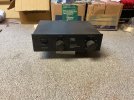
Jeff, thanks for all the thought you put into this. I had to read it 2.5x to unpack it all! I’m shortly headed out the door but wanted to first answer a few of your questions:

1) Presently I’m running both channels via Out 1 from the C220 into a decent quality y-adaptor into a single JBL BX63A “summing/dividing crossover”. The BX63A only has one LF (low frequency) input, but two LF outputs. I’m then utilizing both outputs to input individually the L-R channels on the MC2300. Incidentally, I’ve also tried two BX63As at once and two different Dahlquist DQ-LP1s (which are two channel electronic crossovers), all with the same noisy result.

2) I have bypassed the crossovers and connected via same cable directly between the C220 and MC2300. Same thing: noise. However, I have not done this yet with all other connections removed and the input set to Aux.

3) With nothing connected to the inputs of the MC2300 and input bias in maximum position, no noise.

4) I have tried at least one other amp, and I did not hear noise from the subs.

5) I have tried three different sets of RCA cables.

Additional note: via the main C220 output, full range output is run directly (not through a crossover) to the MC60s and this results in no spurious noise from the JBL 4333s.

OK, thanks again. I’ll sign back in later today, likely from the scene of the crime (garage).
 
@whoaru99 makes an excellent point that many with adjustable gain amplifiers don’t often know and practice. Pro-audio amps typically have adjustable gain, home-audio amps typically do not. There is still an underlying problem that hopefully will eventually be found and addressed.

The C220 should be quiet, very quiet. It is a reasonably contemporary piece with good specs and modern shielding. If you’re using the Unbalanced (RCA) MAIN outputs and nothing else is hooked to the C220 inputs and outputs, C220 VOLUME turned to minimum and AUX selected, it should be silent. If this is how you’re configured and there is noise it is likely that there is a problem.
The MC2300 isn’t a quiet amp by today’s standards (even in as-new condition): 0.25%THD and more importantly Noise and Hum: 90dB below rated output.

However with the rated output being 200WPC and the JBL B380s at 90dB sensitivity, you should be pretty well matched. You’re running stereo mode with two inputs and using both outputs for the two subwoofers?

The telling thing (IMO) is that the gain knobs change your noise level. The gain pots on (most McIntosh amps) the MC2300 are pretty much moving the amplifier’s input (internal) between the RCA signal and shield. The gain knobs are the first thing that the signal sees. The amplifier is amplifying the differential between the shield and signal on the input RCA jack. At full gain it is getting all of its input from the RCA signal, at minimum gain the input is connected (shorted) to the shield/ground of your RCA. The shield on the RCA input jack is also tied to electrical ground in the MC2300.

So the troubleshooting follows that no input connected is no hum, not coming from the MC2300 internal circuitry*.
With the C220 connected and GAIN turned to minimum, no hum so again not MC2300 internal circuitry*.
C220 connected and GAIN at max., hum occurs. This indicates that the amplifier is seeing a hum/signal between the shield/ground and signal wire. This can be a result of a ground mismatch between the units, or signal generated in the MC220. The hum being 60Hz would also indicate either bad RCA cables, a ground mismatch (aka: ground loop), or a hum present in the MC220.

You have tried a different amplifier of similar power output / gain, on the same RCA cables, same subwoofers and no hum? This should eliminate everything but a ground mismatch.
 

Attachments

  • IMG_3687.jpeg
    IMG_3687.jpeg
    323.5 KB · Views: 8
  • IMG_3688.jpeg
    IMG_3688.jpeg
    281.9 KB · Views: 7
  • IMG_3690.jpeg
    IMG_3690.jpeg
    292.3 KB · Views: 8
  • IMG_3691.jpeg
    IMG_3691.jpeg
    293.2 KB · Views: 10
Good summation of your troubleshooting steps, thank you. From what I’m reading you’ve eliminated: Y-adapter, external crossovers, RCA cables.

An un-grounded adapter for the power might be the next step after you try running the direct with no inputs test.

Cleaning my garage today, on doggie (health issue) watch, might re-wire the main audio system, … busy-work.
 
This y-connector - are you using it to sum L+R signals?
Yes, as a temporary measure that is how I’m using the y-adaptor. I had some misgivings about combining the two signals in that way though and frankly swept those thoughts aside (read: forgot until you just reminded me) while in pursuit of tracking down the source of the noise. What are your thoughts about combining the signals in that way? Is it ill-advised?
 
Good summation of your troubleshooting steps, thank you. From what I’m reading you’ve eliminated: Y-adapter, external crossovers, RCA cables.

An un-grounded adapter for the power might be the next step after you try running the direct with no inputs test.

Cleaning my garage today, on doggie (health issue) watch, might re-wire the main audio system, … busy-work.
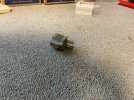
Uh-huh, there it is. As a retired electrician, it’s a sacrilege to possess one of these, much less use one!
 

Attachments

  • IMG_3692.jpeg
    IMG_3692.jpeg
    332.3 KB · Views: 3
Yes, as a temporary measure that is how I’m using the y-adaptor. I had some misgivings about combining the two signals in that way though and frankly swept those thoughts aside (read: forgot until you just reminded me) while in pursuit of tracking down the source of the noise. What are your thoughts about combining the signals in that way? Is it ill-advised?
Well, when you sum the L+R outputs of a line level preamp in this fashion, you now have a mono preamp ...
 
Well, when you sum the L+R outputs of a line level preamp in this fashion, you now have a mono preamp ...
Yes, that occurred to me as a possible consequence. However, more importantly, my previous descriptions stemmed from an increasingly faulty memory, not an eyes on account. Presently I am staring at the back of the BX63A and, I’m embarrassed to acknowledge, the summing of L&R happens after the crossover—not before.

Note the y adaptor coming off the LF OUTPUT at the far left. Ordinarily, I think the intention was for only passive sub to used, so the LF OUTPUT was combined L+R.

(Sorry about my previously confused description.)
 

Attachments

  • IMG_3693.jpeg
    IMG_3693.jpeg
    207.4 KB · Views: 5
Good summation of your troubleshooting steps, thank you. From what I’m reading you’ve eliminated: Y-adapter, external crossovers, RCA cables.

An un-grounded adapter for the power might be the next step after you try running the direct with no inputs test.

Cleaning my garage today, on doggie (health issue) watch, might re-wire the main audio system, … busy-work.
2/3 prong adaptor deployed, still hear a noise, which is sounding more like a 60hz hum than a buzz. Noise nonetheless emitting from the B380s.

Some caveats: I have rickety old electrician’s knees and it’s not particularly easy to kneel in front of the woofers on the concrete floor of my garage and, due to the incessant drone of the MC2300s fans, a buzz can sound like a hum that can sound like fan drone…and so on.

I’m going to work backwards through the elimination process again. I’ll update.

Thanks!
 
Yes, that occurred to me as a possible consequence. However, more importantly, my previous descriptions stemmed from an increasingly faulty memory, not an eyes on account. Presently I am staring at the back of the BX63A and, I’m embarrassed to acknowledge, the summing of L&R happens after the crossover—not before.

Note the y adaptor coming off the LF OUTPUT at the far left. Ordinarily, I think the intention was for only passive sub to used, so the LF OUTPUT was combined L+R.

(Sorry about my previously confused description.)
that's proper - so you're all good on that front!
 
Oh my! This is almost comical.

Ok, here goes…

Jeff, you were 100% correct about isolating the ground on the MC2300. It did indeed work! At first at I thought it hadn’t, but I was somewhat mystified that what had previously sounded like a buzz, now sounded more like a 60hz hum. Due to the drone of the MC2300’s fans, I thought maybe I was experiencing hallucinatory auditory meld syndrome—or some such thing. Phew, apparently not.

It point of fact, the 60hz hum was a new and different noise created when I when turned the BX63A around to verify the connections and left it sitting in such a way that the RCA cable leading to the MC2300 was resting on a power cable that had a wall wart connected.

I repositioned the RCA and—voila!—no more 60hz hum. Moreover, no noise at all (that I can heard over the @#&+ fans, yada, yada :).

Boy am I grateful for all the help I received from y’all sorting this out. I thank you sincerely.

…a new, related question though…how can I ground the MC2300 without reintroducing the noise?
 
That's great! Even at 100% gain? And it was just the RCA cable?
Yes, 100% gain. In fact, I’m so surprised I’m going to test it again tomorrow.

What did it is isolating (essentially removing) the power ground going to the MC2300. SaturationPt Jeff recommended I try this and it worked. Two things though. First, I’d like to understand better why it worked. I’m hoping Jeff can break that down for me. I’d also like to restore an electrical ground to the MC2300 without reintroducing the noise.
 
The shield of the RCA is common to the chassis as the RCAs are pressed into the rear panel. By floating the AC ground, you've eliminated the ground loop between the line and line level signal.

This was so common with 2300s that I've owned numerous examples where the ground prong on the AC inlet was removed - likely by a roadie or tech who was tired of misplacing their 3/2 adapter ...
 
Great news, we have progress!

If you want to run the 2300 grounded, and it is possible that that McIntosh only put it there for commercial use (wild guess, but a lot of amplifiers run un-grounded with UL ratings, I believe that I remember seeing a grounded IEC connector in one of my McIntosh amps where the ground terminal was not connected but can’t recall which one).

However, what I would try is (butchering) modifying a pair of RCA cables to disconnect the shield at one end. This will remove the current carried on the shield. Whether this will work, or which end (amp/preamp) to connect to the shield would be an experiment so you might be altering a pair of RCA cables for no change. I would verify that they are quiet first, then modify them and re-ground the MC2300, start with the gain at minimums. I have modified a lot of cables over the years to go between balanced and unbalanced equipment. Verify your power outlets are wired correctly first.

What is happening in your system? Maybe the 2300 was modified, probably not. Maybe the 220 has a bad isolating cap, maybe not. Usually in a ground-loop the shield, which should have the same electrical potential at both ends, is carrying a 60Hz current, and it has resistance, so the voltage is different at one end vs the other. Since audio amplifiers using a 2-wire “unbalanced” input are amplifying the differential/signal between the ground and the signal wire, if the ground also has a signal due to a difference between its ground reference and the signal (center conductor) this is added to the differential and the amplifier is doing everything right. By removing the ground from the MC2300 you are allowing the audio/signal ground to be at the same level on both ends.

In older equipment that has a non-polarized plug (ex: your MC60s) you can often rotate the plug 180* to change the hot and neutral/ground and voilà! Hum goes away. Super common before polarized plugs. With two devices that are grounded or have polarized plugs however this is not an option.

So typically the two scenarios that can cause this are: ground loop, ground carrying current or: amplifier and preamp are wired differently regarding which side of your power is tied to the audio/signal ground.

BTW, and it sounds like you know enough to check, I plugged an RV I had into a friend’s garage many years ago and blew a breaker instantly. My RV had the neutral and ground bonded at the breaker panel (typical in those days before GFCIs) and his garage outlet had the hot and neutral reversed (bad electrical contractor apparently). He had lived there for several years and nothing in the garage had indicated a problem until this day. If your outlet or power strip has these reversed it could cause a noise problem.
 
Last edited:
Back
Top Bottom