• The move to the new server is done. There are some software and database maintenance updates in process. This has us passing the hat around to help out. We appreciate any donations. Seriously, even a dollar helps. The payment page may be found here - https://www.audiokarma.org/support.html

Cable Length

toddalin

AK Subscriber
Subscriber
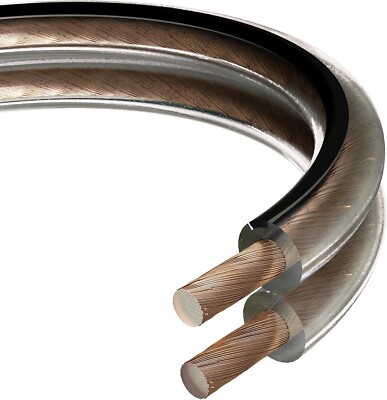
You just bought cable and are assembling your own speaker wires by adding banana jacks to one end and spade lugs to the other. You need 10 meters for the right speaker (which will run through the walls for the right, center, and sub) and 5 meters for the left speaker (to remain accessible).

Do you leave the left cable full length, or cut it to 5 meters and avoid the excess? There is no difference in cost because you've had to buy two spools anyways. The cable comes in 10 meter spools and because this runs through the walls, will never be resold.
 
Register to hide this ad
Everything I have read online suggests that unless you are running thin gauge wire or long lengths ( 40-50 feet ),different lengths wire are ok.

For me,I'm big into consistency and balance for anything and everything so I keep my left and right wires the same length.
 
Always cut to length unless you plan moving your speakers around to get the best sound in your room, which can be a real challenge if your room is not Symmetrical. I always three feet after I have found the place for the speakers in case my taste changes. I also leave a couple of feet spare at the amplifier in case I have to rotate them to check connections.
 
Ooooh! Tough one! I like it! People often use the term psychoacoustics in a sort of derogatory way. But I think it is very real. I feel that if one believes that equal length cables sound better then they will. The way we hear and perceive sound is very complex. I believe my old electronics teacher who said “think of a wire as a hose full of marbles. Put a marble in one end and one comes out the other end” not just very fast but literally instantaneously! So for me personally I would opt for cutting the cable to the right length.

Of course since it’s me, I would cut it 2 feet too short and need to go get another spool of wire anyway! But that’s a whole nother thing!

Cheers………………..Todd
 
The only concern I would have is if I care about cutting the second wire in half. I'm a little nutty about that. Don't like to cut things up unless I have to. So if I didn't mind the extra length I would leave it alone. Then if some day I needed it.
 
They’re equal length in my system, but I’d have no issue making them unequal length’s if that's what was needed. In fact, the system in the upstairs loft has one speaker leg about 8 feet and the other around 15-20 feet. No noticeable. difference in sound between speakers and that's a “lower powered” pioneer sx680.

Speaker cable length falls under "minutia" for me. I don't sweat things that are minutia because, well....ultimately: they just don't really matter.
 
Last edited:
My late NAD 2140's had a Signal Level Compensator circuit to adjust for unequal speakers wires.

11. SPEAKER LEAD COMPENSATOR (SLC™*). When a speaker is connected to an amplifier through a length of wire, the résistance of the wire will affect the signal reaching the speaker terminals. If the wire is suff iciently sho rt or suffi ciently la rge in diameter, its résistance will be negligible. As a general rule, 18wire should be used for lengths of up to 20 feet (6 meters) and 16-gauge or heavier wire for lengths of up to 30 feet thinner wire, or greater lengths, the wire résistance may have a directly audible effect on the speaker's sound—especially with low-impedance speakers, or pairs of speakers wired in parallel. This effect is of four kinds:
(1) Some power is dissipated in the wires, and the signal delive
to the speaker is slightly reduced in level.
(2) Since the speaker's impedance varies with frequency, the reduction in signal level varies in proportion; i.e. the tonal balance the signal is altered.
(3) Typical speaker impedances are complex, varying with signal level (for example, the voice-coil inductance varies as the coil moves in and out of the magnet gap), and may become non-linear at high volume levels. The resulting non-linear current flow produces a non-linear (i.e. distorted) voltage across the résistance audio signal may be completely terminals, yet exhibit sev leads where they
(4) Finally, the wire résistance reduces the amplifier's
damping factor.
The Speaker Lead Compensator (SLC) cancels the effects of the wire résistance, eliminating the distortion and restoring performance which would be obtained if the wire had no SLC is calibrated for a specific amount of wire résistance, corresponding to the following lengths of standard
In the bridged mode the speaker wires must be
distortion-free at the amplifier's output
eral percent of distortion at the far end of the
connect to the speaker terminals.


Page 4

 
The difference will be the different total inductance that the amplifier is driving (resistance, inductance, capacitance) due to the different wire lengths, which in theory can influence the sound.

Whether it is audible or matters at all is questionable, but I prefer equal wire lengths when practical. Not coiled, laid out straight in long loops is my method.
 
I cut mine to equal lengths. Always a bit long, and NEVER coiled if in use.

Wire arguments aside, using different lengths or gauges creates 2 dissimilar circuits. Maybe you can hear it, maybe you can't. A 10' of 8ga and a 20' of 8ga will have measurable differences and that must affect the circuit.
 
After thinking about it,I'll bet you probably need to worry more about the banana jacks, spade lugs and connection degrading signal then the actual length of wire.
Both are gold plated to ensure a good contact and avoid future corrosion. The banana plugs (actually "Z-plugs") use two gold plated screws to bare down on the wire and the spade lugs are a crimp contact that will receive silver solder.

Wire is 12 gauge.

BTW, I got the four rolls. If these last two rolls are still available GIT EM! You won't come to anywhere near the quality at <$1/ft!

 
I’d be grabbing a roll or two for spares, … if I didn’t already have spares. Looks like excellent wire for that price.
 
My rack is to the right side so unequal length speaker cables. I don't like having a pile of unneeded wire under the rack or stuffed somewhere. In general I like all cables, signal or power, to be no longer than needed. Signal and power cables separated and not in parallel.
 
I wonder if coiling may not really matter much, if any, given both conductors are there which I think cancels. E.G, clamp on ammeter won't read current when it's clamped around both "in and out" conductors because the fields cancel.
 
Last edited:
You just bought cable and are assembling your own speaker wires by adding banana jacks to one end and spade lugs to the other. You need 10 meters for the right speaker (which will run through the walls for the right, center, and sub) and 5 meters for the left speaker (to remain accessible).

Do you leave the left cable full length, or cut it to 5 meters and avoid the excess? There is no difference in cost because you've had to buy two spools anyways. The cable comes in 10 meter spools and because this runs through the walls, will never be resold.
I'd prolly leave both sides 10 meters.
 
I wonder if coiling may not really matter much, if any, given both conductors are there which I think cancels. E.G, clamp on ammeter won't read current when it's clamped around both "in and out" conductors because the fields cancel.
Back in the day I had some Polk cable, it was braided and the audio store I bought it from warned against coiling it. That is the only time I'd run into that.

To the OP I like my cables the same length. No downside as far as I know, so why not?
 
Back
Top Bottom