• The move to the new server is done. There are some software and database maintenance updates in process. This has us passing the hat around to help out. We appreciate any donations. Seriously, even a dollar helps. The payment page may be found here - https://www.audiokarma.org/support.html

Can someone recommend 1 foot long RCA cables that are FLEXIBLE?

I did an eBay search in Linn interconnect cable. There were only 2 black cables listed. The rest were all the silver cables. I'm in the US, so I can't buy from Linn directly, and a lot of the eBay sellers are shipping out of the UK, which has pretty high shipping.

On US eBay, the 1.2m interconnect is offered by 2 sellers for $75 + $10 shipping. Those appear to be new. There is one used cable for $59.99 + $10 shipping and everything else looks like a Linn's Silver that's going for between $300-$400.

I didn't bother to learn the difference between the Black and Silver cables. Because of thatm I offended @Hifiler. @Hifiler, I apolagize. You did offer to help with the parameters I provided. I didn't mean to offend.

I think @Aaron Hayman may be right, and I may need to get a longer cable to get the flexibiity I need.
 
DBTs have value, but are not the ultimate arbiter for me. Unfortunately, you cannot compare cables in a true DBT without adding another cable to the mix! If you're interested, I'll tell a tale of an inherently bogus test that some have advanced. For which measurements provide only laughter.

The most transparent cables in my experience (JPS Labs and Nordost) have very low LC values which renders their effective dielectric constant closer to the ideal of 1. That expresses how the cable performs in the time domain. Clarity. Focus.

Sure, I'm up for a good story.
 
I don't really know what these expensive interconnects buy you and I have to wonder if I personally could hear the difference. I just bought a few pair of what seem to be very well built cables, Stanton brand (which are apparently no longer made) on CL for $10 a pair (the seller said that he paid something like $50-60 for them new).
 
I don't really know what these expensive interconnects buy you and I have to wonder if I personally could hear the difference. I just bought a few pair of what seem to be very well built cables, Stanton brand (which are apparently no longer made) on CL for $10 a pair (the seller said that he paid something like $50-60 for them new).

Discussions of cable prices have started huge flame wars across the Internet.
 
So, here is what's going on:

I only need to run a cable from the DAC to the VU on top of it, and then from the VU meter to the amp below it.

I'm not really worried about the cables causing interference because they're too long or anything. I really just want it all to be nice and neat looking, more than anything else.

And here is the mess that is the back of this thing.

d8szZMG.jpg


Not all these wires go to this setup. I definitely have some wire management to do. to do. But you can see the RCA cables just shoot straight back and I can't bend them left or right. I thought shorter cables would not stick out so far back.
The Karma V3 cables will just hang perfectly, I don't know of any other cable that any where close to being as flexible and they are reasonably priced. I would be very careful about buying high-end cables off of eBay to make sure you aren't getting fakes. Even on Amazon you have to be a bit careful to make sure you are getting the legit cables. I have Blue Jeans RCA's that are nice quality, but the cables are pretty stiff and the RCA connectors are a mile long. For areas that are tight, I've replaced the Blue Jeans with Karma V3 and am very happy with them.

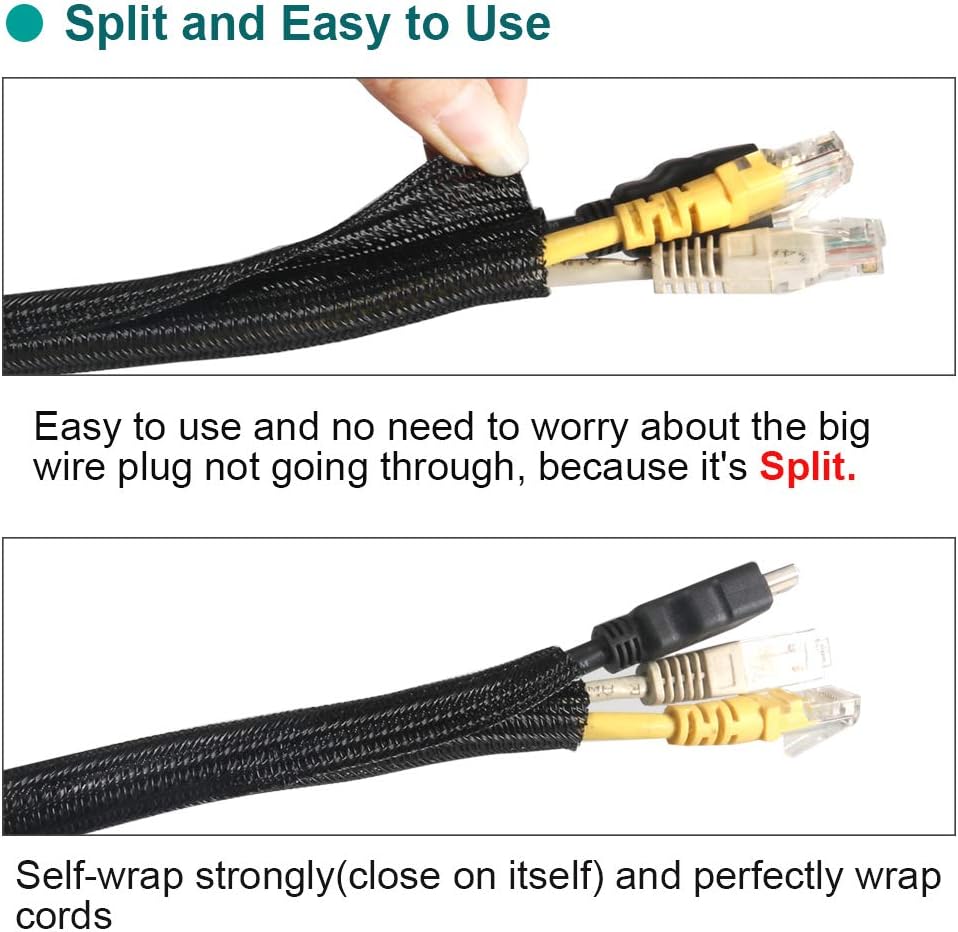
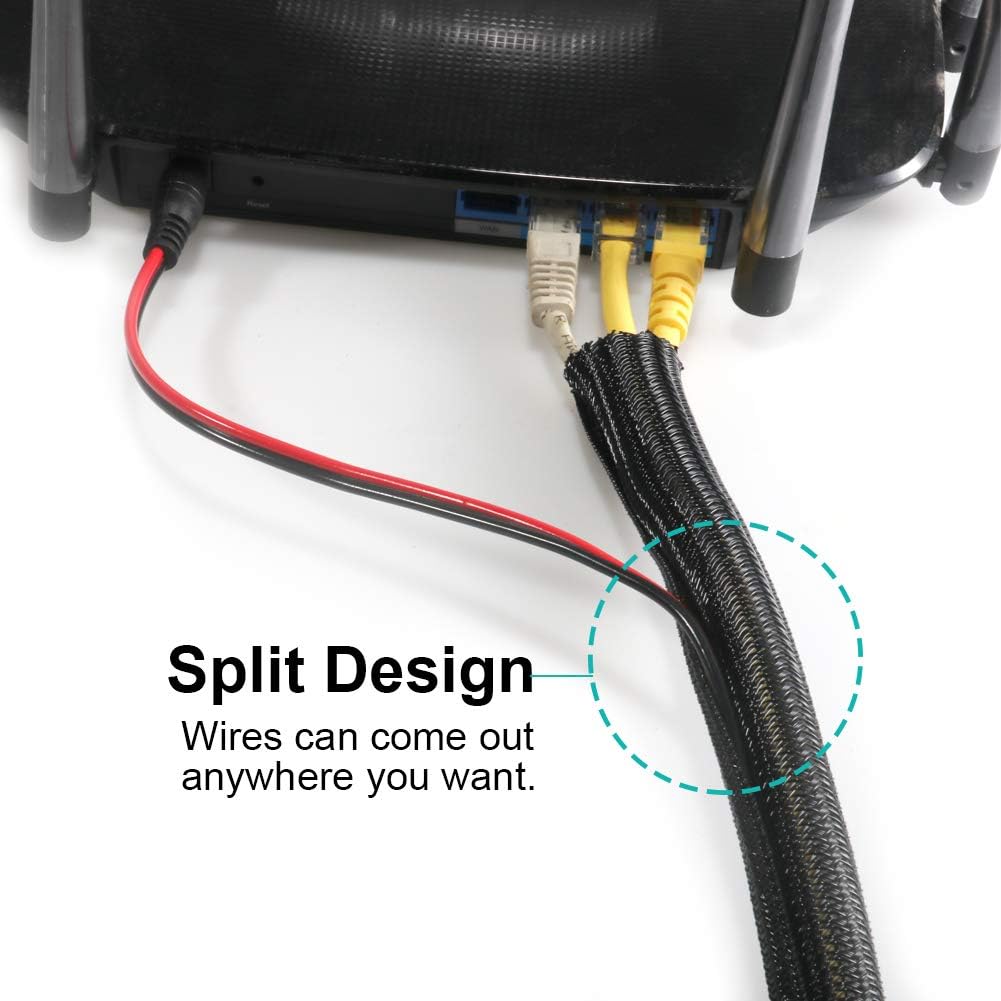
One thing that is a miracle worker for organizing wires is Alex Tech sleeves (https://www.amazon.com/Feet-Protector-Management-Protectors-Television/dp/B07NVG25D1/ref=sr_1_6?crid=35MS4WZDSY89W&dchild=1&keywords=alex+tech+braided+cable+sleeve&qid=1603082295&sprefix=alex+tech,aps,153&sr=8-6). If you have several cables running most of the length in parallel, you can bundle them together with the sleeving below. Unlike TechFlex that is solid, this sleeving is split down its length and self-enclosing, so it's easy to add and remove cables from the bundle as needed. Be sure to order the right diameter based upon how many cables you are bundling together (usually 3/4" works pretty well).

This stuff is pretty life-changing when it comes to organizing cables.

61geXRD1h%2BL._AC_SL1001_.jpg


61u6YBeF9HL._AC_SL1001_.jpg
 
If you can solder, you can make your own. (A solder gun works best for this.)

I've used standard monster type, DIY Belden coax (2 different #'s but can't remember which ones) and Mogami W2534 Quad microphone cable (Parts Express). Going from the standard to the coax made a huge difference in sound. Going from the coax to the Mogami made a lesser, but still very noticeable difference. The Mogami is very flexible.

I recently had a new system installed in my car, and had the installer use the Mogami IC's that I made for the job. Sounds Great!
 
Last edited:
If you use this moment as an opportunity to start making your own cables, you may never look back at store bought cables again.

One of the cables I make is a solid conductor wrapped in cotton and sealed with teflon tape. On the outside I'll wrap a spiral of solid conductor for the ground connection. Then you finish it with a tube, preferably cotton too.

These cables are simple, fast to make, sound very good and are extremely flexible.

More details available on request.
Always up for more knowledge.
 
I have those Monoprice cables, the plugs way to tight. I had to use pliers to get one off the other day, thought the socket was going to come out of the amp.

That Topping amp is cool!
 
Last edited:
If you can solder, you can make your own. (A solder gun works best for this.)

I've used standard monster type, DIY Belden coax (2 different #'s but can't remember which ones) and Mogami W2534 Quad microphone cable (Parts Express). Going from the standard to the coax made a huge difference in sound. Going from the coax to the Mogami made a lesser, but still very noticeable difference. The Mogami is very flexible.

I recently had a new system installed in my car, and had the installer use the Mogami IC's that I made for the job. Sounds Great!
I have also used the Mogami 2534 with good results. I made my own short interconnect cables for use with a switch box. The cables were made to be the exact length I needed which led to a tidy setup.

IMG_2135_zps372d4f54.JPG
 
I have those Monoprice cables, the plugs way to tight. I had to use pliers to get one off the other day, thought the socket was going to come out of the amp.

That Topping amp is cool!

LOL. I was hooking up a portable CD player to an amp last night for testing and the cable that I have is also a Monoprice cable. The RCA plugs did fit very snug onto the jacks and I had to put a bit of force on them to get them in place. I wonder if a bit of grease might help to slide them on there... Still they are very nice cables for the price.
 
That one stiff short cable shooting straight out from the back of your equipment looks to be the least of your worries... Seems that the rest of the cables are more messy...
 
Sure, I'm up for a good story.
Several years ago, I was made aware of a "scientific test" for comparing interconnects. And it is single blind! Follow the link below and scroll down to the section about interconnects:

http://sanderssoundsystems.com/technical-white-papers/54-cables-white-paper

Take a high level source like a CD player and connect Y-adapters to the outputs. Then connect Cable A to one end of each Y and Cable B to the other end. Lastly, plug the other end of the cables into different inputs on you preamp. That enables you to play the source and *compare* Cable A to Cable B merely by switching inputs. Sounds reasonable, right? What could possibly be wrong with this blind test?

I have a capacitance meter and tested values as I put together the "test apparatus". Here is cable A by itself which measures 59 pF:

cableB.jpg


Here is Cable B by itself which measures 544 pF:
cableA.jpg


Let's start connecting them. Here is Cable A now with one end of the y-adapter attached. The combined value is now 88 pF:

yadapter.jpg


Now, lets connect Cable B to the other end of the y-adapter and continue to measure Cable A. Wanna guess the result? 597 pF!!!!!

cableA+B.jpg


What did we just learn? The common ground in the y-adapter has forced the metrics of both cables to be combined. While the objective is to compare Cable A vs Cable B, what we actually end up doing is comparing Cable A+Cable B+y-adapter at one input to Cable A+Cable B+y-adapter at the other input. It forces both to be the same.

Why would anyone expect to hear any difference between 597 pF vs 597 pF? Not only is there no comparison, the connection chain has been dumbed down by the summing effects for either input as well. Read the conclusion of the test:

"After doing this test, you will discover that all the hype surrounding interconnects is just that. The fact is that all well-designed interconnects sound identical."

Smug ignorance is not a great combination. ;)
 
Last edited:
Back
Top Bottom