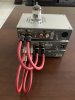
Several years ago, I was made aware of a "scientific test" for comparing interconnects. And it is single blind! Follow the link below and scroll down to the section about interconnects:
http://sanderssoundsystems.com/technical-white-papers/54-cables-white-paper
Take a high level source like a CD player and connect Y-adapters to the outputs. Then connect Cable A to one end of each Y and Cable B to the other end. Lastly, plug the other end of the cables into different inputs on you preamp. That enables you to play the source and *compare* Cable A to Cable B merely by switching inputs. Sounds reasonable, right? What could possibly be wrong with this blind test?
I have a capacitance meter and tested values as I put together the "test apparatus". Here is cable A by itself which measures 59 pF:
Here is Cable B by itself which measures 544 pF:
Let's start connecting them. Here is Cable A now with one end of the y-adapter attached. The combined value is now 88 pF:
Now, lets connect Cable B to the other end of the y-adapter and
continue to measure Cable A. Wanna guess the result? 597 pF!!!!!
What did we just learn? The common ground in the y-adapter has forced the metrics of both cables to be
combined. While the objective is to compare Cable A vs Cable B, what we actually end up doing is comparing Cable A+Cable B+y-adapter at one input to Cable A+Cable B+y-adapter at the other input. It forces both to be the same.
Why would anyone expect to hear any difference between 597 pF vs 597 pF? Not only is there no comparison, the connection chain has been dumbed down by the summing effects for either input as well. Read the conclusion of the test:
"After doing this test, you will discover that all the hype surrounding interconnects is just that. The fact is that all well-designed interconnects sound identical."
Smug ignorance is not a great combination.