• The move to the new server is done. There are some software and database maintenance updates in process. This has us passing the hat around to help out. We appreciate any donations. Seriously, even a dollar helps. The payment page may be found here - https://www.audiokarma.org/support.html

Can you bridge SET amplifier just like you can any other amplifier?

Allen354 (:thumbsup:

I've read a few service manuals that state you can 'bridge' some SS amps stated in the service manual but tube I don't know aside from perhaps single full range drivers that were amplified. (rare) You could add harmonics I suppose with equalizer but generally the idea was dumped with advent of 4 ohm speakers and amps that could handle that.

I see no big deal running off an SS line out to a powerful tube amp and single driver 18"? and get amazing results for volume/ loudness if that is what you want. I've run two old 16ohm drivers but the tube amp was old and designed for 12 or 16ohms.

Indonesia? I wouldn't know the sources there.
 
I don't quite get what you are saying. Can you explain some more?
The concept is to make a single-channel PP amp out of two SET amp channels processing the same signal in opposite phase, all the way through the single-ended OPTs. Power from both channels is combined at the load by paralleling OPT secondary windings in opposite phase. This should yield even-harmonic cancellation along with the supposed low-level linearity benefits of heavily biased OPT core material, I guess.
 
The concept is to make a single-channel PP amp out of two SET amp channels processing the same signal in opposite phase, all the way through the single-ended OPTs. Power from both channels is combined at the load by paralleling OPT secondary windings in opposite phase. This should yield even-harmonic cancellation along with the supposed low-level linearity benefits of heavily biased OPT core material, I guess.
Do you mean in the primary.....the high voltage side? If you can remember the article your read, please give me a link.....I am curious.
 
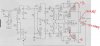
I bite the bullet and created a simulation program with LTSpice to see the result. Sadly, it's it even harmonics that are being cancelled. I post the simulation schematic using just a typical SS amp with distortion. In the schematic, the left side is two of the amps in bridge mode, the right side is the single amp. I made the output equal amplitude.
View attachment 1000181


Here is the harmonic frequency spectrum. The top is from the bridge amp, the bottom is the single amp. Notice I point to the 2nd, 4th and 6th harmonics, they are either missing or greatly reduced in the bridge amp?

View attachment 1000190


So the conclusion is BEYOND DOUBT, bridge amp cancels even harmonics. I would say it's very bad when using tube amps. Tubes amp always has much higher THD. Even harmonics is known to be musical, odd harmonics is known to be non musical.
Thanks, Alan. Very interesting. How about strapping? Does it also eliminate even-order harmonics?

And how do you exactly strap a stereo amp? All examples I found on the internet is strapping two mono amps.
 
Do you mean in the primary.....the high voltage side? If you can remember the article your read, please give me a link.....I am curious.
No, the output power is combined by paralleling OPT secondaries in antiphase. There was at least one thread at diyAudio on this topic, but I couldn't find it after a few minutes of effort. The article I mentioned might have been in Glass Audio or AudioXpress. I'll think about it and keep trying.
 
Thanks, Alan. Very interesting. How about strapping? Does it also eliminate even-order harmonics?

And how do you exactly strap a stereo amp? All examples I found on the internet is strapping two mono amps.
Read post #17 by BinaryMike, he explain why it's not a good idea and I agree.
 
If you can remember the article your read, please give me a link.....I am curious.
Found it: "Dual Single-Ended Amplifier" by Graeme J Cohen in Glass Audio number 3, 1996. The same article apparently appeared as AES preprint #4028 and was presented at an Australian regional AES convention in 1995.
 
Found it: "Dual Single-Ended Amplifier" by Graeme J Cohen in Glass Audio number 3, 1996. The same article apparently appeared as AES preprint #4028 and was presented at an Australian regional AES convention in 1995.
I think this is the circuit:
Bridge SE amp.JPG

Interesting. It's almost like regular push-pull EXCEPT the center tap on the primary of the output transformer is missing, then the +B is fed from V4A and V5A. Other than that, it's like a push pull amp.

I think we have a miss- understanding in the terms "primary" and "secondary". My understanding is the input side is primary and that's where this design doing the summing, not on the secondary.
 
Back
Top Bottom