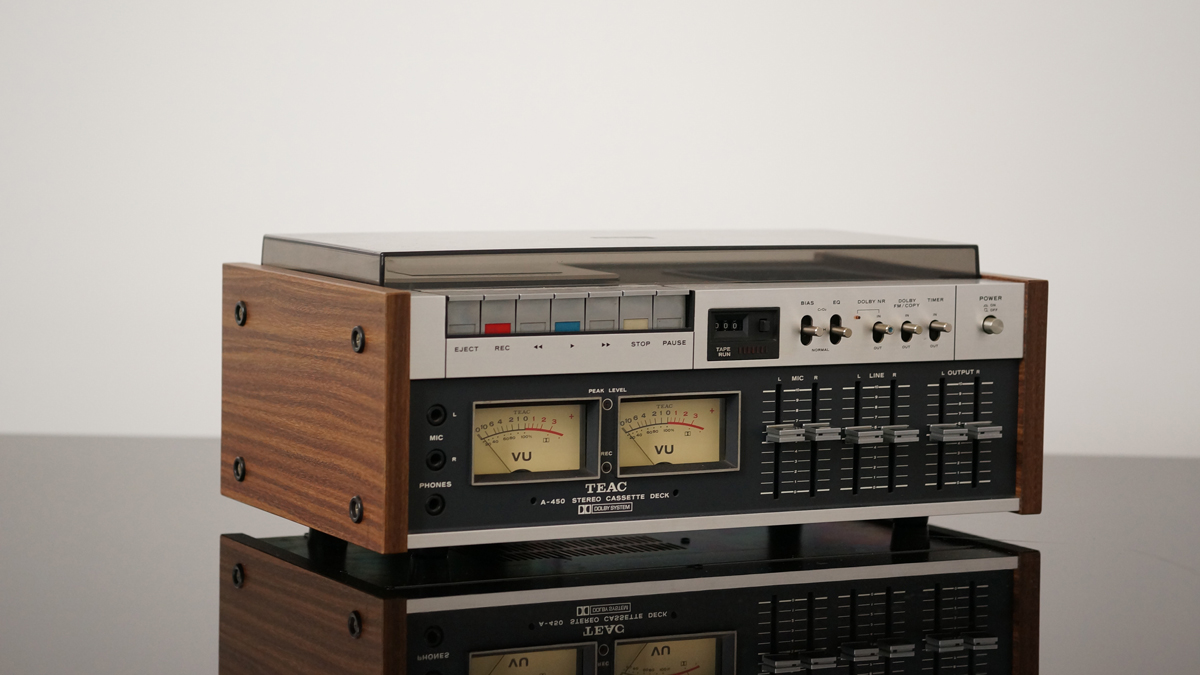
But we're not "back then" anymore. I've seen a lot of vintage decks that are incapable of meeting their factory specifications, even with new belts of the correct size, due to 30-40 years of wear and tear on the mechanism and motor, and the inconsistent quality of new belts.
So, after 40 years or wear and tear many of these old decks still perform better than new ones. This says enough about the new ones that - oh, Lordy! - come with a one-year warranty.
I'm the one who actually owns the equipment and has used and tested and experimented with it for the past four years, while you're just sitting in your chair and making guesses.
As I said above, your owning and testing one machine proves nothing exciting. It does not change the pitiful specs, it does not change the lack of features. If anything, it proves that the performance is all over the place with almost two times difference between two mechas of the same machine.
Vinyl aficionados aren't the ones responsible for vinyl's revival. It's kids with cheap suitcase players. The two top-selling brands are Victrola and Crosley. Almost 90% of all new turntables sold are under $200.
That is exactly my point above. $600 component deck is on the opposite end of the scale. If anything is going to move the needle it would be 21st century ghetto blasters, but as Techmoan has shown, the available machines are laughable hollow half-functioning imitations that copy the look of iconic models. I don't expect them getting better, I don't expect genuine new external styling and genuine engineering.
Somebody has to be making money, if National Audio Company (the largest manufacturer of cassette tapes in the U.S.) says business is better now than it has ever been in the past 20 years
Anything is better than zero, and both vinyl and cassettes were pretty much at zero point twenty years ago, and NAC is the only manufacturer left.
TEAC/TASCAM and Marantz are having trouble making enough new cassette decks to keep up with demand.
Yeah, they could not complete ten orders they received because they have only five mechas of which only two kinda sorta satisfy their pitiful specs after careful hand picking, no wonder they are so expensive.
But they do have a "wow" factor for those who do have fond memories of them.
Thirty years ago I really wanted a good deck with great specs, with auto bias, reverse, Dolby S, etc, with good looks. I lusted for it. Modern decks are just a spit in a face. They are fakes. They are as hollow as the marble columns of Caesar Palace in Las Vegas, which are just thin-walled painted tins. I'd rather spend comparable sum to repair an old deck, but at least it will be a piece of engineering from the time when they were really trying. I actually did. I rejected a fixed and tuned low-end Nakamichi that the repair guy was offering for the same price that I paid him to repair my mid-range machine from a lesser brand (no, not the Technics). As much as I wanted something like Nakamichi back in 1990s, I don't want to get caught owning one now, too passé for me.
Like your experience with a single Teac deck does not prove anything, my own feelings do not reflect the trend. And the trend is... let's read some capitalist news: "Sales of cassettes nearly doubled from 173,000 in 2020 to 343,000 in 2021, according to entertainment data tracker Luminate. With year-to-date sales of 215,000, the trend seems to be continuing in 2022." This was from July 1, so if I am reading this correctly, the projected yearly sales would be 430K, which is 25% more than in 2021, not a double growth like from 2020 to 2021.
The nostalgia train slows down as the passengers lose interest or fall off the wagon.