• The move to the new server is done. There are some software and database maintenance updates in process. This has us passing the hat around to help out. We appreciate any donations. Seriously, even a dollar helps. The payment page may be found here - https://www.audiokarma.org/support.html

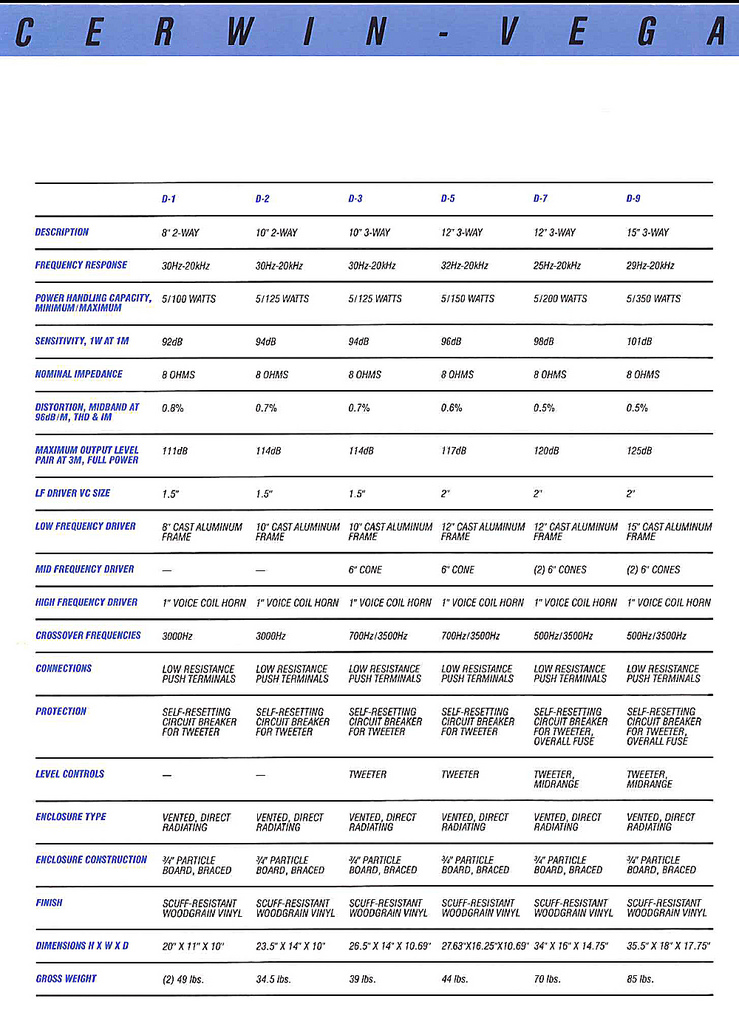
Cerwin-Vega D-Series Spec sheet

Just bought a second pair of D9 speakers. (I repaired and flipped the first pair.) The previous owner refoamed them, but one was off and the voice coil was rubbing. I freed up the surround from the basket, shimmed the voice coil, and reglued the surround. Joy! Black and grey cabinet, with a black foam surround. :) IMG_6075.JPG
 
I'm about to buy a nice pair of CV D-1's. I plan on doing a few upgrades such as a better crossover, lining the inside with 1 3/4 inch sound dampener, and upgrading the tweeter driver. I had a few questions as I'm new to cerwin vega speakers. Would anyone know what the Ohm load is for just the woofer? Also, does anyone know if the driver for the horn tweeter unscrews from the horn housing like modern horns do? If anyone could shed some light on this it would be greatly appreciated. Thank you and cheers!
 
You receive any information regarding your post? Just traded for a pair of these..and thinking about similar upgrades.
 
From da grave! My 3 year old question still stand, though :D

...The question was about why the D-7 had a slightly lower bass response than the D-9 on paper...

It’s a fine balance of factors... The D-7 has an almost inaudibly lower F3 than the big D-9 due to the smaller woofer having a more optimal set of t/s parameters given the enclosure size. Not sure of the Qms or Qes and whether the same magnet and spider was used, but the larger cone would likely have a larger Vas and require a larger than proportional enclosure size. CV made the D-9 enclosure slightly smaller than optimal to keep sensitivity and power handling high, not to mention shipping costs and marketability. If the cone were heavier, sensitivity would suffer and the two 6” mids would likely require more padding than safe for the crossover board and l-pads. All down to bass alignment and packaging. The D7 omitted some tradeoffs, one of which was not sensitivity.
 
Last edited:
In a general sense, to keep sensitivity without increasing motor strength that would lower Qts and eat at an LF contour, you’d fight a heavier cone that lowers sensitivity but also resonance frequency with looser suspension, which would raise Fs and Vas, and in the vented alignment, likely create a mid bass bump that you could narrow and deepen by reducing motor strength that would... lower sensitivity... unless the woofer coil was closer to the magnet pole, which would change Qes and thereby influence Qts, again, raising system resonance and sensitivity.

Big box still too small to rival D-7’s extension. Not so detrimental a margin.

Hoffman’s iron law.
 
Last edited:
The three T/S parameters crucial to a response curve, plus sensitivity, all fight one another.

Spl (sensitivity)
Fs (free air resonance)
Vas (volume air stiffness [a longer column of air is more easily compressed than a shorter one])
Qts (product of electrical [Qes] and mechanical [Qms] compliance)
 
I'm about to buy a nice pair of CV D-1's. I plan on doing a few upgrades such as a better crossover, lining the inside with 1 3/4 inch sound dampener, and upgrading the tweeter driver. I had a few questions as I'm new to cerwin vega speakers. Would anyone know what the Ohm load is for just the woofer? Also, does anyone know if the driver for the horn tweeter unscrews from the horn housing like modern horns do? If anyone could shed some light on this it would be greatly appreciated. Thank you and cheers!

D-1 are the real gems. They sound big for their size. I think the D1 tweeter horn unbolts from the magnet and the diaphragm is serviceable. You could check the woofer DCR with a multimeter. My guess is 5-7 ohms nominal.
 
the original posters image is no longer available

I'm the original poster and the picture should be working just fine. I've also edited the post to attach the image directly to the post (this feature was not available back in 2007 when I first made the post).

Also, I'm curious about the origin of your image, as some of the details are different.

For example, the D-9 is 8-ohms nominal, not 4-ohms nominal. The catch is that it has a lower minimum impedance than most 8-ohm speakers (actual impedance varies depending on frequency and can dip significantly below nominal). This can lead to problems with some amps that people assume won't happen with a speaker that is 8-ohms nominal. Since it was easier than trying to educate people about the concept of minimum impedance, Cerwin-Vega simply began labeling their later models as "4-8 ohms" nominal. From a technical perspective however, they are indeed 8-ohms nominal.

 
Last edited:
I'm the original poster and the picture should be working just fine. I've also edited the post to attach the image directly to the post (this feature was not available back in 2007 when I first made the post).

Also, I'm curious about the origin of your image, as some of the details are different.

For example, the D-9 is 8-ohms nominal, not 4-ohms nominal. The catch is that it has a lower minimum impedance than most 8-ohm speakers (actual impedance varies depending on frequency and can dip significantly below nominal). This can lead to problems with some amps that people assume won't happen with a speaker that is 8-ohms nominal. Since it was easier than trying to educate people about the concept of minimum impedance, Cerwin-Vega simply began labeling their later models as "4-8 ohms" nominal. From a technical perspective however, they are indeed 8-ohms nominal.

Hi Chris Your image is still not showing for me in your latest comment but does show on your original post Since some speakers can dip below there rated ohm spec when being pushed to there maximum wattage ratings maybe why the 4-8 ohm spec discrepancy on the spec sheets
as in the E series state there impedances as 8 ohm compatible a lot of consumers are
not going to be pushing 350-400 watt RMS or more a channel

The speakers them self's say 4-8 ohm (see picture) so as you mentioned maybe to help consumes know they can use either a 4 or 8 ohm amp
CV D9.jpg

Maybe the should have put a caution label on the D9 as Amp killers but that would kinda kill the marketing strategy:rolleyes:
 
Last edited:
Just picked up a free pair of ugly black D-2 speakers. But they sound so good. I am in a crisis, these are so uncool, but they sound so kickass! WHat is a status-conscious audiophile to do?!?!
 
When I purchased one of the pairs of Cerwin Vega D-9’s I had, the owner had kept everything from the receipt to the sales information that came with it.

I found this again the other day and figured I’d scan it. I don’t know if this information is listed elsewhere or not, but I figured some might find it useful:

This has information for the D-1, D-2, D-3, D-5, D-7, and D-9

cerwin.JPG
Thanks for the specs!
 
Sorry if this has already been asked previously but anybody know about how much the D-7's MSRP was back in the 1980's? TIA
 
Well I got tired of fussing with blown fuses and loose fuse holders on my D9s so I had custom crossovers built that bypass the fuses and level controls. I have to be careful not to drive them to hard so I dont blow the OEM tweeters that are very hard to find these days.
 
the first chart states that all had self resetting circuit breakers but d7 and d9 had manual breakers

the 2nd chart doesn't state if they are auto or manual so i just thought i'd chime in.

of my d3s,d5s and d9, i miss the d3s the most. they were much friendlier to a "normal" size living room.

the d9s were just too dam big to only have a single 2x4 brace front to rear and i thought the cardboard tubes for ports were laughable, but they were fun. they would take every bit of my kenwood 700m. it was too much for my small house plus my neighbors hated me so i moved the system to the shop i worked at. after hours at the shop was like a concert without the crowd.:rockon:
 
If they're like my ATs, there's a fuse for the speaker, with self resetting circuit breakers in the tweeters.
 
Back
Top Bottom