• The move to the new server is done. There are some software and database maintenance updates in process. This has us passing the hat around to help out. We appreciate any donations. Seriously, even a dollar helps. The payment page may be found here - https://www.audiokarma.org/support.html

Classic High-End Gear

What do you consider strong points of the Hafler amplifier. I was always considering finding a clean example to put into the system and give it a listen. I really mssed out on getting one when you purchased yours. There were so many choices back then.

A Marantz Model 15 that I went through a few years back remains my favorite of the older generation. It only misses the lowest lows in level but that is what a subwoofer can correct. I may examine the capacitor values in the input, feedback, etc. some day.
IIRC, most Hafler amps used Mosfets rather than BJT transistors- you can set the bias higher and stay in Class A longer with Mosfets- lots of current and damping (Parasound Halo amps use a similar topology) I have never heard a Halfler amp that didn't sound good.
 
Buddy of mine is a big Hafler fan. Bought his first DH500 as a kit in the early-1980s. Now he has multiple DH500s both consumer and "Pro" versions, a couple of DH200s, an XL280 or two. I'm not sure if he has an XL600 or not. He encouraged his friends to buy DH500s. One of them used one or two DH500s to power the kinda-goofy Polk SDA-SRS, the big-boy coffin-sized speakers. This did not work out as good as hoped, since the guy lived in an old house that only had 60-ampere electrical service. With other electrical items in the house working--water heater, stove, dryer, etc., the amps were starving for electrical power.

Everything but that first one came from sellers on eBay. Not all were in suitable condition. One eBay purchase was DOA. The seller claimed "shipping damage", but when my friend popped the cover, the leads to some of the output transistors were BURNT OFF. That doesn't happen in shipping, that amp was dead before it was put in the box and sold. OTOH it does give rise to the old saying about FETs being "Flame-Emitting Transistors". (More commonly applied to early Carver amps, but also true in this case.)

The Hafler DH and XL series are very fix-able, and at least "were" well-supported in the aftermarket. (I haven't looked recently, but I have no doubt that they're still supported.) All of his wounded amps have been repaired, some with upgraded parts from...Musical Concepts? To me, that's a HUGE ADVANTAGE for an amp that started-out with a fine reputation, but is now getting kinda "elderly".

I suppose I should be a Hafler owner, based on his experiences...but I wound-up with Aragon instead. Also robust amps, but without much in the way of aftermarket support.
 
If your amp generates a lot of heat, which this one probably does, you need to put it on top of the rack. Maybe put the turntable on a separate table to the side. Otherwise, you'll burn that amp up. I have a Yamaha B-2, and that is my cardinal rule for placement.

Also, I hope you're not in earthquake country.

My solution for heat (a Sanyo P55 power amp that has "sealed" freon heatsinks where sometimes that freon is long gone) was to put a super quiet slim computer fan over the outputs. can't see it in rack and the amp is actually cool to the touch with the fan running while quite hot without.
 
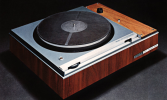
Wanted to add the SONY TTS3000 turntable (1970), servo-drive with a belt and a huge motor. I use it with a Rabco SL-8 and a Denon103e. Very steady with no rumble I've ever heard, just keep it lubricated
 

Attachments

  • Screenshot 2026-05-01 141057.png
    Screenshot 2026-05-01 141057.png
    860 KB · Views: 9
I guess these are classics, although not ancient...
My main speakers are Infinity MTS Preludes, stereophile class A in ~ year 2000. Love them, used every day for streaming (junk sound mostly), FM radio and CD music. Super clear, very low distortion, powerful bass in a large room, go clean to very high levels. Kept in storage for 20 years or so as our kids grew up.

Amp mostly used: Forte Model 1a, 50W class A operation. Something Threshold put out in early '90's. First amp I owned with actual smooth sound. Still works great, rebiased it a year or so ago. Simple enough to be rebuildable forever, if needed. Drives the 4 ohm Infinity's well. Makes a nice heater...

McIntosh MR 67 tuner. Modaferi'd a few years ago by previous owner. Classic looks, works well, although the dx improvement from the mod can't really be appreciated by me. Mint condition, beautiful.

I have a bunch of stuff like these, have been an audio nerd since forever. :)
 
Ok then, I’m playing with:
Accuphase P-20,C200
AR LS3,SP9,D400
Belles OCM200
Mitsubishi DA-P20,DA-C7,two DA-A15DC,DA-M10
Hafler 945,XL-280,XL-600,
Adcom GTP-500,GFA-545,GFA-5500
Rotel to many to number
Pioneer VSX-59TXi

Always looking…
Our lists overlap, but who *doesn't* have an Adcom GFA-545 in their collection?! And they have been increasing in value! (I paid $125 for mine about 20 years ago, and I think they are more than double that price today)

Audio Research LS7, Rotel 980 pre and power pair that were purchased locally from different owners, Threshold S/200, and a Parasound HCA-something (-1000 or -1500 I think)
 
Our lists overlap, but who *doesn't* have an Adcom GFA-545 in their collection?! And they have been increasing in value! (I paid $125 for mine about 20 years ago, and I think they are more than double that price today)

Audio Research LS7, Rotel 980 pre and power pair that were purchased locally from different owners, Threshold S/200, and a Parasound HCA-something (-1000 or -1500 I think)
Most excellent gear man.
 
The Rotel 980 pre-amp (and Adcom 545) was an enormous step in my audio journey for very little cash (I was using a "top-of-the-line" receiver before this, which the preamp slaughtered).

I didn't pick up the 980 power amp until a few years later; I wasn't shopping for one, it just kind of found me. At the time, I expected it to beat the Adcom, because it was heavier and supposedly has more power. The Adcom is better. And around this time learned about Threshold and that they were from the same designer, with Threshold being a big step up.

Then my brother in law let me borrow an ARC SS linestage for a year and a half while he had relocated for work (the LS1 or LS3), and I knew I wanted to upgrade from the Rotel 980.

Several years later, a friend of a friend that was upgrading his gear sold me the Threshold amp along with the ARC linestage in a combo sale.
This stuff is on a whole new level for me!

Then came tube-rolling! The ARC came with the stock (and very tired) Sovtek tubes as spares, with some installed "modern" JJ and EH tubes that seemed off to me in their own different ways, so I ordered new JJ and EH (cause they're dirt cheap!) but the new ones sounded mostly the same as the old ones, except with less hiss.

NOS Amperex 6DJ8 tubes with the orange world/globe logo (and not the stupid expensive ones!) turned the ARC into an entirely better linestage.
(Eventually I also found some reasonable NOS Telefunken tubes which sound ever so slightly different, but no better or worse than the Amperex, and I found that one pair of tube sockets really care which tubes are used (I think these are the gain stage), while the other pair of sockets don't seem to care at all (I think these are the cathode followers).

 
I've recently put two 1979 preamps back in business as phono preamps.

I purchased a used ARC SP-6B on eBay and had ARC refurb it. Not too expensive. After tube rolling, I replaced the new EH 12AX7 tubes ARC installed with Genalex ECC83/B759 (new stock) after a bunch of tube rolling (brands mentioned below). The new stock Genalex sounds the best, very similar to the Amperex (not Bugle Boy), but has a sweetness that is unsurpassed.

I completely rebuilt the power supply and signal caps on my rather unique Paragon Model "E" preamp. I purchased it at The Audible Difference in Palo Alto, CA in 1979, based on a strong recommendation by the shop's owner. There were about 250 units made in local San Carlos. Point to point wiring, no circuit board. The "E" is a stripped version of their flagship model - Model 12 (I think). Four 12AX7 tubes are in the phono section and two in the line level section. Except for the transformer and diodes, I replaced every component in the unregulated power supply. I had to determine the correct resistor to generate the heater voltage as that voltage was not close to 12V. The noise floor is about 20dB higher than the SP-6B. I can't hear this noise at my listening position, there's more LP surface noise. Mark Deneen has indicated to me that he wished he had reduced the power supply noise a bit more. Since this was a "weekend" project that turned into a product, he did pretty well.
Testing after the rebuild showed distortion is about 0.05%, good enough! Gain and noise floor stayed the same. The original tubes are Tungsram Hungary. I did a lot of tube rolling using Mullard, Telefunken. JJ, EH, EI, RCA blackplates, Amperex, and Genalex. To my wonderment, the RCA sounded the best. Great for rock, the bite of the guitar midrange and lower treble as well as the deep and very powerful bass are a great combination. The Genalex, Mullard, and Amperex tubes sound good also, but none has the combo the RCA has in this preamp. I thought at first that the RCA 12AX7 tubes wou

As I mentioned above, I am using these as phono preamps. I take the signal out at the "Tape" jacks. This way only three SP-6B and four "E" tubes are in the signal path. I occupy the other slots with just OK tubes, such as the JJ. Main preamp is a BAT VK-33se (no phono). I use MC cartridges (Hana Umami Red with the SP-6B in the arm on my Technics Sl-1200G table and Benz Micro LP-S on a Micro Seiki MA-505L arm on a outboard pod with the "E"). Each channel has a dedicated SUT set to the manufacturer's recommendation between the cartridge and phono preamp.

I've reawakened my old Apt preamps as well, but they cannot approach the sound of these two tube amps.

I've found it quite rewarding to bring these survivors back to full health. The result is a sound that can't be found in today's equipment. Some say that is a good thing, but I rather like the "tubey" sound, although I would not say that the sound of my system is as "tubey" as it is usually defined.
 
The Rotel 980 pre-amp (and Adcom 545) was an enormous step in my audio journey for very little cash (I was using a "top-of-the-line" receiver before this, which the preamp slaughtered).

I didn't pick up the 980 power amp until a few years later; I wasn't shopping for one, it just kind of found me. At the time, I expected it to beat the Adcom, because it was heavier and supposedly has more power. The Adcom is better. And around this time learned about Threshold and that they were from the same designer, with Threshold being a big step up.

Then my brother in law let me borrow an ARC SS linestage for a year and a half while he had relocated for work (the LS1 or LS3), and I knew I wanted to upgrade from the Rotel 980.

Several years later, a friend of a friend that was upgrading his gear sold me the Threshold amp along with the ARC linestage in a combo sale.
This stuff is on a whole new level for me!

Then came tube-rolling! The ARC came with the stock (and very tired) Sovtek tubes as spares, with some installed "modern" JJ and EH tubes that seemed off to me in their own different ways, so I ordered new JJ and EH (cause they're dirt cheap!) but the new ones sounded mostly the same as the old ones, except with less hiss.

NOS Amperex 6DJ8 tubes with the orange world/globe logo (and not the stupid expensive ones!) turned the ARC into an entirely better linestage.
(Eventually I also found some reasonable NOS Telefunken tubes which sound ever so slightly different, but no better or worse than the Amperex, and I found that one pair of tube sockets really care which tubes are used (I think these are the gain stage), while the other pair of sockets don't seem to care at all (I think these are the cathode followers).
I've been on a somewhat similar journey. See my post #652 this thread, especially the tube rolling parts.
 
Back
Top Bottom