• The move to the new server is done. There are some software and database maintenance updates in process. This has us passing the hat around to help out. We appreciate any donations. Seriously, even a dollar helps. The payment page may be found here - https://www.audiokarma.org/support.html

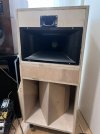
Compact 3-Way Horn Speaker

View attachment 3434076

It rolled off at the bottom in the mid 30's, without the benefit of corner loading! I put on Bela Fleck and Flecktones and every bit of Victor Wooten's baseline were there. While the bass wasn't as authoritative as my big horns, which extend to 20Hz, it had considerable presence.

I'll put together a proper network, clear out a corner and get more measurements, soon

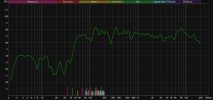
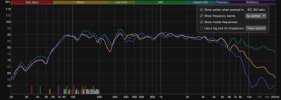
I owe youse all a retraction. When I pulled the first measurement, I turned the volume on the small Mirage subwoofer in my studio all of the way down. What I didn't realize was that that did not turn it off and it gave me inaccurate measurements:
1740401687909.jpeg
The pink circle shows the actual response of the speaker, whereas the part that follows is the sub.
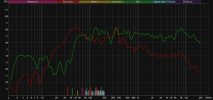
Below are plots in red showing the response without the passive radiator, and in purple, with the passive.
1740401762191.jpeg

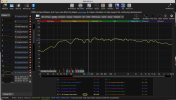
unassisted with bass reflex, the frequency response begins falling off at 100Hz, while with the passive radiator employed, it falls off around 55Hz, which is better than the AL-1, but not quite as good as the AL-5, which has nominal better extension, as shown in this plot from Stereophile magazine.
1740402200825.png

This is deeply embarrassing and disappointing; there's no beating physics, but I'm not done quite yet.

To be continued...
 
Last edited:
I’ll add that attaching weight to the back of the passive radiator gave a modest improvement to the frequency response and amplitude, increasing the former down to the low 50Hz range and improving the latter by +3dB. Unfortunately, my measurements were lost when my laptop updated overnight and I’m not able to find the temp file folder. Basically, though, I’ve created a 80% scale copy that effectively replicates the AL5, with arguably better midrange and better response overall. On a lark, I set it up last night as the center channel in my home theater system, with the heresy inspired speakers in the side surround channels. We listened to some Apple Music Atmos content, Fleetwood Mac’s Rumours and the new record from Sharn Van Etten, and watched a movie; I almost regret living in the inner city: if we lived in a suburban home with enough space, it would make a really sweet surround system. It was really quite remarkable.

At any rate, I’ll be in the woodshop today and more measurements will be forthcoming.
 
As you can see, the Mini LS mode is less than impressive, rolling off at 60 Hz, although it's less steep and an arguably smoother curve than the LS-1. Without the passive, it I suspect it would make a great center channel horn speaker.
The only reason it looks like a smoother curve is because you have the display limits on the graph set with a 120dB range on the vertical axis.
The LS1 graph shows a 50dB range.
If you scale your most recent measurement the same and overlay it on the LS1 graph it looks something like this.
lancemini-LS1.png
 
back at this after a week off in the shop, doing guitar stuff. earlier last week, I made a 4" extension collar to add about .75 cubic feet of volume to the cabinet.
1740947283501.jpeg


After hooking it up, I threw on some music and I swear to dog, the bass was definitely there. I even double checked to make sure my sub was unplugged. Playing Bele Fleck & the Flecktone's Flight of the Cosmic Hippo delivered every note of Victor Wooten's bass line. The first sweep, however, was disappointing.

1740947764107.jpeg

WTF?! :mad:

Then it hit me: I should also measure the passive. That was illuminating. with an average 85 dB SPL, extension at -5db was at 28Hz.
1740947804293.jpeg

The tweeter response was troubling, however. Texting back and forth with @mboxler, we increased the inductance on the tweeter circuit to .160µH, from 100µH and reduced the first capacitor from 2µF to 1µF:
1740962580362.png
That smoothed out the hump nicely, but we still have the issue of the falling response of the tweeter. we tried a few tricks, including putting it on the autoformer, moving the input to 4, the squawker from 4 to 3 and putting the tweeter on the 5 tap, but that was not helpful.

1740962782330.jpeg
the previous measurement is in green, the measurement in orange depicts the adjustments and purple is a sweep without the tweeter at all. Ultimately, I think I'll write off the DS18 Tweeter or at least save it for another project I'm planning down the road. Next up will be a K-79 lens with a B&C DE10, which is well proven. I'll have to take the upper enclosure back to the shop and mortise it for the K79, but that will be easy, since I already have the router jig left over from the big 3-way horns. Looks like I'll be making a 2nd to go with it, although I have no idea where I'll put them when they're done.
 
Last edited:

This will help flatten the tweeter response and yield a flat response.
I may very well be entering the data wrong, but it's not generating a configuration for me. It doesn't seem to be applicable for my situation. "The first is a RL (Resistor & Inductor) network that is used when the response is rising as the frequency increases. The other network is a RC (Resistor & Capacitor) network for drivers whose response is rising as the frequency decreases." Neither accounts for a falling rate, which is what I have going on; the RC circuit seems to, but on closer examination, it's not. either way, the calculator doesn't output values to help.
 
If you look at the tweeter response by itself, it does indeed have a rising response as frequency decreases. This equates to a falling response as frequency increases.

If you flatten out the increase at lower frequencies, then the overall response will be flat.

Mike should be able to simulate it in LT Spice. I've never learned LT but might give it ago in the near future.
 
If you look at the tweeter response by itself, it does indeed have a rising response as frequency decreases. This equates to a falling response as frequency increases.

If you flatten out the increase at lower frequencies, then the overall response will be flat.

Mike should be able to simulate it in LT Spice. I've never learned LT but might give it ago in the near future.
The problem I’m finding is that it generates inductor values so small that they don’t exist without putting them in parallel and it gives me null values for resistors, as far as I can tell. Like I said before, I may be doing it wrong, but that’s what I’m getting. That doesn’t address the other issues associated with attenuating everything else to match. It strikes me as sub-optimal. The DS18 tweeter was a good, inexpensive experiment and I learned a lot from it. I have some other projects on a back burner that it may be good for: d’Appolito configured surround speakers, provided I can find suitably sensitive 5-6” mid bass drivers for them.
In the mean time, Boxler and I are working on something with a DE10, which I’ve had good results with previously and have a spare available.
 
Last edited:
If you have your curve data and zma's accessible somewhere, we can poke at it (or set the optimizers on it) if you can tell us mic position vs. driver positions. Seems like a cool little tweeter (what's it sound like? :) ) much flatter than datasheet curve (and not many phenolics left--for which I always have a soft spot--like Dean says, "some bark and some bite").
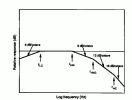
Kinda looks "normal" Keele-graph mass rolloff ~4kHz and later coil inductance adding the next slope...in which case you just treat it like the nornal R||C if the attenuation works out...which means it must not (?) for you (ie you want to keep it louder nominally than you need to pad the thing down to "flatten" it).

itswhathornsdo.png
DS18_edit.jpg

Could be just the numbers--ie, if you have to pad more than say 12 dB to get what you want, maybe the integration task difficulty/tradeoff mix is too unwieldy.

OTOH, if you use the popular (Harmon) target of -1dB/octave-ish, maybe not. Maybe the answer is how live is your room...oh--watched the imgur vid, too, BTW--quite grand--congrats (makes me wanna find my Bela copy).
 
If you have your curve data and zma's accessible somewhere, we can poke at it (or set the optimizers on it) if you can tell us mic position vs. driver positions. Seems like a cool little tweeter (what's it sound like? :) ) much flatter than datasheet curve (and not many phenolics left--for which I always have a soft spot--like Dean says, "some bark and some bite").
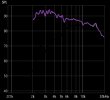
Kinda looks "normal" Keele-graph mass rolloff ~4kHz and later coil inductance adding the next slope...in which case you just treat it like the nornal R||C if the attenuation works out...which means it must not (?) for you (ie you want to keep it louder nominally than you need to pad the thing down to "flatten" it).

View attachment 3443457
View attachment 3443465

Could be just the numbers--ie, if you have to pad more than say 12 dB to get what you want, maybe the integration task difficulty/tradeoff mix is too unwieldy.

OTOH, if you use the popular (Harmon) target of -1dB/octave-ish, maybe not. Maybe the answer is how live is your room...oh--watched the imgur vid, too, BTW--quite grand--congrats (makes me wanna find my Bela copy).
The tweeter sounds nice, it’s great for under $20 and frankly, I can’t hear much of the rolloff, or anything above 9750Hz, for that matter. That said, when I was an apprentice carpenter, my mentor used to say frequently, “perfect is good enough,” and I’m holding out for that, or at least a better approximation thereof. My mentor also used to say “don’t let perfect be the enemy of good,” but this is not the time to invoke that maxim. I’ve got a spare B&C DE10 that will do the job quite well.
 
I’m wishing I had two right now.
don't try this playlist on your OEM LaScala without a subwoofer.
 
I’m wishing I had two right now.
don't try this playlist on your OEM LaScala without a subwoofer.
Listening to this now, very good bass, my room is vibrating in a very good way!
It's giving me an itch to listen to Bob Marley, or Stick Figure.
 
Listening to this now, very good bass, my room is vibrating in a very good way!
It's giving me an itch to listen to Bob Marley, or Stick Figure.
Check out Mad Professor, Lee Scratch Perry, King Tubby and Linval Thompson, while you’re at it.
 
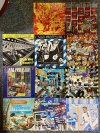
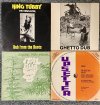
I know it's a bit off topic, but I had to post these, since Gigantic made the suggestions (nice handle, btw. Love the Pixies).

I bought these as they were released, all 80s era, I believe. I had the complete collection of Mad Professor, but you know how that goes when records are borrowed. The King Tubby Ghetto Dub was a Revolver release (basically Sherwood's On-U Sound, but recorded in Jamaica); Ital Dub is Augustus Pablo playing over Lee Perry's original Marley tracks, mixed by Tubby. My absolute all-time favorite, though, is the Upsetter's triple box set. All dubs with Carly and Family man rhythm section, mixed by Perry. Outstanding, get it if you can find it. It's on Trojan, so maybe they offer periodic reissues?

mad professor.jpgtubby.jpg
 
As much as the tired cliche about audiophiles drones on about “listening to gear,” at the root of it all, we’re driven by creating a better experience of listening to music.
 
Back
Top Bottom