• The move to the new server is done. There are some software and database maintenance updates in process. This has us passing the hat around to help out. We appreciate any donations. Seriously, even a dollar helps. The payment page may be found here - https://www.audiokarma.org/support.html

Component replacement challange, informed upgrades to an Sx, paging Leestereo

Hey man I appreciate that and I'm not trying to be passive aggressive. What I'm after here are opinions on a few key areas on a 780 that could use a preemptive update or upgrade beyond the usual stuff. Not after changing everything.

I cited Leestereo's rebuilds as an example as he doesn't just change out everything but also doesn't just do the standard recap.

a few months ago i reworked an sx-780 for another ak'r that wouldnt come out of protection. they are nice units for what they are. the main downfall will be the power packs. the original units are actually preferred and are more robust that the aftermarket replacements. people have opened both and while the internal circuitry is the same, the innards are not as robust. this could be the explanation for why replacements are blowing for some.

both the sx-780 i redid for him and the one i have on deck for a refurb are blessed to have both originals in working order so i have not explored the options further but it sounds like another ak'r might have come up with a better solution. i would investigate that if you are itching to mod.

the recap list found on this site was what i did use and what i will use next time. when the lists are combed over any voltage concerns are addressed and many members have used these lists with great success. resistors IMHO are only in need of replacement if they have drifted or failed. a cap dries out with age,(thus the replacement) a resistor does not. unless you have a larage stock on hand and an over abundance of time i wouldnt mess with them unless there is a problem.

post #4 perfectly sums up any work that would need to be done to an sx-780. he is spot on there. pay close attention to the diodes he mentioned. both of my units needed some reflowing for those.

i know when i first started i wanted to go overboard on everything i touched. with time and more units that faded a bit and the fiscal side started to make more sense to me. there is a ton of work and time that goes into just a proper recap and for most units thats all that is necessary. i just wanted to try to share my experiences to try and reign in some of the entusiasm you may or may not have.

even if you think this unit will be with you forever most of the time we eventually move them on. if you dont go overboard, sometimes you can even get your money back out of them. ive over-spent on a few myself and have kinda moved towards separates but i still repair for others.
 
Same thing with the 7100. WIMAs, KLs, KWs or PWs if you prefer. Make sure you regrease the outputs. I've never used a triac, turn the power switch upside down and use two poles instead of one, and fit a proper spark surpressor.

Lee.
Ahhh, I'll have to find that triac thread. After so much time all the posts just blur together. I've been looking forward to the KA, had it thrown in to justify spending more than I wanted on a broken Scott LK-72.

Actually why I've taken the 780 down from the shelf. Knock it off the list and head over to the Kenwood/Trio section. I'll definitely be re-greasing as I like to do that when I'm in there.
Might even post the build as it's pretty grungy and will show well as a before and after. Look forward to some questions!

Cartl
 
a few months ago i reworked an sx-780 for another ak'r that wouldnt come out of protection. they are nice units for what they are. the main downfall will be the power packs. the original units are actually preferred and are more robust that the aftermarket replacements. people have opened both and while the internal circuitry is the same, the innards are not as robust. this could be the explanation for why replacements are blowing for some.

both the sx-780 i redid for him and the one i have on deck for a refurb are blessed to have both originals in working order so i have not explored the options further but it sounds like another ak'r might have come up with a better solution. i would investigate that if you are itching to mod.

the recap list found on this site was what i did use and what i will use next time. when the lists are combed over any voltage concerns are addressed and many members have used these lists with great success. resistors IMHO are only in need of replacement if they have drifted or failed. a cap dries out with age,(thus the replacement) a resistor does not. unless you have a larage stock on hand and an over abundance of time i wouldnt mess with them unless there is a problem.

post #4 perfectly sums up any work that would need to be done to an sx-780. he is spot on there. pay close attention to the diodes he mentioned. both of my units needed some reflowing for those.

i know when i first started i wanted to go overboard on everything i touched. with time and more units that faded a bit and the fiscal side started to make more sense to me. there is a ton of work and time that goes into just a proper recap and for most units thats all that is necessary. i just wanted to try to share my experiences to try and reign in some of the entusiasm you may or may not have.

even if you think this unit will be with you forever most of the time we eventually move them on. if you dont go overboard, sometimes you can even get your money back out of them. ive over-spent on a few myself and have kinda moved towards separates but i still repair for others.
Hey thanks man for sticking in there.

This isn't my first rodeo as I collect and fix broken equipment. Through my AK lens it seems like the 780 is a bit trouble prone with components stressed more than other units. I've already recapped most of this guy and addressed D6-13, Q19-26. It's just when I got to the end of the board and noticed I was out of some caps and needed to order more stuff that I thought I might put a little more time and energy into it. Preemptively beef up a few areas that don't get the same attention as others.

I'm ordering from Mauser so if anyone has any positive opinions on 780 resistors that might benefit from an update...I definitely will reread older 780 threads to zero in on those that may drift and do some more checking.

-Carl
 
As previously mentioned, improvements to the signal path passive components (e.g., film and C0G capacitors in the high pass and low pass filters, respectively) will readily yield audible results. If you must use an electrolytic in the signal path due to physical size constraints, consider using bipolar types (e.g., Nichicon ES); note that although low-leakage electrolytic types (e.g., Nichicon KL) are often recommended for use in the signal path, the reverse voltage from the signal itself will induce leakage currents in a polarized type.

Regarding resistors, consider replacing the carbon film types in the feedback loop with 1% metal film types; also using a 0.5W rated resistor is also recommended (a "trick" often used by Sansui engineers).
 
As previously mentioned, improvements to the signal path passive components (e.g., film and C0G capacitors in the high pass and low pass filters, respectively) will readily yield audible results. If you must use an electrolytic in the signal path due to physical size constraints, consider using bipolar types (e.g., Nichicon ES); note that although low-leakage electrolytic types (e.g., Nichicon KL) are often recommended for use in the signal path, the reverse voltage from the signal itself will induce leakage currents in a polarized type.

Regarding resistors, consider replacing the carbon film types in the feedback loop with 1% metal film types; also using a 0.5W rated resistor is also recommended (a "trick" often used by Sansui engineers).
Hi Leestereo, thanks for the suggestions.

Still curious to hear why you choose to increase the uF size of power supply caps?
 
Increasing the capacity of the decoupling capacitors reduces the AC ripple (noise) on the power rails. It also contributes to a more stable voltage rails by minimizing the voltage sag when current demands increase when amplifying large (loud) signals.
 
Increasing the capacity of the decoupling capacitors reduces the AC ripple (noise) on the power rails. It also contributes to a more stable voltage rails by minimizing the voltage sag when current demands increase when amplifying large (loud) signals.
Yes thank you. That was my assumption.:beerchug:

Appreciate your quick reply. Look forward to your next documented build.

-Carl
 
I do think that the power supply can have a significant impact on the sound of an amplifier; in fact it can be argued that the power supply is very much in the signal path since it is essentially in series with the output stage. Nelson Pass uses the analogy of a water reservoir as the power supply and the output stage as the valve that controls the flow of the water (https://www.passdiy.com/project/articles/power-supplies). If you have a poor and/or inadequate supply, the quality and/or the quantity of water is affected. Correspondingly, in an amplifier, a poor power supply capacitor (e.g., low capacity, high ESR) may not be able to supply the voltage/current that the output stage is "asking" for. IMO, that is why improving the power supply (e.g., increasing capacity, lowering impedance) often does improve the sound of an amplifier.
 
note that although low-leakage electrolytic types (e.g., Nichicon KL) are often recommended for use in the signal path, the reverse voltage from the signal itself will induce leakage currents in a polarized type.
that depends on the DC bias across the ecap. I do agree where the o/p sits at around ground potential, as for a push-pull or similar class A with bi-polar supplies. The input coupling cap is another example of a zero DC bias across the ecap.

Your power supply is very important
Take a look at a au-x1 they have a regulated supply for each gain stage, the extreme.
 
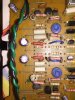
Spending some quality time with resistors and r260 is looking a little stressed. (Top of pic) I didn't record which STK was bad but I'll assume it was the right channel. The resistor tests normal @ 150ohms however I'll replace the pair (259,260). Given q14,12 are inline with r260 I'll pull them and do a check with DVM.IMG_1859.JPG
 
Q16 was basically desoldered from the board. On the other side q13's collector trace broke free with gentle inspection. Assumed q14 would've showed stress but looked ok.

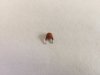
Given the q14's stressed collector trace I pulled c238, 10pf ceramic. It shows darkening around the leads and body. MK-168 might not go down that far as it shows damaged part. DVM gives a .05nf reading. 50pf would be a bit out.

Pulled r254, 262 and d2 and all looked ok.

I'll add KSA1013YBU and KSC2383YTA to the cart for q15/16, q13/14. Plenty of c1845s on hand.

Thanks MTF for the thorough 780 transistor write up on this thread: http://audiokarma.org/forums/index....x-780-no-sound-from-one-channel.619980/page-3
IMG_1905.JPG
 
As they "almost never fail", and you trust it because it may be a 1000 Volts part, is the reason they are easily overlooked.
It can be a real PITA .

Try measure ohms, too, because if they fail, it can be shorted.
 
I would not trust your DMM as an accurate tool for 10pF. try another 10pF and see what it reads.
I agree, and have little faith in it or my component tester. If it weren't for the horrible test leads the MK-168 is a nifty little $30 transistor lead identifier.

I will pull the other just to see what it yields.

I do wonder about the amplifier stage and STK failure.
 
As they "almost never fail", and you trust it because it may be a 1000 Volts part, is the reason they are easily overlooked.
It can be a real PITA .

Try measure ohms, too, because if they fail, it can be shorted.
I did and it's not shorted. Stressed yes. You know as the story goes, components test ok but in fact are cause of issues.
 
Did you figure out the shorted stk and all the collateral damage before mods/recap? I would get it fully functional before I change or mod anything.
 
Did you figure out the shorted stk and all the collateral damage before mods/recap? I would get it fully functional before I change or mod anything.
Did I figure out why the output shorted? Unfortunately not. Components are testing ok but I can't believe the stress I see is a result and not part of the cause. I'm not satisfied blaming a shorted speaker wire as the culprit.

You got any ideas?
 
I could certainly believe that a shorted speaker wire could be the cause. That or over use of the volume knob. I'm wondering if anything else was taken out at the same time. Check all your drivers, pre-drivers and emitter resistors and work your way back. Usually the excess current from shorted output will damage components upstream.

The stuff you have shown here looks like wear from normal use and not a cause of a shorted output. I would get closer to the stk and work backwards through the circuit in the amplifier sections.

General rule of thumb is to figure out and fix any problems to get a working unit. Then start the recap (and mods if you insist). It makes it easier to chase out any issues and removes the possibility of a component you have changed being a problem. It also keeps excess money/work out of a unit that may not be worthwhile fixing (or can't be figured out)

Do you have a dim bulb tester?
 
Last edited:
I do. I was worried with incandescent bulbs being outlawed, but it's been great. I'm energy efficient and haven't had a short since:)
 
Back
Top Bottom