• The move to the new server is done. There are some software and database maintenance updates in process. This has us passing the hat around to help out. We appreciate any donations. Seriously, even a dollar helps. The payment page may be found here - https://www.audiokarma.org/support.html

CONFESSION - about cables and interconnects

Status
Not open for further replies.
Whatever you think is all good. My sanity check is that all my power comes in over a aluminum wire, power switched to them for weight and cheap, so I have a hard time getting my mind around putting in a mega cable when it's fed by aluminum, like a mega cable is going to make it better than what is delivered on. I am not saying cabled make no diff, but what I am saying is that you don't get better than the source with a change in cable, you can go down, but you can't go up unless you are doing something with the source as well. ;)

IMHO you can only make sure your power side isn't worse than the supply.

JT
 
Thank you for sharing your experience with cables. I too have found a difference usually for the better . A very discerning hifi enthusiast friend told of his experience with power strips and higher grade AC outlets. I poo pooed the concept until I tried it. I found that the power amp did sound better when plugged directly into the wall outlet. I have tried and still use some very nice power outlet strips. But I always plug the power amp directly into the wall outlet. I also replace the outlets for my hifi gear with hospital grade types.
I did try a high end ( expensive) set of Aluminum speaker cables and they sounded horrible in my system , lamp cord was much better.

You are very welcome. When my husband and I bought our current house, we had a new fusebox, outlets, and breakers installed. I made certain though, that my listening space got it's own breaker. While I don't have the "hospital" type outlets, those that I have are new and run on their own circuit. I have had very good luck with Tripp-Lite Isobar power strips. I feel more confident in them (as well as Panamax) than other brands. Oddly enough, the attached TV and multimedia computer are running on an APC - UPS. :) I am going to have to try plugging the amp into the wall outlet directly to see if that brings any change in sound. I am a bit hesitant to do that because central Mississippi where I live has a lot of thunderstorm activity.

I have been thinking about the speaker cables you mentioned. I have personally never heard of aluminum speaker wires. I am sure they exist, but I cannot reason why they should be used. :idea: I have seen sealed OFC wires where the ends were coated in silver. I personally use 12 gauge OFC copper, with banana plugs. Soldered them myself utilizing gold plated Nakamichi connectors.
 
I'm happy that you were able to get sound you like better from your system. Over 30 years ago I was privileged to work part-time in a small hifi shop. I remember the owner and product reps talking about and experimenting with interconnects and speaker wire to find combinations they felt worked well for whatever gear they were selling. Customers might also have their own ideas about what cables they wanted to audition in shop or borrow for an in-home trial.

For my own use, I've been content to just use whatever the amplifier manufacturer recommended. When I used a Linn preamp/amp combination, I used Linn interconnects and speaker wire; when I later switched to Audio by Van Alstine, I used what they recommended, which, at the time, was to buy whatever interconnects had the lowest price at a hardware store or department store plus simple 16 gauge zip cord for speaker wire (my speaker manufacturer also said that would work great up to 30 feet). The Linn setup sounded terrific (until a non-replaceable control board in the preamp gave out after about 20 years), and so did the AVA gear.
I used 18 gauge wire (or smaller) when I first started in the hobby, and the cheapest OEM interconnects. I have found that while all of those things "work", there are others that make the components work much better. It's about diminishing returns, I think. For what my husband does... 18 gauge speaker wire and the cheapest OEM interconnects will work just fine!! :eek::rflmao::music:
 
Read more closely . They state the cables are constructed using a proprietary blend of metals https://jpslabs.com/pages/alumiloy-conductor
“Alumiloy” .

Specifications:
Aluminata AC Cable

- Huge 8 AWG/8.36 mm2 custom wound finely stranded copper alloy conductors

I don't see any definition of what actual Copper alloy they use.

Maybe I'll ask them. However, since they've gone to great pains to keep the wire a proprietary secret I doubt if they'll be very forthcoming.

I did find this in a quick search:
Is aluminum copper alloy strong?
"); display: inline-block; height: 24px; width: 24px; margin-top: -1px; transform: rotateZ(-180deg);">

The susceptibility to solidification cracking of aluminum-copper alloys is increased; consequently, some of these alloys can be the most challenging aluminum alloys to weld. These alloys include some of the highest strength heat treatable aluminum alloys.

Sorry for thread crapping NB. i've learned something new today.

FWIW: I've known there are differences in the sound of wires and cables for 30+ years. I've even tried the ones made from CAT-5 cable. I braided up a couple of the full-bore version.

At one time I had Kimber Silver Streak IC's and 8TC speaker cable. Around 15 years ago I switched to DH Lab Silver Sonic (Silver plated Copper) speaker cables (Q-10 Signature) and IC's (Air Matrix).
 
RCA cables do make a difference and the capacitance may be the largest difference on 100% shielded cables. Power cords, I do not believe it. Some are misinformed by the Placebo effect. If you expect a difference your brain will simulate a difference.
By the same logic, if you are certain a difference does not exist you will not hear one. The placebo effect works both ways.
 
Agreed... in the end, it's not relevant what anyone else thinks... if you like it go for it, my skin's is thick and my walls fortified. Whatever you think best, you need no validation. I never did give damn what, "they" think. ;)

Out

JT

Agree. People are going to believe whatever they want to believe. When you give personal experience you will get the confirmation bias response. I don't think I have ever seen a thread where a person changes their mind by whatever is said in a thread. Anymore I share experiences and call it good.
 
The CAT-5 speaker cables convinced me that speaker cable break-in is real. At first they reminded me of audible barbed wire. They were harsh and peaky. I was on the verge of removing them. I held off because they took several hours to make. In this case the outcome was good. After 40+ hours they smoothed right out and didn't irritate any more.
 
What really needs to be done is to have a pair of expensive wires connected to your system, see them and know that they are actually connected and working, and listen to them for about a half hour or so, then switch back to the cheap conventional original wires and listen to them for about a half hour or so.

Now here's the kicker. Have someone else like a friend give you a blind test. Let's say the friend hooks up the cheap wires but tells you it is the expensive wires. You listen to it for about a half hour or so. Now let's say the friend tells you that he/she swapped out the expensive wires with the cheap wires and have you listen for another half hour or so. Now remove the blind fold and the friend then informs you that he/she never even used the expensive wires. :wtf:

:rflmao:
 
What really needs to be done is to have a pair of expensive wires connected to your system, see them and know that they are actually connected and working, and listen to them for about a half hour or so, then switch back to the cheap conventional original wires and listen to them for about a half hour or so.

absolutely! That’s how it got all started.
I then started the cable swap journey until I compared a MIT power cord vs computer power cord .., and the computer cord sounded better on the CD player… that’s how I into DIY cable journey 20+ yrs ago
 
The Tripplite Isobar is the main power strip that I use . I must have a dozen . But , the Conrad Johnson premier 11a sounds better when not plugged into it . I also tried a few different Monster ones and another one I don’t remember the name of. Don’t get me wrong, the amp sounds excellent plugged into the power strips , just better when not.
I always use a Tripplite isobar when gigging as it lets me know if the outlets are wired wrong , and it happens more than it should. Also, plugging all my gear into the same source helps prevent ground loop hum.
 
What really needs to be done is to have a pair of expensive wires connected to your system, see them and know that they are actually connected and working, and listen to them for about a half hour or so, then switch back to the cheap conventional original wires and listen to them for about a half hour or so.

Now here's the kicker. Have someone else like a friend give you a blind test. Let's say the friend hooks up the cheap wires but tells you it is the expensive wires. You listen to it for about a half hour or so. Now let's say the friend tells you that he/she swapped out the expensive wires with the cheap wires and have you listen for another half hour or so. Now remove the blind fold and the friend then informs you that he/she never even used the expensive wires. :wtf:

:rflmao:

I'm an advocate of the LTLT (long-term listening test). Insert whatever new device you wish to audition. Leave it there for a couple of weeks. Meanwhile keep an informal record of how much time you spend listening. If you listen more than before keep the new "whatever". If you listen less get rid of it. If there's no difference, it's at best a lateral move.

The Tripplite Isobar is the main power strip that I use . I must have a dozen . But , the Conrad Johnson premier 11a sounds better when not plugged into it . I also tried a few different Monster ones and another one I don’t remember the name of. Don’t get me wrong, the amp sounds excellent plugged into the power strips , just better when not.
I always use a Tripplite isobar when gigging as it lets me know if the outlets are wired wrong , and it happens more than it should. Also, plugging all my gear into the same source helps prevent ground loop hum.

Tripplite has replaced a melted Isobar that saved my gear from a lightning strike. I use it for all my low/line level gear. Power amps are connected to dedicated outlets. They were of when the lightning struck. The Isobar was/is always on.
 
I have a confession to make: I used to be a believer that cables and interconnects (other than the cheapest things that come OEM from component manufactures) really do not make a difference. A few years ago, I met this gentleman, whom my husband and I have become very good friends with, who convinced me otherwise. Although his and my budget for things are VASTLY different, he has gifted me with some interconnects and a power cable to "try" for as long as I wanted. He made me a believer....

My friends, quality power cables and interconnects do make a significant difference in the sound that the system produces. While there is a point of diminishing returns, which is unique to the individual, the previous is still undeniable fact. Please forgive me ignorance for having doubted the impact of proper cables / interconnect / speaker wire in the past. :oops:

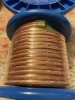
try finding some Auvio branded 12awg speaker wire.

15E6B239-65D0-4EBC-920D-1A0976902C59.jpeg B20FAC59-5225-469D-837A-FE353FFA8BCC.jpeg 8AD4BAAC-689D-4C95-8218-C750C1D6546C.jpeg B27E4B82-F3BF-4107-8001-1F9A990C3016.jpeg

A1681B21-EC69-4DD7-9978-6C72DC00FC5D.jpeg

some of the best cable you can buy, low buck.. just out of production so gotta eBay the crap out of it. No joke, I look every evening.
 
he has gifted me with some interconnects and a power cable to "try" for as long as I wanted. He made me a believer...
Similar story for me.

A reviewer friend introduced me to the concept of aftermarket power cords and lent me his three Kimber Palladians for a weekend some twenty years ago. One for the CDP and the others for the power amps. I was using passive attenuators at the time so that was the signal chain. I simply heard more information from familiar material. Such is widely accepted by those who have actually used them in their system - as opposed to the chorus of non-experiential theorists who must rely upon *belief*.

The benefits also apply to low voltage DC cables used for driving small streaming endpoints. The designer of the Sonore ultraRendu I use in the main system suggested trying low inductance Canare star quad cable. Spent the princely sum of $8 for wire and connectors and gave it a whirl. What improved was dynamics - an unanticipated area of improvement. I later spend a bit more for commercially produced cabling with better connectors from Ghent Audio. And got another for the RPi used in the garage system. Think those ran about $30 each.
 
I will tell you what I experienced. I was gifted with some very expensive (for me) interconnects. They were around $350 or so... I'm a foreign language teacher, and I simply do not have the budget for interconnects like those. I would have never have purchased them on my own. I placed them between my pre and power amp. There was, again to my ears, an improvement in everything but bass; the music seemed more defined. The power cable (also probably $100-150), made no difference with any of the components, except the power amp. There seemed, to me, to be a very slight improvement in the mid-range; i found it most noticeable when listening to Pat Benetar (one of my favorite artists). Perhaps as I listen to her material often, I was able to tell the difference.

I experimented with speaker cable. I settled on relatively cheap 12 gauge OFC with banana connectors, for approximately a 15 foot run. I had used much thinner 18 gauge cable in the past, and the 12 gauge provided an improvement in the lower frequency ranges. I then tried 10 gauge, but that seemed to have lost of the sparkle in the higher frequencies. I made some interconnects using very high quality 75ohm COAX cable and RCA adapters. With those, and the before mentioned interconnect, I heard no difference at all. The only difference would be in cost (about $25 vs $350) and appearance. :):music:

Well that's one for the reference file. Thank you for making it perfectly clear. I believe it.
 
Status
Not open for further replies.
Back
Top Bottom