• The move to the new server is done. There are some software and database maintenance updates in process. This has us passing the hat around to help out. We appreciate any donations. Seriously, even a dollar helps. The payment page may be found here - https://www.audiokarma.org/support.html

Confusion on speaker stands versus floor standing

Karn

Retroactively Audiodidactic
Ok so, I haven't exactly been able to find a straight answer about this, but why would you want to have a smaller speaker on stands to improve the sound (keeping it from hitting the ground in front of the speaker I'm sure) but with bigger speakers (like Polk SDAs) you actually want to spike them to connect them *better* to the ground?

Surely small speakers lose any of that ground connection being on a stand. Is it a trade off? As in, it's better to get the smaller speaker off the ground for sound dispersion, versus leaving it connected to the ground for -I assume- bass response?

Just a little confused on the different methodology I see/read about.

Thanks for everyone's input in advance!
 
Register to hide this ad
You're conflating two different issues here. Getting the speakers at the correct height is the primary function of speaker stands. Whether or not the speakers should be coupled rigidly to the floor is another matter. Many people believe they should be and in order to achieve that with stand-mounted speakers they use spikes on the bottom of the stands and spikes or cones between the speakers and stands. That couples them rigidly to the ground, just like floorstanders.

Actually, in the recording studio world the opposite approach is usually taken. There they often place soft/absorbent material under the speakers to decouple them from the surface they're on.
 
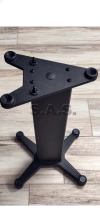
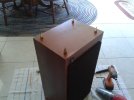
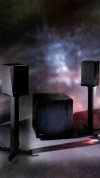
The proprietary stands for the Infinity Modulus are designed specifically to decouple the speaker from the stand. The stands have small rubber cups suspended in the top that the speaker spikes rest in. There are also screws through rubber grommets that hold the speakers to the stands so they don't fall off. Then the stands are also filled with either sand, lead, or a combination of both.

They also have spiked feet to couple the "stands" to the floor to give any vibrational energy picked up by the stands a good path to ground rather than to the speaker cabinet. They also allow leveling the speakers, another highly important aspect of speaker setup often ignored.

The stands are a big contributor to the SQ of the system.

Screenshot_20230901-051440.png

IMG_20230820_105950102.jpg

Screenshot_20210417-014213.jpg
 
Last edited:
Is that meant to prove something? If so, what?

That they're a proprietary stand for the Modulus, you have an issue with that lol?

Did I quote you? No.

Maybe you should read the rest of the post and maybe do some research on the Modulus if wanting some "proof" of something eh.
 
Last edited:
That they're a proprietary stand for the Modulus, you have an issue with that lol?

Did I quote you? No.

Maybe you should read the rest of the post and maybe do some research on the Modulus if wanting some "proof" of something eh.
I've read the entire thread and I addressed the OP's question. I have no issue with Infinity producing a proprietary stand for one of their speakers, I was wondering how showing that provided any kind of answer for the OP.
Sorry for asking for clarification, I didn't realise my request would prompt such a childish response.
 
Wow, that started for no good reason and escalated quickly.

While I've seen this question answered both ways, it's never been explained thoroughly enough for me to feel like I really know the answer.

It seems like coupling to a slab foundation might be desirable, but maybe decoupling might be better in an off grade situation.
 
Wow, that started for no good reason and escalated quickly.

While I've seen this question answered both ways, it's never been explained thoroughly enough for me to feel like I really know the answer.

It seems like coupling to a slab foundation might be desirable, but maybe decoupling might be better in an off grade situation.

It's a great site but we have the occasional member that needs to be put on time out, hence the ignore function.

I usually spike my floor standers if they don't have them already. Helps tighten up the bass, allows leveling the speakers, protects the bottoms from being scratched, and will help ground some of the vibrations in the cabinet.

I started doing this when I noticed my speakers were inching backwards when I cranked the music, this told me I was losing bass energy moving the speaker that should be moving air.

Klipsch Heresy
20181202_221401.jpg

AR58s in the process of being spiked
20180429_152006.jpg
 
Last edited:
As others have stated, the main reason to put speakers on stands is to get the tweeter at ear level while sitting down and listening. You wouldn't want a bookshelf speaker sitting on the floor with the tweeter pointing at your knees. Also, a good pair of stands will give you the ability to fill them with some sort of shot, sand, etc.. And spike them to the floor. This will tighten up the bass and improve the soundstage.
Tower speakers don't need stands of course, because the tweeter will be at the correct height when your sitting. Most speakers benefit from being on a stand of some sort or on spikes, verses being plopped down on carpet.
 
Is that meant to prove something? If so, what?
Yes, that there's no consensus as to whether speakers should be rigidly coupled to the fabric of the building or decoupled from it. In the hi-fi world rigid coupling seems to be favoured whereas in the studio world decoupling is more popular.
 
Its all about proper imaging and freedom from blurred bass. With small speakers on stands. Tall floor models add a bit more level and extend the range of the bass with designers being very careful not to compromise the upper bass and lower midrange. Thats why a lot speakers extend their midranges down to and below 300 HZ. MIne are at 250 HZ before the woofer takes over. Some companies use only use one woofer till below 150 hz then add the others where multiple driver bass isn't that much of an issue. Plus with that long of a wave length the minor difference between the direct sound and the direct reflection of the sound is of little concern with a 10 foot wave length at 120 hz or so. Its the Upper harmonics of the bass determine the speed of the bass.
 
Truly, one thing I don't usually understand, are people who get small speakers on stands- then add subwoofers.

Usually, that winds up occupying even more floor space, than a good set of full-bandwidth floor-standing speakers. And sometimes, more total cost too. And they don't always integrate as well as a full-bandwidth single speaker system...

As mentioned above- the benefits of good speaker stands- isolation and/or direct coupling, leveling, aiming and such- can also be done with floor standing speakers. Spikes, isolating platforms, and such, are just as compatible with floor-standers as stand-mount speakers.

Regards,
Gordon.
 
That they're a proprietary stand for the Modulus, you have an issue with that lol?

Did I quote you? No.

Maybe you should read the rest of the post and maybe do some research on the Modulus if wanting some "proof" of something eh.

My guess is it was a typo and they meant to say "improve" something, not "prove" something.
 
You're conflating two different issues here. Getting the speakers at the correct height is the primary function of speaker stands. Whether or not the speakers should be coupled rigidly to the floor is another matter. Many people believe they should be and in order to achieve that with stand-mounted speakers they use spikes on the bottom of the stands and spikes or cones between the speakers and stands. That couples them rigidly to the ground, just like floorstanders.

Actually, in the recording studio world the opposite approach is usually taken. There they often place soft/absorbent material under the speakers to decouple them from the surface they're on.
That's interesting about studio use. What I've been told over the years in this hobby is that you want the cabinet as rigidly fixed in place as you can get it. This is because the only thing that makes sound in your room is the relative motion of the driver to the board, and cabinet, it's mounted to. If the cabinet is able to move with the motion of the speaker driver, such as when it's sitting on soft rubber feet or carpeted floor, then you're losing sonic information that should have been going to your ears. Good, spiked stands can give a noticeable increase in resolution and dynamics. Some dealers liked using Blu Tack instead of spikes between the speaker cabinet and the top plate of the stands; they said it worked well and meant they could sell their floor sample speakers without a bunch of little holes on the bottoms of them.
 
Truly, one thing I don't usually understand, are people who get small speakers on stands- then add subwoofers.

Usually, that winds up occupying even more floor space, than a good set of full-bandwidth floor-standing speakers. And sometimes, more total cost too. And they don't always integrate as well as a full-bandwidth single speaker system...

As mentioned above- the benefits of good speaker stands- isolation and/or direct coupling, leveling, aiming and such- can also be done with floor standing speakers. Spikes, isolating platforms, and such, are just as compatible with floor-standers as stand-mount speakers.

Regards,
Gordon.

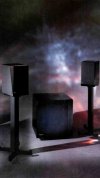
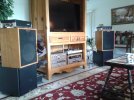
Show me floor standers that reach to 18hz -3db that take up less space or even similar space to this?
Screenshot_20210417-014213.jpg

And don't completely dominate the room due to their physical size.

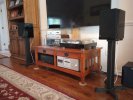
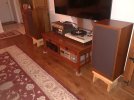
As for your other comments about integration, ya that's really not the case, I've been utilizing subs with large and small speakers for decades, it's really the best way to have your cake and eat it too. With this setup the subs were connected in stereo, in this configuration they worked as a whole. This allowed moving the speakers out into the room for improved imaging, lifted the tweeters to ear level, and preserved the Klipsch sound only now with 25hz capability.

20161125_093526.jpg

Especially with great small speakers that are imaging champs, you have to lay down some serious green to get large speakers that can compete here.

The AR's are outstanding speakers but the Modulus are just better, and paired with the Velodyne mini subs just on another level. Would love to sit you down here in either room so you could see its quite possible to completely integrate the two seamlessly with huge benefits.

And it's easy to see this has definitely opened up the space around the system when comparing this before picture to the after I posted earlier.

20210606_224545.jpg
 
Last edited:
Back
Top Bottom