I think most here would agree that the old FTC standards were a lot better than what passes for standards nowadays. I cringe every time I see an ad for a "1000-Watt" "five-pound" receiver, or "1000 Watt" speakers.
I bought one of the original IBM PC's Amber monitor and all when they first came out. I'm still a fan of the old clicky IBM keyboards. Currently I have a couple of Corsair keyboards with Blue switches.
Without question. The vast, vast majority of amp specs are very, very ambiguous, so you literally do not know what you are getting in terms or performance. The Outlaw receiver is an exception that has much better than typical specs for a modern amp (though still less than 1974 testing standards):
Outlaw RR-2160MKII: https://outlawaudio.com/shop/stereo-receivers/56-rr2160mkii-stereo-receiver.html:
Outlaw's specs: 110 watts per channel, 20 Hz - 20kHz, 0.05% THD, both channels driven into 8 ohms 165 watts per channel, 20 Hz - 20kHz, 0.05% THD, both channels driven into 4 ohms
My Comments: This is much better than typical modern, quotes power with full frequency range and distortion -- their spec doesn't say "continuous", but S&V bench tests backs these stats up as continuous
Most of the others are totally ambiguous, and have red flags if you read specs carefully:
NAD C 3050 ($1400) https://nadelectronics.com/product/c-3050-stereophonic-amplifier/
NAD's Specs: Full Disclosure Power: 100 watts continuous per channel into 8/4 ohms
My Comments: Doesn't say at what distortion or frequency range for power rating. In fact, neither frequency response nor distortion is listed anywhere in the stats. It's also very telling about power supply current capability that 4ohm power output is same as 8 ohm
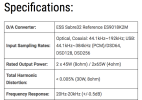
Leak 130: ($1000, $1200 with wood) https://www.leak-hifi.co.uk/stereo130/
Leak's stats:
| Rated Output Power | 2 x 45W (8ohm)/2x65W (4ohm) |
| Total Harmonic Distortion | < 0.005% (30W, 8ohm) |
| Frequency Response | 20Hz-20kHz (+/-0.5dB) |
There was a thread a not long ago that got closed down asking whether vintage watts are greater than modern watts. The answer to that question is "yes", vintage watts are greater the vast majority of the time. That doesn't mean there aren't good modern amps, but it is necessary to evaluate each modern amp very closely. Because modern specs are all over the map and loose, for the vast majority of modern products, a "100 watt" or whatever watt rating to day is less (and often far less) than a 100 or whatever rating from the vintage (post 1974 FTC law) era where equipment was tested to a much higher standard than almost anyone uses today.
Last edited:


 )
)


 Yamaha stated with no power levels specified). I don't need 100 watts, I need only 10 good watts per channel (e.g. sound quality up to 10 watts). I had that receiver for 15 minutes and it sounded like crap at 0 to 10 watts. I was even using it with a sub, but could not dial in decent bass performance because speaker-level output (it doesn't have a sub output) from the amp is limited in low frequency output. People in another thread have said, it's $200 receiver, what do you expect? Well, I should be able to expect 100 wpc because that is how it is broadly represented everywhere it is sold. That said, my bar was a way, way lower -- I couldn't have cared less about 100wpc, I only wanted 10 watts (at most) that didn't sound awful, and it did not deliver. It sounded awful, then it failed after 15 minutes at moderate volume.