Mister Pig
Pigamus Maximus
That's what? A strawman argument?
No you worry about you and what you can control.


That's what? A strawman argument?

If you're in control of it, why worry? And your argument was indeed made of straw.No you worry about you and what you can control.


well, you quoted me and used some bs argument against the opinion I postedNo you worry about you and what you can control.
Yes, but it takes commitment on the part of the owner and the repair person to keep a piece of vintage gear running properly.Restore the vintage piece properly and it won't need any more work anytime soon. (At least your lifetime.) It will outlast any newer, "more dependable", units.
For $1K, the Odyssey Khartago might be all the amp you need. True German high-end design, the first ten watts are in Class A bias, quality parts, a 20 year warranty, and a unique buying experience. You can't order an amp without talking to Klaus on the phone. It MIGHT be possible, technically, but I've never heard of it.....

I've never understood the usefulness of stating prices of old gear in today's dollars.Since I did the today's dollars on the Kenwood I thought people would extrapolate the 5000 on the Sansui which originally sold for 900 that the 5000 was in today's dollars.
It's something economists like to do since it represents the impact of inflation on the cost of goods and services. One known shortcoming though is that it doesn't account for the incorporation of new technologies into products such as powered wheeled vehicles, stereos and aircraft. In addition, with items e.g. phones, computers and TVs the incorporation of new technologies has actually greatly improved performance, etc. while at the same time reducing the price in real terms and when inflation adjusted. Trying to understand this fully is enough to make one's head spin.I've never understood the usefulness of stating prices of old gear in today's dollars.


And I've never understood the usefulness of comparing anything that's 50-years-old to new. We all carry different measuring sticks for different things.I've never understood the usefulness of stating prices of old gear in today's dollars.
It seem reasonable to me that comparing the performance of an older piece of gear to a newer one is just as useful as comparing new to new or old to old. It always comes down to which one sounds better (at least for me). There are certainly some older components that sound better (more preferable) than some newer components, and vice versa. For example, I have recently been comparing a Lexicon (Bryston) amp to my rebuilt Sansui AU919. I will be selling the Lexicon.And I've never understood the usefulness of comparing anything that's 50-years-old to new. We all carry different measuring sticks for different things.
You're right. Anyone who's just getting into audio probably should eventually explore both. I just have a hard time recommending vintage audio components right away to those people because of the potential issues and the time required to correct those issues. Plus, unless they know someone who has some, it's harder to find good vintage samples that you can actually see, touch and hear before buying. Those things can quickly become discouraging to a lot of newbies, and many just give up and resort back to their earbuds. I think it's better to take the easier route with new entry level components to get their feet wet with. Once they're ready to dive into the deep end, they can explore vintage stuff and/or new higher-level stuff. No matter which route they decide to take, they'll still have a system to use while they research. It's just my opinion on the best way to enter the audio hobby. In this case, the OP already has experience with some old stuff and now wants to explore new things. No reason to discourage him from doing that.It seem reasonable to me that comparing the performance of an older piece of gear to a newer one is just as useful as comparing new to new or old to old. It always comes down to which one sounds better (at least for me). There are certainly some older components that sound better (more preferable) than some newer components, and vice versa.

Agreed, and this is why I recommended new for noobs. Plus it's easy now to get better than good SQ for short $. Dollar for dollar you get "more" for less then when I was coming up in the 70's.You're right. Anyone who's just getting into audio probably should eventually explore both. I just have a hard time recommending vintage audio components right away to those people because of the potential issues and the time required to correct those issues. Plus, unless they know someone who has some, it's harder to find good vintage samples that you can actually see, touch and hear before buying. Those things can quickly become discouraging to a lot of newbies, and many just give up and resort back to their earbuds. I think it's better to take the easier route with new entry level components to get their feet wet with. Once they're ready to dive into the deep end, they can explore vintage stuff and/or new higher-level stuff. No matter which route they decide to take, they'll still have a system to use while they research. It's just my opinion on the best way to enter the audio hobby.


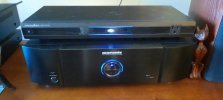

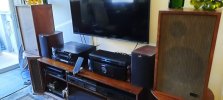


Trying to answer OP's original question: There are plenty of makers of mid-market stereo (2-channel) gear left, and prices and features are all over the place. Without more information, it's impossible to answer the original question.
Things I'd want to understand:
Current stereo receivers on the market include Sony, Yamaha, Outlaw, Cambridge Audio, Onkyo, Pioneer, Denon, Marantz, Rockville (cheap) and McIntosh (really not cheap).
- What is the approximate budget?
- Is a receiver (with tuner) needed? If not listening to broadcast radio, is an integrated amplifier suitable, or can separates be considered?
- OP wanted to get something with the same sound quality, but what are some adjectives that can help guide us who are trying to respond?
- Are there any styling or brand requirements? Everything these days has electronic displays, but what knobs and buttons are important?
- Are any post-1970s features important? Bluetooth or other network music reception? Turntable input? Subwoofer output?
I think that there are really too many choices and not enough information to try to recommend anything.

Never thought there would be almost 100 replies...Thanks all!Trying to answer OP's original question: There are plenty of makers of mid-market stereo (2-channel) gear left, and prices and features are all over the place. Without more information, it's impossible to answer the original question.
Things I'd want to understand:
Current stereo receivers on the market include Sony, Yamaha, Outlaw, Cambridge Audio, Onkyo, Pioneer, Denon, Marantz, Rockville (cheap) and McIntosh (really not cheap).
- What is the approximate budget?
- Is a receiver (with tuner) needed? If not listening to broadcast radio, is an integrated amplifier suitable, or can separates be considered?
- OP wanted to get something with the same sound quality, but what are some adjectives that can help guide us who are trying to respond?
- Are there any styling or brand requirements? Everything these days has electronic displays, but what knobs and buttons are important?
- Are any post-1970s features important? Bluetooth or other network music reception? Turntable input? Subwoofer output?
I think that there are really too many choices and not enough information to try to recommend anything.

That describes my B&K ex4420 Mosfet amp. Although, I'd use the terms smooth and full in place of warm and fat.--Warm, fat, transparent, crisp...
