

You are using an out of date browser. It may not display this or other websites correctly.
You should upgrade or use an alternative browser.
You should upgrade or use an alternative browser.
Crossover question
- Thread starter highend64
- Start date
Register to hide this ad

It's not that it's L-R- but that it's second order.
Second order crossovers shift the phase 90 degrees in one direction on the low pass, and 90 degrees in the other direction on the high pass, at crossover. That makes the output a total of 180 degrees out of phase at crossover. To avoid cancellation, a phase reversal of one or the other driver is required.
The L-R crossover- due to it already having a 6dB attenuation at the crossover point on each driver- is especially noticeable as being "wrong" if the polarity is incorrect at crossover. Cancellation will result in a DEEP hole in the response, at the crossover point- even more than with a Butterworth or other crossover types with less damping at resonance.
HOWEVER- that ASSUMES TEXTBOOK FLAT RESPONSE from BOTH drivers, through the crossover point. If either driver is rolling off on its own- it's OWN phase shift will ADD to that of the crossover. For example- if the tweeter is also rolling off at 12dB/octave (a second order highpass rolloff, which is typical of all drivers below resonance), near the crossover point- then it adds to the second order of the crossover itself- making a total of FOURTH order highpass. That has a 180 degree phase shift at the crossover point! Combining that with a second order lowpass, will make the phase only 90 relative degrees out, low-to-high, no matter WHICH polarity you connect the drivers. Under those conditions- usually, you'd want both drivers in phase- just for better step response, usually- but which ever way sounds better, is better...
The same applies, to the woofer- if the woofer is rolling off on the upper end of its response near the crossover point- it can act as a first or second order lowpass in itself. That again changes the total slope/order of the lowpass- making it either act as a third or fourth order lowpass. That again changes the phase relationship with the tweeter- either another 45 or 90 degrees of phase shift, which has to be accounted for...
This is why, for one example, something like an EPI M150- despite only having ONE cap in the crossover (first order highpass on the tweeter, and NOTHING on the woofer)- actually acts like a second order lowpass (due to the woofer mechanical rolloff) and a third order highpass (due to the combination of the first order crossover plus second order tweeter mechanical rolloff)! This is why most of these early EPI speakers sound better, with the tweeter in reverse polarity...
Regards,
Gordon.
Second order crossovers shift the phase 90 degrees in one direction on the low pass, and 90 degrees in the other direction on the high pass, at crossover. That makes the output a total of 180 degrees out of phase at crossover. To avoid cancellation, a phase reversal of one or the other driver is required.
The L-R crossover- due to it already having a 6dB attenuation at the crossover point on each driver- is especially noticeable as being "wrong" if the polarity is incorrect at crossover. Cancellation will result in a DEEP hole in the response, at the crossover point- even more than with a Butterworth or other crossover types with less damping at resonance.
HOWEVER- that ASSUMES TEXTBOOK FLAT RESPONSE from BOTH drivers, through the crossover point. If either driver is rolling off on its own- it's OWN phase shift will ADD to that of the crossover. For example- if the tweeter is also rolling off at 12dB/octave (a second order highpass rolloff, which is typical of all drivers below resonance), near the crossover point- then it adds to the second order of the crossover itself- making a total of FOURTH order highpass. That has a 180 degree phase shift at the crossover point! Combining that with a second order lowpass, will make the phase only 90 relative degrees out, low-to-high, no matter WHICH polarity you connect the drivers. Under those conditions- usually, you'd want both drivers in phase- just for better step response, usually- but which ever way sounds better, is better...
The same applies, to the woofer- if the woofer is rolling off on the upper end of its response near the crossover point- it can act as a first or second order lowpass in itself. That again changes the total slope/order of the lowpass- making it either act as a third or fourth order lowpass. That again changes the phase relationship with the tweeter- either another 45 or 90 degrees of phase shift, which has to be accounted for...
This is why, for one example, something like an EPI M150- despite only having ONE cap in the crossover (first order highpass on the tweeter, and NOTHING on the woofer)- actually acts like a second order lowpass (due to the woofer mechanical rolloff) and a third order highpass (due to the combination of the first order crossover plus second order tweeter mechanical rolloff)! This is why most of these early EPI speakers sound better, with the tweeter in reverse polarity...
Regards,
Gordon.
Last edited:

It's not that it's L-R- but that it's second order.
Second order crossovers shift the phase 90 degrees in one direction on the low pass, and 90 degrees in the other direction on the high pass, at crossover. That makes the output a total of 180 degrees out of phase at crossover. To avoid cancellation, a phase reversal of one or the other driver is required.
The L-R crossover- due to it already having a 6dB attenuation at the crossover point on each driver- is especially noticeable as being "wrong" if the polarity is incorrect at crossover. Cancellation will result in a DEEP hole in the response, at the crossover point- even more than with a Butterworth or other crossover types with less damping at resonance.
HOWEVER- that ASSUMES TEXTBOOK FLAT RESPONSE from BOTH drivers, through the crossover point. If either driver is rolling off on its own- it's OWN phase shift will ADD to that of the crossover. For example- if the tweeter is also rolling off at 12dB/octave (a second order highpass rolloff, which is typical of all drivers below resonance), near the crossover point- then it adds to the second order of the crossover itself- making a total of FOURTH order highpass. That has a 180 degree phase shift at the crossover point! Combining that with a second order lowpass, will make the phase only 90 relative degrees out, low-to-high, no matter WHICH polarity you connect the drivers. Under those conditions- usually, you'd want both drivers in phase- just for better step response, usually- but which ever way sounds better, is better...
The same applies, to the woofer- if the woofer is rolling off on the upper end of its response near the crossover point- it can act as a first or second order lowpass in itself. That again changes the total slope/order of the lowpass- making it either act as a third or fourth order lowpass. That again changes the phase relationship with the tweeter- either another 45 or 90 degrees of phase shift, which has to be accounted for...
This is why, for one example, something like an EPI M150- despite only having ONE cap in the crossover (first order highpass on the tweeter, and NOTHING on the woofer)- actually acts like a second order lowpass (due to the woofer mechanical rolloff) and a third order highpass (due to the combination of the first order crossover plus second order tweeter mechanical rolloff)! This is why most of these early EPI speakers sound better, with the tweeter in reverse polarity...
]
Regards,
Gordon.
Thanks that what I thought. So the rolloff at the crossover point for the tweeter if it was a natural rolloff say 12db/octave, tha would add a 24db rolloff making it a complete 360 or back to 0 degrees pre say.
It would only be a total of 360 degrees (fourth order on both the lowpass and highpass), if the woofer was ALSO rolling off at the crossover point. Second order tweeter rolloff (highpass) plus second order crossover highpass, equals total of fourth order highpass. Second order woofer rolloff (lowpass) plus second order crossover lowpass, also equals fourth order lowpass.
However-if the woofer is NOT rolling off there- the lowpass MAY only act as second order. Then, you'd have fourth order total highpass, with second order total lowpass. 180 degree phase shift on the highpass, plus 90 degrees with the lowpass- equals a net 90 degrees relative phase, regardless of polarity...
Regards,
Gordon.
However-if the woofer is NOT rolling off there- the lowpass MAY only act as second order. Then, you'd have fourth order total highpass, with second order total lowpass. 180 degree phase shift on the highpass, plus 90 degrees with the lowpass- equals a net 90 degrees relative phase, regardless of polarity...
Regards,
Gordon.
bowtie427ss
Lunatic Member
... and also assumes that network component values were scaled to actual measured impedance of the drivers @ the intended knee point.HOWEVER- that ASSUMES TEXTBOOK FLAT RESPONSE from BOTH drivers, through the crossover point.
Too many times we see builders shoot from the hip with a calculator, and just plug in a nice even 8 ohms for the impedance value of the drivers.
Thanks for the responses. I had one more question. I also incorporate a zobel network for the woofers impedance curve. Should this affect the slope at the crossover point? Thanks
Effectively- somewhat.
The ultimate slope (way above the crossover point) will always converge on the slope of the order of the crossover- but, near crossover- variations in impedance- especially impedance that rises with frequency- can reduce the attenuation that the crossover exerts, at the crossover point. This can make the crossover "act like" a shallower slope, for enough of a frequency range above the low pass crossover point, to make it "act" like a shallower slope, for all practical purposes.
If you DO use a Zobel, it would have to be factored in, to the impedance value presented to the crossover calculations. The Zobel will sometimes make the woofer act like a slightly lower overall impedance, than its broadband impedance over the majority of its passband. The crossover needs to be calculated, from the composite impedance of the woofer WITH the Zobel in parallel.
Regards,
Gordon.

Thanks for the responses. I had one more question. I also incorporate a zobel network for the woofers impedance curve. Should this affect the slope at the crossover point? Thanks
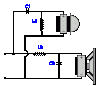
What model speaker and can you provide a link to the crossover schematic?
If the woofer inductor was sized large in order to provide BSC then you often
do not want to use a Zobel. Depends on the design.
Do you have any measurement gear?

elnaldo
Lunatic Member
All your doubts about phase, drivers cancelling freqs, zobel having a negative or positive effects , will disappear if you do a simple measurement with a microphone.
If you plan to DIY your speakers, even tweak the one you already built, I'd suggest to buy or build a DIY measurement mic, and start doing some measurements. To me,it's worth every $$, the final result will be much better, you'll match exactly the SPL of the drivers, you'll see the crossover points, the effect of adding a zobel or not, the effect of adding 1uF to the crossover network, the effect of phase reversing one driver, and much more.
If you plan to DIY your speakers, even tweak the one you already built, I'd suggest to buy or build a DIY measurement mic, and start doing some measurements. To me,it's worth every $$, the final result will be much better, you'll match exactly the SPL of the drivers, you'll see the crossover points, the effect of adding a zobel or not, the effect of adding 1uF to the crossover network, the effect of phase reversing one driver, and much more.
Didn't the Indignia use that woofer?
https://audiokarma.org/forums/index...class-economy-speakers-a-k-a-indignia.160535/
https://audiokarma.org/forums/index...class-economy-speakers-a-k-a-indignia.160535/
Thanks I have a calibrating mic handy but I dont have a software program.All your doubts about phase, drivers cancelling freqs, zobel having a negative or positive effects , will disappear if you do a simple measurement with a microphone.
If you plan to DIY your speakers, even tweak the one you already built, I'd suggest to buy or build a DIY measurement mic, and start doing some measurements. To me,it's worth every $$, the final result will be much better, you'll match exactly the SPL of the drivers, you'll see the crossover points, the effect of adding a zobel or not, the effect of adding 1uF to the crossover network, the effect of phase reversing one driver, and much more.

The woofer speaker is a Dayton Audio DC-160-8
Dayton's measurements:
https://www.daytonaudio.com/images/resources/data-files/DC160-8_data.zip

If I read the graph right, that puts this driver in the area of 20 ohms at 1800Hz. As previous posts note, there are a lot of factors involved in designing a crossover well beyond the nominal ohm rating. Sometimes this information is readily available, often not. Joining AK has made me aware of this, but how much I've actually learned yet is questionable.

whoaru99
Epic Member
Thanks I have a calibrating mic handy but I dont have a software program.
Room EQ Wizard might work for ya.
elnaldo
Lunatic Member
I use Arta software to do this kind of measurements. It works in Demo mode if you don't have a license. There are some tutorials on the Web. A very useful tool.
I'd setup Arta, place your speakers and mic, and check what you have now.
You could start a new thread to measure or tweak your DIY speakers. I had only good and very good results tweaking crossovers with measurements.
I'd setup Arta, place your speakers and mic, and check what you have now.
You could start a new thread to measure or tweak your DIY speakers. I had only good and very good results tweaking crossovers with measurements.
Thanks I would look into that.Room EQ Wizard might work for ya.
What more can I do to tweak the crossover?I use Arta software to do this kind of measurements. It works in Demo mode if you don't have a license. There are some tutorials on the Web. A very useful tool.
I'd setup Arta, place your speakers and mic, and check what you have now.
You could start a new thread to measure or tweak your DIY speakers. I had only good and very good results tweaking crossovers with measurements.
The measurements will dictate the next steps. Mounting the crossover externally to allow for easier changes in components while "tweaking" is an option.Thanks I would look into that.
What more can I do to tweak the crossover?