You are using an out of date browser. It may not display this or other websites correctly.
You should upgrade or use an alternative browser.
You should upgrade or use an alternative browser.
Dahlquist DQ-10 Rebuild issues and tech questions
- Thread starter hlc
- Start date
-
- Tags
- dahlquist dahlquist dq 10
I got the monolith uprights. I've seen pictures of the 3 leg design which I really like. I might try to make myself a set since I've got the tools and skills.
I've been looking for a pair of DQ-10's for awhile now, loved the look and design. If they're as good as I've read, I plan to make them a permanent part of my rotation.
Should I replace all the resistor too? How far should I go with replacing components?
I've been looking for a pair of DQ-10's for awhile now, loved the look and design. If they're as good as I've read, I plan to make them a permanent part of my rotation.
Should I replace all the resistor too? How far should I go with replacing components?

Be sure to replace those sandcast resistors too, they don't age well and have bad tolerances.

Blue Shadow
Waiting for Vintage Gear from this century
Just the caps. Some like to go with the Mills resistors or something but I don't know if it is necessary. Check what you have for resistance.
I had a set of the 3-post stands made about a third larger in all dimensions and they are great. Puts the speakers at the right level.
I had a set of the 3-post stands made about a third larger in all dimensions and they are great. Puts the speakers at the right level.
Last edited:
I've done some searching already on replacement resistors. I haven't been able to track down exactly what the originals state. Can I use a 5.1 ohm, 1%, 10W and a 5.6 ohm, 1% 10W in place of a 5 ohm, 10% 5W and 5.5 ohm, 10% 5W resistor? For any others, how close do I need to get if I can't find exact matches? It also applies to capacitors. In the past, I've tried to keep it as close as I can. If an 80uF is needed but can't be found, I've used an 82uF instead. Is that close enough?
Great idea making the stands bigger!
Great idea making the stands bigger!
I'm sorry for cross posting this, but I don't know how else to do it.
I've done some searching already on replacement resistors. I haven't been able to track down exactly what the originals state. Can I use a 5.1 ohm, 1%, 10W and a 5.6 ohm, 1% 10W in place of a 5 ohm, 10% 5W and 5.5 ohm, 10% 5W resistor? For any others, how close do I need to get if I can't find exact matches? It also applies to capacitors. In the past, I've tried to keep it as close as I can. If an 80uF is needed but can't be found, I've used an 82uF instead. Is that close enough?
I've done some searching already on replacement resistors. I haven't been able to track down exactly what the originals state. Can I use a 5.1 ohm, 1%, 10W and a 5.6 ohm, 1% 10W in place of a 5 ohm, 10% 5W and 5.5 ohm, 10% 5W resistor? For any others, how close do I need to get if I can't find exact matches? It also applies to capacitors. In the past, I've tried to keep it as close as I can. If an 80uF is needed but can't be found, I've used an 82uF instead. Is that close enough?
Blue Shadow
Waiting for Vintage Gear from this century
Let's leave that discussion to the other thread. This thread about yanking the drivers out has been solved. We can just move on from this one unless we need to talk about the drivers glued in or whatever. Doing double duty on the crossover rebuild isn't gonna get more answers. It was spread the answers out across two threads and folks will miss what others are saying.
Just let this thread sit and don't ask any crossover questions in it as you have a most excellent thread for that already. If you can still edit your response above do that with a question about stands or just put a few ...s there.
Update: Of course, they can merge the threads and you can talk all you want about any DQ-10 subject and we can get your set sorted and sounding great.
Just let this thread sit and don't ask any crossover questions in it as you have a most excellent thread for that already. If you can still edit your response above do that with a question about stands or just put a few ...s there.
Update: Of course, they can merge the threads and you can talk all you want about any DQ-10 subject and we can get your set sorted and sounding great.
Last edited:

I merged both of your DQ-10s into a single rebuild thread. So others in the future can gain advantage of the common issues ...
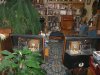
(Looks like my DQ-10 rebuild thread got eaten in a server burp ...)
I had a pair with the matched passive sub, circa June 2011 -
Mine were not mirrored, but I redid the one and made them mirrored.
(Looks like my DQ-10 rebuild thread got eaten in a server burp ...)
I had a pair with the matched passive sub, circa June 2011 -
Mine were not mirrored, but I redid the one and made them mirrored.
Last edited:
Blue Shadow
Waiting for Vintage Gear from this century
Would you mind sharing a pic of those stands?
Finally some stands for my DQ-10s | Audiokarma Home Audio Stereo Discussion Forums
Very nice stands!
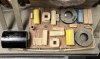
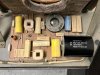
I have a problem. I neglected to read the dimensions for the 80uF Solen 400 Volt Metalized Polypropylene I ordered. They came today and are gigantic, 2" diameter 2-9/16" long. I should have known they weren't going to be small. See pic. I don't know how I'm going to make that fit. Anyone have a lead on a smaller 80uF polypropylene capacitor? Should I rewire everything onto a new board?
Here is the list of parts I've already ordered
2-80uF capacitors
2-6uF capacitors
2-3ohm 5W resistors
2-30ohm 5W resistors
2-5ohm 5W resistors
2-5.5ohm 12W resistors
2-35ohm 12W resistors
I can purchase the remaining resistors to then have all new. I can reuse all inductors and remaining capacitors. Thoughts?
I have a problem. I neglected to read the dimensions for the 80uF Solen 400 Volt Metalized Polypropylene I ordered. They came today and are gigantic, 2" diameter 2-9/16" long. I should have known they weren't going to be small. See pic. I don't know how I'm going to make that fit. Anyone have a lead on a smaller 80uF polypropylene capacitor? Should I rewire everything onto a new board?
Here is the list of parts I've already ordered
2-80uF capacitors
2-6uF capacitors
2-3ohm 5W resistors
2-30ohm 5W resistors
2-5ohm 5W resistors
2-5.5ohm 12W resistors
2-35ohm 12W resistors
I can purchase the remaining resistors to then have all new. I can reuse all inductors and remaining capacitors. Thoughts?
Attachments
Blue Shadow
Waiting for Vintage Gear from this century
A poly cap is going to be big. Just mount it off board and run wire to it. Some have strapped them to the legs, I just mounted a pair to a cut open can on the far end of the speaker with a jumper wire. Formed the can into a cradle and screwed it to the speaker. Wire tie and the cap is securely mounted to the speaker.
Last edited:
Blue Shadow
Waiting for Vintage Gear from this century
If you are going to drive your speakers full-range and very loud with 200+ wpc, those two resistors next to the 80µF cap can get very hot after a long session. I have had them smelling toasty a couple times but this is on an older crossover which was wax coated at the factory. Leaving that space in the crossover is going to be good.
When I use the sub those two resistors don't get hot. The specs on the resistor says they can get very hot without problems so I don't worry about it but as I upgrade my speakers, mounting them above the board might happen. Right now I'm using 50 watts of tube power and the sub so no problem with heating the resistors or with volume.
When I use the sub those two resistors don't get hot. The specs on the resistor says they can get very hot without problems so I don't worry about it but as I upgrade my speakers, mounting them above the board might happen. Right now I'm using 50 watts of tube power and the sub so no problem with heating the resistors or with volume.
My plan is to thoroughly clean each speaker (man, there's a lot of dust!) and have them be part of my office rotation which is driven by an ML23.5. Being in the office, I probably won't drive them super loud. Wife tends not to like volume 11.
I'm hoping to start the soldering process this week. Do you think I need to replace the 4ohm, 15watt resistors that are next to the the 80uF capacitor?
Speaking about the dust. I tried blowing the crossovers off. That didn't get all the dust. Is there a product I can use to wipe them down?
I'm hoping to start the soldering process this week. Do you think I need to replace the 4ohm, 15watt resistors that are next to the the 80uF capacitor?
Speaking about the dust. I tried blowing the crossovers off. That didn't get all the dust. Is there a product I can use to wipe them down?
Blue Shadow
Waiting for Vintage Gear from this century
man, there's a lot of dust!
They look clean to me. This is dusty:
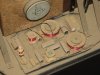
You don't need to do anything with the resistors if you do not intend to play the speaker full range with high power (at least 150 wpc) for a long time, 45 minutes or more I think. Using a sub and not having the 10s do the bottom couple octaves will eliminate any need to address those two resistors.
That system was filthy but cleaned up nicely:
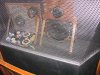
The amps one post cleaning, full disassembly similar to the speakers with all drivers removed from the boards and the boards and legs removed, too.
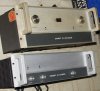
Go all out if you can. They're worth it.You win, those were dusty! Did you use a cleaning agent?
I don't have a sub, so I might replace those resistors to be safe.
Blue Shadow
Waiting for Vintage Gear from this century
No reason to replace them. If you want them to be protected from heat of blasting rock and roll with a big amp for hours, just mount them above the board and if really serious, attach a heatsink to them. The temp the resistors can handle is close to 500°F which will be enough to smolder the hardboard and the resistor will be fine. I shot mine with an IR Temp gun and got something in the upper 200s and then looked up the temp capabilities of the resistor and just stopped worrying about it. So no need to replace them.
You could use some large, stiff conductor leads to lift them off the board and then use JBWeld (not electrically conductive and heat resistant and thermally conductive) to glue a heat sink to the top or sides of the resistors to take heat away from them. I'm thinking about this as I have JBWeld and some scrap heat sink material from computers or something. It is not a top of my list project and I will beat the snot out of the DQ-10s if I want, when I want without the sub and just know that the smell is the crossovers getting hot.
I have seen pics of the smaller resistor near those two having burn marks under and around it.
You could use some large, stiff conductor leads to lift them off the board and then use JBWeld (not electrically conductive and heat resistant and thermally conductive) to glue a heat sink to the top or sides of the resistors to take heat away from them. I'm thinking about this as I have JBWeld and some scrap heat sink material from computers or something. It is not a top of my list project and I will beat the snot out of the DQ-10s if I want, when I want without the sub and just know that the smell is the crossovers getting hot.
I have seen pics of the smaller resistor near those two having burn marks under and around it.
Blue Shadow
Waiting for Vintage Gear from this century
Most of this is dust so I swept them cleaner and then wiped em with a damp microfiber cloth. Water or isopropyl alcohol don't recall maybe both. Screens got a new coat of paint and they are recapped as these early models had all 'lytics except the ones for the tweeters.Did you use a cleaning agent?