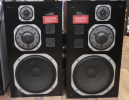
So, the guy gets a speaker that perhaps has capacitors that have drifted a lot, and that perhaps needs service, making sure the surrounds are OK and that the cone has not been stored in a humid location, etc. and proceeds to measure it as it is, as if it was a sample of a healthy NS-1000M.
Then he goes on a lot about the measurements. Of course he needs to show them so the customer sees that objectively his/her speaker was improved. But I wonder if he actually listens to speakers.
The Yamaha NS-690 and -690II are almost universially liked speakers. I've owned the 690II and the little brother 670. The NS-1000M is like a -690 where the silk domes were replaced by beryllium domes and the midrange was beefed up in magnetic flux density. It can't really sound bad...
But even looking at his mearurements, he never ever shows at impulse response or step response. Hint, hint! The magic of that speaker is in the impulse domain, not in the amplitude domain. He doesn't do any distortion measurements either. On the Martin Colloms book, which is well known, the Yamaha midrange Be driver is mentioned to be the midrange driver with the least distortion measured yet (at the time of publication).
Still, compliments for restoring and improving the speaker. Although Troels Gravesen already addressed many of the problems with the original crossover with an improved crossover design, and got a ruler flat freq response, if anybody feels the need for that.
Genelec already, years, decades ago, used the NS-1000 and modified into a fully active Genelec speaker.
I would run it fully active, as well, if it was mine.