• The move to the new server is done. There are some software and database maintenance updates in process. This has us passing the hat around to help out. We appreciate any donations. Seriously, even a dollar helps. The payment page may be found here - https://www.audiokarma.org/support.html

Depth Poll - Where is your image located?

Where is your stereo image usually located?

  • Between the speakers, without much depth

    Votes: 8 10.1%
  • Between the speakers, and extending in front of them

    Votes: 9 11.4%
  • Between the speakers, and extending behind them

    Votes: 22 27.8%
  • Both in front of and behind the speakers

    Votes: 40 50.6%

  • Total voters
    79
... Jon Dahlquist said that there are only two kinds of speakers, "they are here" speakers, with his example being Klipschorns, and "you are there" speakers, like his, and Quads. I am wondering if an image behind the speakers is a characteristic of a "you are there" speaker....

That's an interesting observation. I chose "between and behind" but wonder now if I'm faithfully describing what I hear, or mostly what I prefer. I'll have to attend to it during some listening now.
 
OTOH, I'm certainly open to the idea that optimizing for a certain kind of information, accidentally or on purpose, could be considered a coloration.

Klipschorns seem optimized for Pink Floyd's 'Time'. ;)
 
When I first got my Vandersteen 2Ce Signature ii’s I was not impressed , that was before I read about the importance of properly setting them up based on your room . Well I started messing with setting them up as per Vandersteen’s instructions and I started getting much better sound but something as still missing . Many times I almost gave up and went with another set of speakers but in the back of my mind something kept telling me that these speakers have something and are different.

So I kept at it , adding many different Amps , receivers , pre amos, front ends cables etc you name it and it was all changed to work around the Vandys. What we have today is a system that is exactly what I like for a sound of a good system . What made the vandys come to life was allot more power , clean power , Tube pre and SS amp an integrated to be exact , a tube Dac and very good cables to bring the noise floor down to pretty much non existent to average human ears .


What I get from all this work is a sound stage that is large and real in its presence, pinpoint imaging etc . Most of the time the music is behind the speakers with singers voices always behind the speakers and dead center with great height , much higher than the speakers if I had to guess I would say 6-7ft high . But like others have said it all depends on the recording, however you do need the rest of it to come together in order to get that great sound .


Audiofreak71
 
Depends upon the recording. Ideally defines a large space extending mostly from behind.

I'm definitely a fan of dipolar line sources.
 
I own some dipole speakers. I consider the artificial sense of space they create to be a strong coloration and trying to configure them in such a way that the imaging doesn't get vague and confused is a pain in the ass. It's the single biggest reason I went with conventional dynamic speakers when I bought new ones. I still like the old ones. They sound nice in the bedroom, but I rarely sit and really listen to them anymore.
 
ESS AMT1's. I used to stuff the back of the AMT with wash rags if I wanted to get good imaging out of them. If I was going to get serious about big dipoles, I'd order about a pallet of OC 703 and build walls out of the stuff 3 or 4 inches thick to put behind the speakers.
 
Thanks. I confess it's been forty some years since I've heard a pair. Note the woofer operates as a monopole for the lower five octaves.

Full range dipoles do require breathing room to front wall for most linear bass and optimum sound staging. I find the rule of thirds works as a good starting point. I prefer the use of diffraction as opposed to absorption.
 
Thanks. I confess it's been forty some years since I've heard a pair. Note the woofer operates as a monopole for the lower five octaves.

Full range dipoles do require breathing room to front wall for most linear bass and optimum sound staging. I find the rule of thirds works as a good starting point. I prefer the use of diffraction as opposed to absorption.

They're first gens. Not A's, B's, C's, or D's. 10" vented driver that crosses at 700Hz. The woofer ain't the problem. It's very predictable.
 
As a coherency freak, I am not a fan of hybrids. Having the lower part of a piano keyboard radiated one way while the upper octaves are another sounds distracting to me.

I also found the Heil driver overly BRIGHT!
 
Last edited:
I can't help but chuckle when I read this conclusion by Linkwitz:

"It's difficult to screw up an open baffle speaker design to where it sounds worse than your typical box speaker"
 
I can't help but chuckle when I read this conclusion by Linkwitz:

"It's difficult to screw up an open baffle speaker design to where it sounds worse than your typical box speaker"

He also did a Burning Amp lecture about how ANY baffle was problematic and demonstrates a baffle-less design..

Theory and application are often quite different things. Electrostats, big ribbons, and dipoles in general have the handicap of massive amounts of out of phase energy being pumped into the room which is going to NEED to be rigorously managed.

Personally, I'm not sold on massive radiating surfaces or dipole speakers. They have weird sonic characteristics that sound artificial to novice listeners. I'm not at all surprised such speakers are a minor niche in the market.
 
I've done some experimentation with baffle-less speakers and like what I hear. I try not to be dismissive of any design until hearing them. Open baffles may fall under the broader category of dipoles but they don't sound or behave like panels which are the most common dipoles. To distinguish between the two It's best to use the term open baffle which implies cone speakers rather than membranes.

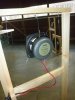
PC270011 2.jpg
 
Last edited:
A baffle-less speaker

ef7c64a436e24ab262acc11be0d9e0ec.jpg
 
They have weird sonic characteristics that sound artificial to novice listeners.
Who cares what novice listeners think? They're happy playing Taylor Swift on their phone using lossy MP3s. ;)

I'm not at all surprised such speakers are a minor niche in the market.
I clearly remember hearing Magnepan Tympani IIIs tri-amped by Audio Research electronics when I was 17. I had never before heard such realism of the image size and depth of a symphony orchestra playing The Planets. I've been a fan ever since. Magnepan has sold over 200,000 of the MMG model alone which has recently been replaced by the LRS. They have always offered a 60 day money back guarantee.

That dealer later carried Acoustat which I later purchased at 20. I worked part time there during college and remember the first customer. Dr. Cobbs was a cardiologist who loved classical music. He brought quite a few records to audition and loved the sound. He had a magnificent room in which to place his pair of the model X.
 
Last edited:
Who cares what novice listeners think? They're happy playing Taylor Swift on their phone using lossy MP3s. ;)


I clearly remember hearing Magnepan Tympani IIIs tri-amped by Audio Research electronics when I was 17. I had never before heard such realism of the image size and depth of a symphony orchestra playing The Planets. I've been a fan ever since. Magnepan has sold over 200,000 of the MMG model alone which has recently been replaced by the LRS. They have always offered a 60 day money back guarantee.

That dealer later carried Acoustat which I later purchased at 20. I worked part time there during college and remember the first customer. Dr. Cobbs was a cardiologist who loved classical music. He brought quite a few records to audition and loved the sound. He had a magnificent room in which to place his pair of the model X.

I like the "novice listener" opinion because I'm pretty sure plenty of audiophiles loose sight of the forest and zone out on a few trees that they convince themselves are the entire forest.

I think I first heard Maggie's when I was 16. They intrigued me, but they didn't strike me as real kind of like the GE One.R didn't strike me as real. "Hyper-real" is the word I'd choose. The last time I listened to a pair of ML's I brought a girl with me and she found them to sound very synthetic.
 
I'm pretty sure plenty of audiophiles loose sight of the forest and zone out on a few trees that they convince themselves are the entire forest.
???

As for me, I deeply enjoy listening to the sound of live, unamplified music. And systems that more closely replicate that experience.

When my wife, who is also a musician, first heard the Sound Labs playing one of her favorites - "Amanda" by Amanda McBroom she commented "They're not there". Which is how I like a system to (not) sound. ;)
 
Last edited:
Back
Top Bottom