• The move to the new server is done. There are some software and database maintenance updates in process. This has us passing the hat around to help out. We appreciate any donations. Seriously, even a dollar helps. The payment page may be found here - https://www.audiokarma.org/support.html

Depth Poll - Where is your image located?

Where is your stereo image usually located?

  • Between the speakers, without much depth

    Votes: 8 10.1%
  • Between the speakers, and extending in front of them

    Votes: 9 11.4%
  • Between the speakers, and extending behind them

    Votes: 22 27.8%
  • Both in front of and behind the speakers

    Votes: 40 50.6%

  • Total voters
    79
ESS AMT1's. I used to stuff the back of the AMT with wash rags if I wanted to get good imaging out of them. If I was going to get serious about big dipoles, I'd order about a pallet of OC 703 and build walls out of the stuff 3 or 4 inches thick to put behind the speakers.
I thought I was the only one. I've had a pair of AMT 1D's for, maybe 30 years, and in some rooms I've placed a big block of foam rubber behind each tweeter.
 
I thought I was the only one. I've had a pair of AMT 1D's for, maybe 30 years, and in some rooms I've placed a big block of foam rubber behind each tweeter.

That's not all I've done. I played with putting different sound reflective objects behind them too. Coffee mugs. Tiles propped up to send the sound upwards or to the side or sides. Up has worked best for me. I've read about people putting foam rubber blocks on either side of the AMT to get rid of some of their problems at the bottom of their pass band. I've never tried that.The speaker is so short that I loosened the bolts and shimmed them to aim up a bit and that really helped.
 
I never thought of reflecting the back sound waves sooner. When I had them in front of brick and glass the imaging was awful. the foam block behind the tweeters really improved it.
 
I never thought of reflecting the back sound waves sooner. When I had them in front of brick and glass the imaging was awful. the foam block behind the tweeters really improved it.

That's been my experience too. All that delayed energy makes for this foggy, amorphous cacophony riddled with sweeping combing effects. I love the speakers, but that jazz has to be dealt with. Pointing that energy somewhere within a few inches really cleans things up. If you try it, I'd like to know how it works for you.
 
That's been my experience too. All that delayed energy makes for this foggy, amorphous cacophony riddled with sweeping combing effects. I love the speakers, but that jazz has to be dealt with. Pointing that energy somewhere within a few inches really cleans things up. If you try it, I'd like to know how it works for you.
I will
 
Heils radiate to the front and rear so blocking their back wave is not a good idea. Just like all open baffle speakers they'll sound their best pulled out into the room away from walls.
 
That's not all I've done. I played with putting different sound reflective objects behind them too. Coffee mugs. Tiles propped up to send the sound upwards or to the side or sides. Up has worked best for me. I've read about people putting foam rubber blocks on either side of the AMT to get rid of some of their problems at the bottom of their pass band. I've never tried that.The speaker is so short that I loosened the bolts and shimmed them to aim up a bit and that really helped.

Dipole speakers have been the only speakers that I've used since 1976. IME a combination of absorption, diffusion and dispersion creates the deepest and widest soundstage.
 
It goes without saying (but I'll say it anyway) that the room and the speaker's positioning in the room have a huge influence on how they sound, especially with dipoles. When I was using foam behind my Heils they were in a large room, positioned on the long wall. Behind one was a sliding glass door and a brick wall behind the other.
Now they are in a small room with lots furniture, and a slanted attic ceiling. In this room they sound best with nothing behind the Heils. The foam blocks, and ceramic plates do improve the focus, but cause them to sound less natural, more like speakers, IN THIS ROOM.
 
I selected both in front and behind. Reality is that it's quite recording specific. There's some sound effects in a few recordings where I think the sound is coming from outside the house or in the hall. So does my dog at times and can set him off barking.
 
I selected in between because I don't know what to listen for :dunno: As long as it sounds great, then I'm good.
 
My image is exactly where it needs to be at any given time, due to the wonders of balance and volume controls ...

The system uses phantom rear, overhead, and center channels on separate amplifiers, so I ain't kidding. I can put most anything anywhere. Dialing it all in was a real PITA, but happy to say, the image is pretty consistent across several sources and genres.

Well ... with a little tweak here, and a little tweak there ... here a tweak ... there a tweak ... everywhere a tweak tweak anyway ... <G>
 
Heils radiate to the front and rear so blocking their back wave is not a good idea. Just like all open baffle speakers they'll sound their best pulled out into the room away from walls.

I've done side by side comparisons of my AMT1's with my Focal 936's. Unless the rear output of that thing is dealt with, they sound like a blurry, unfocused mess. You can't just drop them a foot or two from a wall and get good results. The troubles I had getting good definition out of those are the reason I didn't even look at dipoles when I bought new speakers.
 
I've done side by side comparisons of my AMT1's with my Focal 936's. Unless the rear output of that thing is dealt with, they sound like a blurry, unfocused mess. You can't just drop them a foot or two from a wall and get good results. The troubles I had getting good definition out of those are the reason I didn't even look at dipoles when I bought new speakers.

Heils are not that easy to integrate within one's system.
 
Heils are not that easy to integrate within one's system.

It's just the nature of dipoles. There's nothing particularly difficult about building a speaker around an AMT. Martin Logan, ELAC, Golden Ear, ADAM, Legacy, and others all do it quite well. I understand why people like that dipole sound. It sounds awesome and spacious, but it's really just a coloration. It's not the sound of the source material.
 
It's not the sound of the source material.
Perhaps you don't attend symphony concerts. The sound field generated by many acoustical instruments such as strings becomes dipolar beyond a certain threshold frequency and below a threshold for the grand piano.

Hint: that's why concert halls use acoustic shells behind and above the performers. As for me, I prefer a realistic presentation of the sound field. I agree, however, that hybrids lack coherency to these ears.
 
Last edited:
Perhaps you don't attend symphony concerts. The sound field generated by many acoustical instruments such as strings becomes dipolar beyond a certain threshold frequency and below a threshold for the grand piano.

Hint: that's why concert halls use acoustic shells behind and above the performers. As for me, I prefer a realistic presentation of the sound field. I agree, however, that hybrids lack coherency to these ears.

There's no necessity for the speaker to simulate that because A) microphones are typically cardioid, not dipolar, and B) all of that spacial information is recorded. The microphone doesn't strip it away assuming that through some voodoo the speakers will reproduce the missing information. If the information is there, and the speakers is NOT reproducing it, that would be coloration. If the information is there and the speaker is overtly accentuating it, that, too, would be coloration. In any event, there isn't any debate that the information is in the recording and doesn't depend on a type of speaker to replicate it.

I don't understand what you mean by a musical instrument becoming dipolar at some point. A cello is mostly a cardioid source because the size of it's radiating surfaces is much larger than the frequencies it produces, and below those frequencies it behaves more like an omnidirectional point source.
 
There's no necessity for the speaker to simulate that because A) microphones are typically cardioid, not dipolar, and B) all of that spacial information is recorded.
Not to these ears. To each his own.

I don't understand what you mean by a musical instrument becoming dipolar at some point. A cello is mostly a cardioid source because the size of it's radiating surfaces is much larger than the frequencies it produces, and below those frequencies it behaves more like an omnidirectional point source.
Follow the provided link for information.
 
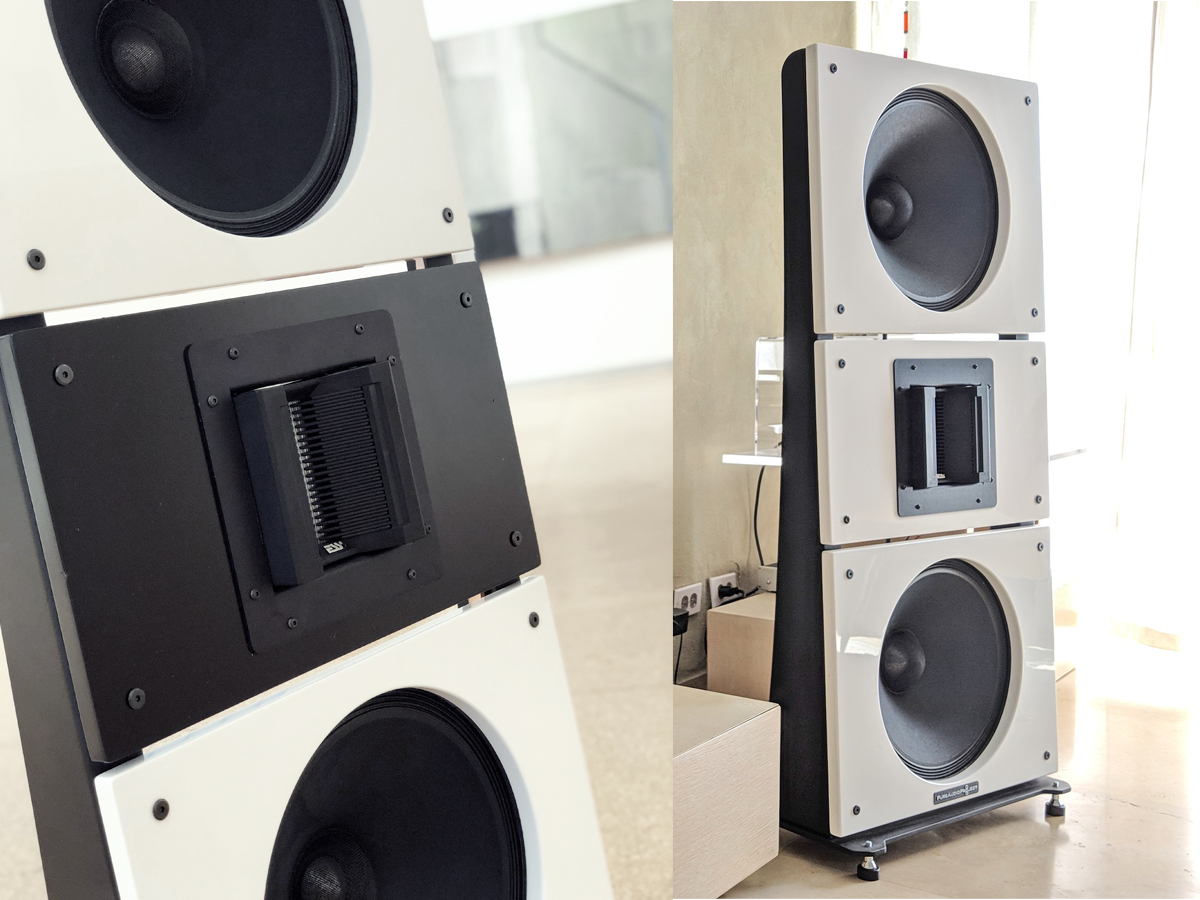
The PureAudioTrio 15 OB's are a great example of AMT's done right. If you attend a symphony you won't hear music coming from a box. You hear natural sounds from all over with some arriving slightly sooner and some lingering longer ( decay ). That's why the open baffle sound is so addictive as it's so much closer to what you experience "live". A box speaker is handicapped in producing a sense of depth which is one of the strengths of open baffles. I can enjoy my OB's standing behind them because of that incredible back wave which box speakers go to extremes to eliminate. It's fascinating that many folks are quick to offer an opinion on OB's even though they've never heard them.

20191003184834_PureAudioProject-Trio15HeilAMTFrontWeb.jpeg
 
Last edited:
Back
Top Bottom