• The move to the new server is done. There are some software and database maintenance updates in process. This has us passing the hat around to help out. We appreciate any donations. Seriously, even a dollar helps. The payment page may be found here - https://www.audiokarma.org/support.html

Depth Poll - Where is your image located?

Where is your stereo image usually located?

  • Between the speakers, without much depth

    Votes: 8 10.1%
  • Between the speakers, and extending in front of them

    Votes: 9 11.4%
  • Between the speakers, and extending behind them

    Votes: 22 27.8%
  • Both in front of and behind the speakers

    Votes: 40 50.6%

  • Total voters
    79
I can enjoy my OB's standing behind them...
That is an important characteristic for me that I find to be true listening to any number of live unamplified instruments.

I enjoy taking that two steps further: as tall, full range dipolar line sources, my stats sound pretty much the same not only whether in front or behind but also whether seated or standing (actually at any height or location on the panel) and whether up close or at a distance. Just like the real world. Wifey's piano doesn't suddenly go dull when I walk behind it or change relative height.
 
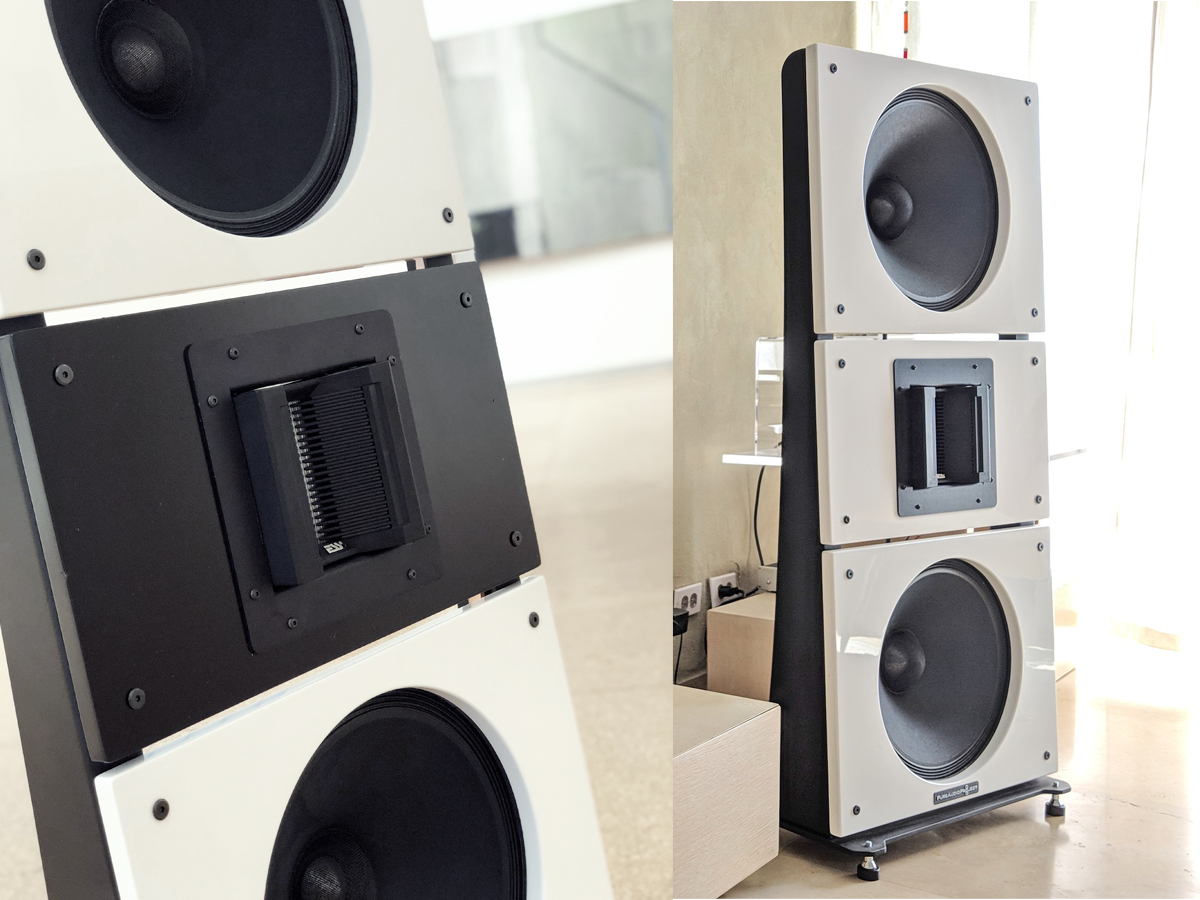
The PureAudioTrio 15 OB's are a great example of AMT's done right. If you attend a symphony you won't hear music coming from a box. You hear natural sounds from all over with some arriving slightly sooner and some lingering longer ( decay ). That's why the open baffle sound is so addictive as it's so much closer to what you experience "live". A box speaker is handicapped in producing a sense of depth which is one of the strengths of open baffles. I can enjoy my OB's standing behind them because of that incredible back wave which box speakers go to extremes to eliminate. It's fascinating that many folks are quick to offer an opinion on OB's even though they've never heard them.

20191003184834_PureAudioProject-Trio15HeilAMTFrontWeb.jpeg
Those are nice , I bet they sound great .

Audiofreak71
 
Rule of thumb here ... I know I've got it right when I can close my eyes and the speakers disappear.

(which is quite the trick with 100 pounders sitting eight feet away, eh) ;-}
 
No offense, guys, but am I not being understood or something?

Assuming the speakers is designed halfway good, it doesn't sound like a box. Speakers usually sound like boxes when they have uncontrolled resonances and large baffles that produce edge diffractions, which in turn produce the kind of significantly out-of-time wavefronts that are also endemic to dipoles.

Are we assuming that all special information arising from the venue is somehow deleted from the recording? Or, are we assuming that information is in the recording? If it's there, then why do you need a speaker that can create it's own spacial information in the reproduction room? I don't understand why people think a dipole speaker is required to reproduce dipole sound sources. Ears and speakers are essentially cardioid pick up devices, so it stands to reason a monopolar, mostly cardioid speaker should be able to replicate spacial information, doesn't it?

I feel the sidebar:2 in the following article articulates well the virtues of planar speakers when it comes to reproducing pianos and stringed instruments, and if that's why you enjoy them, so be it! But if you go on and look at the measurements, they're not particularly impressive as speakers in general go. They're full of weird peaks and stuff which isn't unusual. The advantage of big planars is their impedance coupling to the air, but there's another technology that's even better at that, that doesn't have the back wave problems, and that technology would be the horn.

https://www.stereophile.com/content/magnepan-mg-20-loudspeaker-planar-imaging
 
Assuming the speakers is designed halfway good, it doesn't sound like a box.
Agree on that point with modern designs that address diffraction and cabinet resonance. For about the same budget, I think I'd still take U-1s vs Maestros.

Are we assuming that all special information arising from the venue is somehow deleted from the recording?
Some content has good cues while other does not. Regardless for me, I find that dipolar line sources more closely replicate what I experience at the concert hall (or even wifey playing the baby grand in the living room) in terms of realism. Signal character doesn't depend so much upon your location.
 
Last edited:
I was sitting and listening to some fairly large, relatively inexpensive, home theater boxes today. I've got my TT pretty well dialed in, and can switch from a SS pre with a very good phono-stage to a tube hybrid pre with a pretty decent outboard phono pre. With the tubes, the stereo image is mostly behind the plane of the front baffles, but wider than the stance of the speakers with some material, and has noticeable depth and separation. With the SS pre, the image is brought forward of the plane of the baffles, and out into the room a bit, as well as behind, tho the overall image has a touch less depth. Most importantly, it sounds good both ways. The box speakers actually do a fairly decent job of not sounding terribly boxy, when fed a good signal with enough power. They may not completely disappear, but they do a fine job of getting out of the way....
 
I find open baffle (or open back to some) simply sounds more open, relaxed yet fast and transparent than box speakers. They really do excel at creating a natural image.... Not pin point accurate though natural.

This could well be a coloration in and of itself though to my ears it sounds more like the real thing than anything else I've heard.
 
Agree on that point with modern designs that address diffraction and cabinet resonance. For about the same budget, I think I'd still take U-1s vs Maestros.


Some content has good cues while other does not. Regardless for me, I find that dipolar line sources more closely replicate what I experience at the concert hall (or even wifey playing the baby grand in the living room) in terms of realism. Signal character doesn't depend so much upon your location.

I honestly don't think that has anything to do with the speakers being dipoles. I think that's the dynamics you get from any speaker that has good coupling with the air. Have you listened to a pair of Klipsch LaScala?
 
I find open baffle (or open back to some) simply sounds more open, relaxed yet fast and transparent than box speakers. They really do excel at creating a natural image.... Not pin point accurate though natural.

This could well be a coloration in and of itself though to my ears it sounds more like the real thing than anything else I've heard.

If that's what you and others like, great! I'm a nutjob for top notch imaging and excellent vocals. You kinda want a speaker that does very exacting imaging for that.
 
Pin point imaging is not natural. It is Hi-Fi. Real unamplified sound is not like that. It is surrounding, and reflects off all surfaces including the back wall. Likewise OB gives more accurate detailed bass, if not as deep. In my experience superior detail all around.
 
Last edited:
Pin point imagine is not natural. It is Hi-Fi. Real unamplified sound is not like that.

No... It actually is real. It's the actual sound the microphones pick up. It's the sound you get when you don't have a lot of color added to the sound through reflections and diffractions. If the pin point accurate information isn't in the recording, then it won't be in the reproduction. It really depends on what's in the recording.
 
I honestly don't think that has anything to do with the speakers being dipoles.
You're welcome to believe whatever you choose. My experience of more than forty years of hearing live music with a range of planar dipoles tells me otherwise.

Have you listened to a pair of Klipsch LaScala?
Oh yes. It is difficult to imagine a larger contrast in terms of midrange response to the Sound Labs. I tend to agree with AKer Tom Brennan as to their optimum placement.

No... It actually is real. It's the actual sound the microphones pick up. I
It is what you find on horribly close multi-miked recordings - the least natural sounding IMHO.
 
Last edited:
No... It actually is real. It's the actual sound the microphones pick up.

Rephrase that to "it's the actual sound the microphones pick up after some ham handed recording engineer has it's way with it and then passes it on to the production team, hoping they're having a good day and do a reasonable job of transcribing it to whatever media they're targeting AND not to mention said media is probably several generations old by the time we get to give it a listen ... "

In other words, it's up to us and our equipment to try and recover the ambiance and impact of the original production. It may not be a "pure" rendition (whatever that is) playing in the home system, but as long as it satisfies the soul, who really gives the hindquarters of a member of species muridae?

Besides, IMHO, the tweaking we do to fill the room naturally and "suspend disbelief" is half the fun, eh.
 
It is what you find on horribly close multi-miked recordings - the least natural sounding IMHO.

So you concede that it's what the source actually sounds like?

Plenty of music uses close and distant mics. Danny Carey uses both in his recording technique. That's how he gets the space and ambiance in his mix. I've seen it done with full orchestras too, and I think it sounds better.
 
So you concede that it's what the source actually sounds like?
Depends upon the quality of the source. Poor close miked, multi-track recordings do exhibit "pin point imaging". Reminds me of early stereo ping pong effects. My speakers are quick to show that. Fortunately, better recordings exist.

I don't understand why you question me about things others have posted - it was not me who brought up "pin point imaging".

Plenty of music uses close and distant mics. Danny Carey uses both in his recording technique. That's how he gets the space and ambiance in his mix. I've seen it done with full orchestras too, and I think it sounds better.
Distant miking, yes. I've participated in a Telarc recording of the ASO myself. Up close miking, not so much. Too artificial sounding IMHO.
 
Last edited:
Exactly what *requires* pinpoint imaging?

Vocals. Unless opera is all anyone listens to, vocals are always closely mic'd.

Also, I'm not trying to pick on you. You and I are having a civilized public discussion and other people are watching. You make points, I make points, and maybe somebody out there is learning something from it. You seem like a nice guy and I enjoy talking with you.
 
Vocals. Unless opera is all anyone listens to, vocals are always closely mic'd.
I'm a fan of choral (not opera) as one of my mentors has been a bass in the Atlanta Symphony Chorus for decades. Distant miking sounds like what you hear when you are there live. Even soloists to choral content as you find with works like Carmina Burana aren't spot miked in the best venues.

It is a shame that many vocals are so closely miked. It's not that you couldn't otherwise identify their position on the stage since that is easily done with most any speaker design. What I object to is their apparent image size thus becomes huge as compared with other instruments. You end up with six foot tall mouths when everything is presented in a lifelike image size.

Also, I'm not trying to pick on you. You and I are having a civilized public discussion and other people are watching. You make points, I make points, and maybe somebody out there is learning something from it. You seem like a nice guy and I enjoy talking with you.
:beerchug:
 
Last edited:
I'm a fan of choral (not opera) as one of my mentors has been a bass in the Atlanta Symphony Chorus for decades. Distant miking sounds like what you hear when you are there live. Even soloists to choral content as you find with works like Carmina Burana aren't spot miked in the best venues.

It is a shame that many vocals are so closely miked. It's not that you couldn't otherwise identify their position on the stage since that is easily done with most any speaker design. What I object to is their apparent image size thus becomes huge as compared with other instruments. You end up with six foot tall mouths when everything is presented in a lifelike image size.


:beerchug:

I think the size thing is an artifact of your speakers. Human voices are neither line sources, nor large radiating surfaces. They're point sources. I find with my speakers that voices to be startlingly lifelike, with appropriate energy, height, and dimension. Likewise, collectively mic'd backing vocalist have the appropriate space, distance, ambiance, and less defined specificity. Loreena McKennitt's albums are excellent examples of that.

In live acoustic performances I make it a point to sit in the first 10 rows. It avoids hearing much of the room and allows me to hear the people on the stage with clarity.
 
Back
Top Bottom