

You are using an out of date browser. It may not display this or other websites correctly.
You should upgrade or use an alternative browser.
You should upgrade or use an alternative browser.
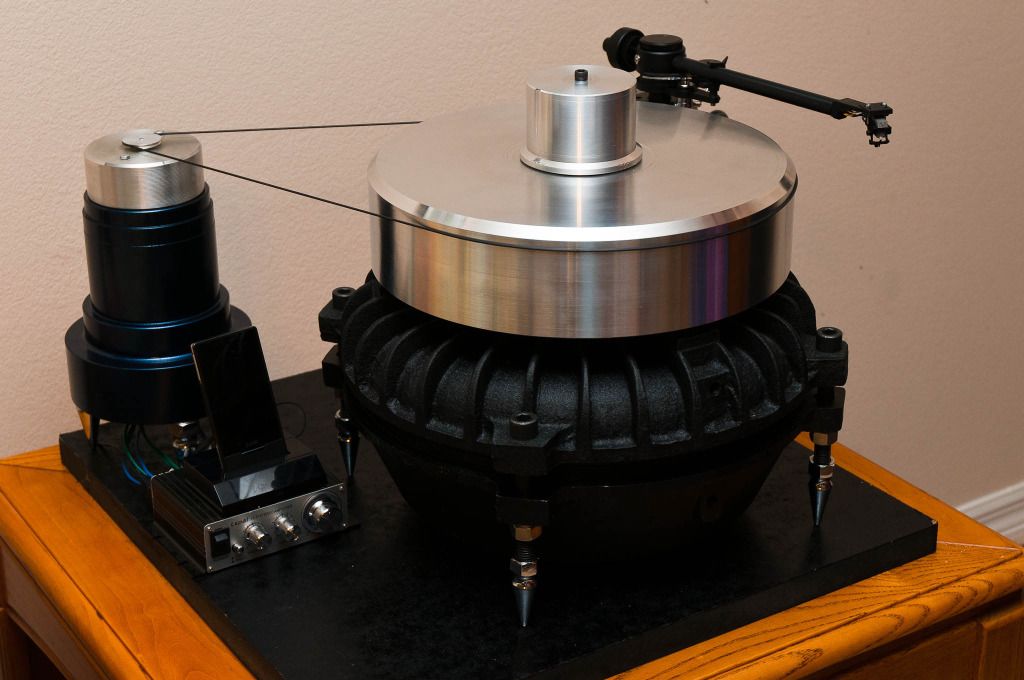
Diy TT project
- Thread starter edd9000
- Start date


edd9000
Don't Panic!
I got my hands on a test lp with a 3150hz test signal. The ipod app platterspeed will then give a read out of the speed, and average over time. With a little tweaking here is the result over 30 seconds.

The low pass removes the error from the hole being off center. For comparison, my yamaha ypd-71 measured at 3148hz, and slightly better deviation before the low pass, but pretty much the same after, which I put down to my spindle being too small so the record was more off center.
The low pass removes the error from the hole being off center. For comparison, my yamaha ypd-71 measured at 3148hz, and slightly better deviation before the low pass, but pretty much the same after, which I put down to my spindle being too small so the record was more off center.



Indeed......... that is an amazingly great job. :thmbsp: :yes:
Having access to a lathe and mill would be wonderful.
Having access to a lathe and mill would be wonderful.


atom94
Active Member
Wow... how have I missed this thread until now! This is possibly the coolest DIY project I've seen in my time on AK. :thmbsp:
If it was me I'd be looking at a DIY drive system now. Don't bother paying $500 for that drive kit, you could put together something yourself for well under $100 if you can solder. With a crystal referenced setup you could probably get an even more accurate speed than the iPod - crystal tolerances are measured in ppb. It also wouldn't be too difficult to add an RPM sensor to correct speed automatically.
If it was me I'd be looking at a DIY drive system now. Don't bother paying $500 for that drive kit, you could put together something yourself for well under $100 if you can solder. With a crystal referenced setup you could probably get an even more accurate speed than the iPod - crystal tolerances are measured in ppb. It also wouldn't be too difficult to add an RPM sensor to correct speed automatically.

An inexpensive upgrade of the drive system would be to double the one you've got. Any variations from one are minimized by the second one.
edd9000
Don't Panic!
I wont be changing the motor sytem I am using now.
Look at the measured results above. Over a period of 30 seconds, acounting for the lp being off center, speed is acurate within 0.02%.
All lps are off center, not acounting for that shows the speed is acurate to 0.17%. Or 8 times worse than the turntable.
Moving the motor pod a few inches away or toward the turntable speeds or slows the table, ie stretching the belt and lowering pitch diameter reduces the speed. This makes a roughly 0.1% difference.
I would like a better belt, the current one has a twist because I glued it together. The pully I made isnt the best either.
So, if I ever get the chance to make something more for the turntable, it would be a self centering system .
.
Look at the measured results above. Over a period of 30 seconds, acounting for the lp being off center, speed is acurate within 0.02%.
All lps are off center, not acounting for that shows the speed is acurate to 0.17%. Or 8 times worse than the turntable.
Moving the motor pod a few inches away or toward the turntable speeds or slows the table, ie stretching the belt and lowering pitch diameter reduces the speed. This makes a roughly 0.1% difference.
I would like a better belt, the current one has a twist because I glued it together. The pully I made isnt the best either.
So, if I ever get the chance to make something more for the turntable, it would be a self centering system
.
Have not read the details of your post, but if your platter has been machined to a 'standard' (VPI, for instance) diameter and your motor operates at a standard speed then you could purchase a pulley and belt from VPI (or other TT manufacturer). They once upon a time to grind their belts (simply commercial o-rings) to remove the mold lines and to acheive a uniform cross-section.
edd9000
Don't Panic!
Well initially, the 3150hz signal played at 3150.5 hz. or 0.015% fast. I then realised if I moved the motor pod away from the table, it stretched the belt, reducing the belt pitch, and slowing the speed which allowed me to get it to 3150hz. So yes, it was a good guess.
The -0.01% + 0.02% is the maximum speed drift over 20 seconds. It ocillates over a 10 second period leading me to belive its a combination of the belt/pulley. It may just be the motor.
The -0.01% + 0.02% is the maximum speed drift over 20 seconds. It ocillates over a 10 second period leading me to belive its a combination of the belt/pulley. It may just be the motor.

palasr
Active Member
You'd have to change the pulley, but you might want to consider using 2 mil 1/2" Mylar film as a belt material; I use it on my Galibier, and it takes one more "lossy" interface out of the drive chain. You would improve the speed accuracy even more, as you would lose the stretchy compliance of the rubber belt. I prefer the film for belts as opposed to surgical silk because it has a larger surface area and better wrap around the pulley, though you may be able to implement the silk using your current pulley. Food for thought.