
The less I screw around with the connections, the better off I believe I am. They get to know the good notes from the bad ones.



The passivating layer is supposed to be thin enough to not affect conductivity. My concern would be the durability of the layer after repeated connecting and disconnecting..Does that layer affect the conductivity?
Thanks!

 So, I have built GR-Research NX-Studios and upgraded 3 pairs of speakers, which I have NOT used the GR Tube Connectors.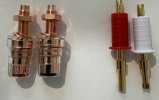
So, the more mods you make the more you will need to make even more mods?

Hmm...The passivating layer is supposed to be thin enough to not affect conductivity.


A different thought - I remember Julien Vereker of Naim tossing in the towel about gold plating on connectors. He said that rhodium plating was better sounding and maybe more durable - the coating process apparently requires multiple steps of plating and the result wasn't as transparent as the average person might imagine - but the market is driven by consumers, well informed or not, and sticking with rhodium was costing too many sales.
I'm thinking on the same boat. I thought that AC electron movement is a surface phenomenon.With no actual knowledge of the subject, the idea that something could be passivating but not affect conductivity seems odd. Admittedly this is without thinking much, but it would seem intuitive that minimizing chemical reactivity would have to also effect the movement of electrons. But maybe not - that's why chemistry is so frustrating - just when you think you understand what is going on, one (or two) new factors suddenly rear their ugly heads.


AKA "Negligible" . . .61 and a half.
Yes and no . . . skin effect is negligible at audio frequencies, increasing as frequency rises.I'm thinking on the same boat. I thought that AC electron movement is a surface phenomenon.
Who knows?
Yeah, sorry, I'm digging deep into the weeds here.Yes and no . . . skin effect is negligible at audio frequencies, increasing as frequency rises.

That's why I use Speakon. Plated copper, large contact area, self cleaning, locking, and *ZERO* audiophool markup . . . (or Chinesium).Yeah, sorry, I'm digging deep into the weeds here.
My take is that if the posts are sturdy and made of reasonably good material. Solid contact that doesn't loosen — you'll be good to go. And move on to other issues.

I am sure either way could sound great. Copper and gold are some of the very best base/plating metals for audio (along with base silver for the trifecta). Between the two and if given the option, I'd go for the tube connectors personally because I'm curious to hear how they'd sound. They appear to be doing many things "right" in terms of the base and plating metals used and their low-mass design. Do you know whether your solid copper binding posts have a passivating layer surrounding them to prevent future oxidation? It's unlikely the copper screw and nut are coated with anything. The clear twist knobs may protect the copper from oxidation under the screw caps if the seal is airtight. Theoretically, some would say all that metal mass of the copper posts could introduce "eddy currents" / localized swirling currents, leading to phase shift and time delayed signal smear in the audio signal. However, the extent to which that actually occurs or would be an issue you'd actually notice remains unknown.Well, do I use Danny's Tube Connectors or solid copper?
The Zu Omen DW MKII that I am rebuilding, I will install 1 TC and 1 Copper and see what happens.
View attachment 3784697

<<snip>> Theoretically, some would say all that metal mass of the copper posts could introduce "eddy currents" / localized swirling currents, leading to phase shift and time delayed signal smear in the audio signal. However, the extent to which that actually occurs or would be an issue you'd actually notice remains unknown.
When you think about it — and I know you aren't really supposed to think TOO hard about these things — why should speaker post make so much difference, but the hundreds of feet or oodles of connectors in the pre-amp and amp really don't. Eddy should be in there, too. Right?… which of course would be a gross overstatement and misapplication of theory to audio, but that’s what pitch-men do.
Let the carnival proceed.


Link, please! Thanks!Mr. Carlson just posted a video about RG-6 that you may find interesting.

 , Douglas Self gave an example of measured distortion attributed to steel binding posts. (But very small even at 100 Watts.)
He forgot to add ... "to no good effect"To quote a friend of mine, "Never has so much, been said about so little, for so long.".
