• The move to the new server is done. There are some software and database maintenance updates in process. This has us passing the hat around to help out. We appreciate any donations. Seriously, even a dollar helps. The payment page may be found here - https://www.audiokarma.org/support.html

Do binding posts really affect sound quality?

The best connection is a solid connection. I am not a big fan of using binding posts for speaker terminals, if used with banana plugs they easily can become unplugged if equipment is moved. Old equipment often used screw terminals, normally the wire was simply wrapped around and the screw tightened. I don't recommend that method either, but you can use forked or better yet ring eye terminals on your wires and then screw them down.

Many binding posts can be used with ring terminals, those that can't are not really binding posts but are just banana jacks. Obviously better quality connectors of any kind are less likely to degrade sound but still ensuring a solid connection is much more important than worrying about the actual materials used in the connectors construction.
 
At the risk of posting on-topic :), Douglas Self gave an example of measured distortion attributed to steel binding posts. (But very small even at 100 Watts.)

""Although the amplifier output currents were only passing through about 10 mm of steel (the current went through that length twice, on go and return), the non-linear magnetic effects were sufficient to increase the output distortion from 0.00120% to 0.00227% at 100 W into 8 [Ohm] at 1 kHz."

Quote taken from ASR.

Brilliant! :rflmao:

Proof as if it were needed of the old phrase - "we can't measure everything that matters, but not everything we can measure matters."
 
Many binding posts can be used with ring terminals, those that can't are not really binding posts but are just banana jacks. Obviously better quality connectors of any kind are less likely to degrade sound but still ensuring a solid connection is much more important than worrying about the actual materials used in the connectors construction.

I put big, copper ring terminals on the speaker cables I recently made. Maybe I've never encountered really good ones but I have never liked the way banana jacks felt, simply not positive enough for me.

The only knock to using ring terminals is having to completely remove nut to get the ring on.
 
Just for clarification, silver does not readily form an oxide under ambient conditions. The tarnish that is typically observed on silver in an interior environment is primarily silver sulfide (Ag2S). Ag2S is a semiconductor with a band gap of about 1.1 eV, which is similar to the band gap for the copper oxides.
Back in the 90s, when I worked at Boeing, I got some 16ga silver plated copper wire with a Teflon jacket as a sample. We had a number of audio types in my group and we had this discussion about corrosion. I stripped a couple of inches of insulation off a 6 inch long piece of wire and tacked it to my cork board beside my desk. It stayed there for over a year, exposed to office air with no visible corrosion on the exposed strands. We stripped the rest of the insulation off and there was no visible difference between the exposed strands and the length that was inside the insulation.
I have no idea if there was a coating on the wire or if it was an alloy (it was claimed to be pure silver on oxygen free copper) but I used it for internal hook up wire in several DIY amps and as a top cap wire in an 807 tube amp. It soldered well and it still looks shiny. The Teflon was unaffected by the heat of the top caps.
Not making any claims, just saying.
 
I put big, copper ring terminals on the speaker cables I recently made. Maybe I've never encountered really good ones but I have never liked the way banana jacks felt, simply not positive enough for me.

The only knock to using ring terminals is having to completely remove nut to get the ring on.
I agree in the case of regular banana plugs but I recently got some locking bananas (that they claim are rhodium plated) and once tightened they can't be pulled out with any reasonable force.
I've always used good quality spades previously with good results.
 
Back in the 90s, when I worked at Boeing, I got some 16ga silver plated copper wire with a Teflon jacket as a sample.
Reading your comment made me think, rightly or wrongly, that there was something more than just silver and copper in your wire. As you note, that silver could have had another layer on top of it. But maybe not.

I think mil and aerospace wires can also have a layer placed between the copper and silver to prevent the copper atoms from diffusing towards the surface and mixing in with the silver. Not sure if/how that might matter here

But, interesting story... Next time, include a control!
 
Reading your comment made me think, rightly or wrongly, that there was something more than just silver and copper in your wire. As you note, that silver could have had another layer on top of it. But maybe not.

I think mil and aerospace wires can also have a layer placed between the copper and silver to prevent the copper atoms from diffusing towards the surface and mixing in with the silver. Not sure if/how that might matter here

But, interesting story... Next time, include a control!
Next time? There will be no next time. That was the last time for me. Sorry, the song is stuck in my head.
I'm retired now so I would have to source it myself.
 
I put big, copper ring terminals on the speaker cables I recently made. Maybe I've never encountered really good ones but I have never liked the way banana jacks felt, simply not positive enough for me.

The only knock to using ring terminals is having to completely remove nut to get the ring on.
Those Chinese banana plugs, if not specified to be made to high quality standards are junk. I got some from the typical sources and the grub screw was an extended tip screw, an unthreaded tip that meant the grub screw would not catch a thread until it had almost closed the opening. No way to put more than an 18Ga wire in it. The the peel fell off the banana. Pure trash.

Pomona connectors are what the measuring world used in the past and it is good enough for me but my main speaker wires have a set of WBT locking bananas on them from a speaker wire purchase of a friend’s extras from a system he bought used. I got a deal. I will not pay WBT connector prices until I have serious walking around money, you know the kind where folks on ak call people crazy for spending serious money on things that the ak community in general thinks doesn’t matter. I like the WBTs they fit easily and when tightened they make a good connection.

As for the answer to the OP’s question, yes, binding posts make a difference. I do not like the ones many here seem to get, the clear plastic ones with Chinese yellow metal inside that can hold a big wire. I have some of those on some speakers I have and they will guillotine an 18Ga wire with no hesitation. I don’t want my binding posts cutting my speaker wires. Again, I’m in the Pomona camp. They cost a bit more but they are all business. Generally, no fancy yellow metal coating but I don’t need that. With all the gigs we have here listening to different gear, my connections are broken and remade regularly, not just annually as many here have found out makes a nice difference in the sound of their system.

I’m wary of the the solid metal higher performance binding posts from Cardas and WBT as a stray strand might cause a problem but I like em. I have been asked to install them at different times on restoration projects. Now with some serious walking around money, I might upgrade a few of my pieces.
 
Last edited:
… which of course would be a gross overstatement and misapplication of theory to audio, but that’s what pitch-men do.

Let the carnival proceed.
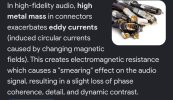
Don't take my word for it. It's not about what I think or personally came up with. The research is there if you care enough to take the deep dive into it. For instance, research eddy currents as it relates to high metal mass. Go ahead, I'll wait.

Denying the science behind audio doesn't net you a better sound, it just means the results obtained are typical, average, or left to chance. There's nothing wrong with that either -it's just not the best it could be when we're discussing what's better and what's not. Staying in a constant comfort zone of familiarity and understanding is ok, but should not be confused with trying to get the most out of your materials and set-up. Differences do exist, so it should come as no surprise that not everything is always equivalent to something else.

1000019531.jpg
 
Last edited:
Eddy currents are real, the effect on audio is not, buy what you want, I’ll stick with my engineering experience on this.

I’m not going to argue religion, you can find any answer you want on the internet if you try and whether it is in context and applicable to the subject at hand is not important to google nor to the enhanced google search that is an AI search.
 
Eddy currents are real, the effect on audio is not, buy what you want, I’ll stick with my engineering experience on this.

I’m not going to argue religion, you can find any answer you want on the internet if you try and whether it is in context and applicable to the subject at hand is not important to google nor to the enhanced google search that is an AI search.
It's fine. I'll stick with years of research and engineering experience on this as well. I don't want you to change your mind at this point -it would be too much of an uphill battle and it's simply not worth the trouble or my time. I post what I do for the benefit of others from what I have learned over the years, and for those open to new ideas or information. That cannot be for everyone. Enjoy your music, however it sounds to you. There's never a need to try and bring others down for no good reason other than to try and make yourself look better than someone else.
 
Pomona connectors are what the measuring world used in the past and it is good enough for me but my main speaker wires have a set of WBT locking bananas on them from a speaker wire purchase of a friend’s extras from a system he bought used. I got a deal.
Most excellent hospital-grade/lab-quality/ mil-spec connectors!

:thumbsup:
 
Don't take my word for it. It's not about what I think or personally came up with. The research is there if you care enough to take the deep dive into it. For instance, research eddy currents as it relates to high metal mass. Go ahead, I'll wait.

Denying the science behind audio doesn't net you a better sound, it just means the results obtained are typical, average, or left to chance. There's nothing wrong with that either -it's just not the best it could be when we're discussing what's better and what's not. Staying in a constant comfort zone of familiarity and understanding is ok, but should not be confused with trying to get the most out of your materials and set-up. Differences do exist, so it should come as no surprise that not everything is always equivalent to something else.

View attachment 3789579
I don't know if I'd rely upon this.... "high metal mass" is supposedly bad? Ergo connectors and wire should be as light, flimsy, and small as possible?

In any event, I've had to delete a few posts, so let's keep it civil guys.
 
Back in the 90s, when I worked at Boeing, I got some 16ga silver plated copper wire with a Teflon jacket as a sample. We had a number of audio types in my group and we had this discussion about corrosion. I stripped a couple of inches of insulation off a 6 inch long piece of wire and tacked it to my cork board beside my desk. It stayed there for over a year, exposed to office air with no visible corrosion on the exposed strands. We stripped the rest of the insulation off and there was no visible difference between the exposed strands and the length that was inside the insulation.
I have no idea if there was a coating on the wire or if it was an alloy (it was claimed to be pure silver on oxygen free copper) but I used it for internal hook up wire in several DIY amps and as a top cap wire in an 807 tube amp. It soldered well and it still looks shiny. The Teflon was unaffected by the heat of the top caps.
Not making any claims, just saying.
Teflon insulated wire has silver plating because, at the temperature required to apply the insulation to the wire, the copper would oxidize.
 
I don't know if I'd rely upon this.... "high metal mass" is supposedly bad? Ergo connectors and wire should be as light, flimsy, and small as possible?

In any event, I've had to delete a few posts, so let's keep it civil guys.
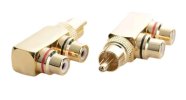
High metal mass in connectors isn't ideal but it certainly works and is in some cases even necessary; like when your preamp only has one set of outputs and you're trying to feed a power amp and a sub as well. I've used these types of rca splitters before (for instance) when I didn't have a choice. In that case, it's certainly better than nothing as it allows a 2.1 setup to function as intended.

I suppose it's possible that conductors could also have too high of a metal mass as well. I haven't really considered that as much. I think they'd have to be quite thick, and a much lower gauge than what is commonly used to produce a similar effect.

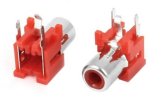
Here's an example of what I'm describing. See the differences? If my preamp out had two sets of outputs using four of these red rca jacks it would have less impact on the signal passing through it when compared to this rca splitter, which uses a solid block of metal mass (perhaps even brass?) for the signal to pass through when compared to a much thinner, minimal rca jack with a hollow metal shell that uses substantially less metal to bridge the same connection and is a more direct/ better connection from point A to point B. The "difference" may not be as great as imagined, but is also not identical and where eddy currents can come into play and effect and somewhat diminish/alter signal integrity.

The same concept applies to binding posts as well. Yes, it's true; they can be quite thick, and still sound quite good which is normal. However, it doesn't mean the commonly used designs represent the pinnacle of technological advancement and can't be improved upon. Not too long ago everyone used zip cord for everything without a second thought probably thinking it couldn't be improved upon, or perhaps they never even considered the possibility of anything better, or that a cable could even influence sound.

Screenshot_20260625_194827_AliExpress~2.jpgScreenshot_20260625_195401_Google~2.jpg
 
Last edited:
Any decently designed preamp with multiple inputs will have a buffer amplifier for each output, rather than just tying all the outputs in parallel. If they didn't do this, the 2nd piece of equipment will load down the output and impact the signal. Which is what happens when you use a splitter. It would seem to me that the difference you note is due to parallel equipment interaction rather than any impact from the physical splitter itself.

Since the current in low-level stages where one uses RCA connectors is miniscule, I would seriously doubt eddy currents would have any impact whatsoever in a splitter or any RCA jack for that matter, unless you're running high power through it as in the Collins S-line transmitters that use the RCA as the output for ~100W of RF at up to 30 MHz.
 
Since the current in low-level stages where one uses RCA connectors is miniscule, I would seriously doubt eddy currents would have any impact whatsoever in a splitter or any RCA jack for that matter, unless you're running high power through it as in the Collins S-line transmitters that use the RCA as the output for ~100W of RF at up to 30 MHz.
Yes! :thumbsup:

In my experience, the quality of the connection over time (clean and tight) seems more important than the specific metal or other EMF issues.

:idea:
 
I don't know if I'd rely upon this.... "high metal mass" is supposedly bad? Ergo connectors and wire should be as light, flimsy, and small as possible?
I'm with you.
I suspect this is another case of something really having no impact at audio frequencies or signal levels.
 
Most audio tweaks are pseudoscience and rely on real physics mis-applied to music reproduction and supported by pitch-man level “evidence”.

I’d use a glaring example of such being RF shielding or other RF-level noise concerns in speaker cables, … when RF is far FAR from any audible frequency to humans or even a young canine.

In real science, real objective research, you spend much of your time trying to disprove your theory, trying to find any deviation from the conclusion that you have postulated, where in audio people spend all of their time finding supporting (and usually inapplicable to humans and music) “data”.

Raw wire is the best, eliminating as many connections as possible of course, adding fancy connectors and terminals is adding convenience not SQ. However, a good connection is a good connection and there are many ways to “skin this cat” that have no negative audible effect, and in most cases any new/clean connection will have the same effect regardless of the type of connection.

There are methods that age better. We did a lot of research into different base metals and plating in a company where I used to work, and the most important factor seemed to be keeping the pressure up enough to prevent corrosion at the contact point and where practical, dielectric grease to prevent corrosion from creeping in. Soldering is a great example of how to preserve a connection, you make a physical connection (as solder, even “silver solder” is a poor conductor compared to copper) and then seal it together with solder.

There have been studies that showed a significant improvement when a wire is removed and re-terminated, mainly due to the connection degrading over time, and many people who “hear an improvement” when replacing cables with new “upgraded” cables will hear this difference where simply cleaning the connections would have yielded the same improvement.

It is funny that probably the most significant factor in degrading connection quality is corrosion (even on a micro-level) and yet I don’t see a plethora of “audio-grade” dielectric grease offerings (it’s just silicone grease).

Screw-terminal connections, although inconvenient, are a great connection. Crimped and soldered lugs make this more convenient, even more convenient are banana or 5-way terminals, I prefer the 5-way terminals so that I have a choice. Gold plating is common and popular, and even though gold is a mediocre conductor (again compared to copper) it is pretty and it is convenient because it is resistant to most corrosion.

Some of my amplifiers are capable of high-current output in the 20Amp/channel range, and somehow good banana plugs and binding posts with dielectric grease seem to work just fine for me.

"Audio grade dielectric grease". Now there's a business opportunity.
 
I don't know if I'd rely upon this.... "high metal mass" is supposedly bad? Ergo connectors and wire should be as light, flimsy, and small as possible?
Obviously not, according to silver-preachers. One goes for silver instead of copper because of the ~6% higher conductivity...and ends up with ~18% higher mass. Sharp!
 
Back
Top Bottom