• The move to the new server is done. There are some software and database maintenance updates in process. This has us passing the hat around to help out. We appreciate any donations. Seriously, even a dollar helps. The payment page may be found here - https://www.audiokarma.org/support.html

Do binding posts really affect sound quality?

OK, I misunderstood.

Stainless steel does form a surface oxide that then resists further oxidation, similar to what happens with aluminum. So, maybe that is the problem with it?
Hmm, yeah. You know what I do? I put a drop of Deoxit D100L on all the contacts before tightening or plugging them together. It helps with surface oxidation and also with disconnecting or unscrewing them years later.

I called Deoxit my electronics holy water. But that's me. ;)
 
You're describing very measurable differences in the acoustic environment, ain't no mystique here.

Show us a picture of how your main system is set up: speaker placement, listening position relative to the speakers, room layout.
 
Last edited:
Rhodium is hard and shiny. Contacts plated with it last longer (through more contact cycles) than gold plated ones. "Shiny" sells good even if it's not gold or silver.
But seriously, how many mate/disconnect cycles is a home speaker going to see in it's lifetime?
 
Show us a picture of how your main system is set up: speaker placement, listening position relative to the speakers, room layout.
It's summer so the main system is on "fill the damn house" duty. Plenty of soft surfaces at corners, but all less than ideal. Nothing in the chain is more than 2 years except the adcom 2535.

Now the basement theater. Layers of wool carpet on the concrete floor, heavy velvet drapes on the front, back, and sides of the space. Soft seating. Fully treated save for the Ceiling, which has plenty of baffling built in. Zero reflection, sub located to minimize standing waves. Rule of thirds, etc i did it. Front are kg4.2 with a heresy doing center duty. Rears are currently crap. Wires are old 14ga pro stuff from markertek that are due replacement, after 20 years corrosion has begun creeping up the ends.
 
It would sound great at first -probably better than anything else currently available, but would tarnish pretty bad if any of the metal was exposed to air and would diminish over time I'm thinking, requiring constant cleaning and maintenance. What about silver binding posts plated in gold, maybe something similar to gr-research's low mass tube connectors but using silver instead of copper as the base metal, do they even exist? A design similar to that would be my first choice if available.

I know that silver tarnishes but isn't that just on the surface unlike rust?

But would silver tarnish "where it matters" meaning where the lug and binding post are clamping and making contact with one another? Or would the surfaces be essentially sealed keeping the tarnish only on the outside where it would be unsightly but not impact the connection?

I guess if one were truly dedicated you could solder the silver cable to the silver binding posts on both the amp and speakers...
 
But would silver tarnish "where it matters" meaning where the lug and binding post are clamping and making contact with one another? Or would the surfaces be essentially sealed keeping the tarnish only on the outside where it would be unsightly but not impact the connection?
Silver will oxidize wherever it is exposed to oxygen. If oxidation or tarnishing is a problem, silver is not the metal for you.
 
I know that silver tarnishes but isn't that just on the surface unlike rust?

But would silver tarnish "where it matters" meaning where the lug and binding post are clamping and making contact with one another? Or would the surfaces be essentially sealed keeping the tarnish only on the outside where it would be unsightly but not impact the connection?

I guess if one were truly dedicated you could solder the silver cable to the silver binding posts on both the amp and speakers...
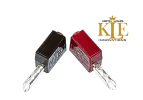
Yes, and no. While it's true silver tarnishes and oxides form worse when it's directly exposed to air, it also tarnishes when silver banana plugs are plugged into speaker banana jacks of less noble metals of a different material through galvanic corrosion and chemical transfer with even the tiniest hint of air surrounding the metal to metal connection. This is why silver always has to be completely plated, sealed, or insulated in another material that covers it from the atmosphere completely. For instance, my KLEI Classic Harmony silver banana plugs became heavily tarnished after being plugged into my Vandersteens for awhile. The only way to truly get real silver not to tarnish or corrode is when it's a base metal that has been plated over, or when it's behind film insulation -like in cables and wires.

This is why bare silver can sometimes act as a cancer to mating metals where it can actually remove the plating material of the mating metal by reacting with ambient sulfur compounds in the atmosphere, such as hydrogen sulfide and sulfur dioxide, causing plated jacks (mine were copper underneath) to also start tarnishing in the future whereas they never tarnished before because their thin, plating metal was protecting them from tarnishing. This can end in a constant maintenance loop, where not only does the silver on the connector itself start to tarnish even when it's plugged in and doesn't seem like it's exposed to "air", but it can also create new tarnish or oxides to form or be deposited or transferred onto the plating metal of the jacks which over time, has eaten through some of my jacks to expose the copper underneath them which then starts tarnishing as well. It can be a vicious cycle.

This is how I learned my lesson to try and avoid anything that has naked silver on the outside of it as much as possible. Silver can be seductive. Bare silver is more revealing than anything else (at first) but slowly diminishes over time without you noticing it because the process is so gradual. To me, it isn't worth it in the long-run. While silver oxides/ sulfides are not the worst dielectric, they also don't sound nearly as clean and detailed as fresh silver. After listening to tarnished silver connectors and then cleaning them with deoxit and listening afterwards; the difference was that the music was slightly more muffled and recessed before the cleaning of the silver connectors and their mating jacks which had also become dirty/ tarnished because of it. This finding was significant and impactful, and why (to me) the ideal metal for banana plugs or binding posts/ jacks would be silver as the base metal (which is the most conductive metal), plated in gold (which is the most conductive plating material that doesn't tarnish). Pure copper plated in gold comes in at a close second and remains the only readily available choice between the two for some reason.

EDIT: To Lou G's point, yes, if you can find bare/ exposed silver that claims to have that clear, protective passivating layer over it, you may be able to get away with it. I just haven't found many bare silver audio products that claim to have that protective layer, at all, and am unsure of its effect on silver's otherwise excellent conductivity. I don't think the data or information exists which states how much (if at all) a clear, protective layer on silver impedes its performance. If they don't mention this clear, protective layer in the silver product's advertising, then they don't have it and any exposed silver will eventually form a grayish, less-conductive layer on the outside of it over time.

Screenshot 2026-06-17 085828.png
 
Last edited:
Silver will oxidize wherever it is exposed to oxygen. If oxidation or tarnishing is a problem, silver is not the metal for you.
Just for clarification, silver does not readily form an oxide under ambient conditions. The tarnish that is typically observed on silver in an interior environment is primarily silver sulfide (Ag2S). Ag2S is a semiconductor with a band gap of about 1.1 eV, which is similar to the band gap for the copper oxides.
 
Just for clarification, silver does not readily form an oxide under ambient conditions. The tarnish that is typically observed on silver in an interior environment is primarily silver sulfide (Ag2S). Ag2S is a semiconductor with a band gap of about 1.1 eV, which is similar to the band gap for the copper oxides.
Don't tell that to my Mom( rest in peace). She was always polishing the tarnish from her silverware.
 
Yes, and no. While it's true silver tarnishes and oxides form worse when it's directly exposed to air, it also tarnishes when silver banana plugs are plugged into speaker banana jacks of less noble metals of a different material through galvanic corrosion and chemical transfer. For instance, my KLEI Classic Harmony silver banana plugs became heavily tarnished after being plugged into my Vandersteens for awhile. The only way to truly get real silver not to tarnish or corrode is when it's a base metal that has been plated over, or when it's behind film insulation -like in cables and wires.

This is why bare silver can sometimes act as a cancer to mating metals where it can actually remove the plating material of the mating metal, causing copper jacks to also start tarnishing in the future whereas they never tarnished before because their thin, plating metal was protecting them from tarnishing. This can end in a constant maintenance loop, where not only does the silver on the connector tarnish even when it's plugged in and doesn't seem like it's exposed to "air", but it can also create new tarnish or oxides to form or be deposited or transferred onto the plating metal of the jacks which over time, has eaten through some of my jacks to expose the copper underneath the jacks which then starts tarnishing as well. It can be a vicious cycle. This is how I learned my lesson never to buy anything that has naked silver on the outside of it. It sounds better at first, but isn't worth it in the long-run. While silver oxides/ sulfides are not the worst dielectric, they also don't sound nearly as clean and detailed as fresh silver. This is why (to me) the ideal metal for banana plugs or binding posts/ jacks would be silver as the base metal (which is the most conductive metal), plated in gold (which is the most conductive plating material that doesn't tarnish).
This is true. Some manufactures apply a thin passivating layer over silver connectors to prevent silver corrosion and silver from acting as a cathode in galvanic corrosion.
 
Solder (tin) is a pretty lousy conductor, but typically a metal-to-metal contact is made first (crimp, set-screw, wire-wrap, etc.) and solder IIRC in this application should act more like a resistor than a diode, which is the lesser of evils and insignificant.
 
All I know is the exact same audio set up sounds different in my workshop than it does in the dedicated, acoustically treated listening room. The room and placement of gear in the room is the only difference and it is very audible. < Reply: The room is resonant chamber the forms part of the audio system. Change the room, and it's like changing some other component in the system.>
 
Last edited:
Back
Top Bottom