• The move to the new server is done. There are some software and database maintenance updates in process. This has us passing the hat around to help out. We appreciate any donations. Seriously, even a dollar helps. The payment page may be found here - https://www.audiokarma.org/support.html

Do you use loudness?

Do you use loudness modifier?

  • Definetly yes!

  • Hell no!

  • It depends...


Results are only viewable after voting.
Loudness switch really is only used on receiver, integrates and just a few preamps. Normally also in line with the Japanese manufacturing and during the 70s early 80s. This was a time when "More" was better, receiver wars, and how many buttons and switches can we cram into one box. Some people equate more switches, buttons and bobbles to more performance and that carried over into AVR as well as stereos into the 80s. Hell even our TVs have easy to switch sound effect buttons to push without any knowledge of what one changed to get that effect.

As humans we acquire a taste to what we like in sound and flavor. Some people like the bass so high when driving around every part of there car is vibrating. Or TV doesn't sound right unless sound is hitting them at different times at all angles and then all of a sudden big rumbles. This is all effects and manipulation to the sound and minds perception of the sound. Give a human five buttons to switch the sound and they will pick the one they like the best at that time. The problem with this is "at the time" since our hearing and mood changes and then we acquire a taste over quality of the recorded sound.

When one starts learning about audio, they learn that the shortest signal path sounds the best. They learn by listening to the sound that's happening, hearing the filtering. They hear the corruption of the signal though many circuit and switches. They learn that the quality of sound does not equate to more switches, buttons and bobbles.
 
I think variable loudness can be useful, but have always found the once-ubiquitous single-level controls way, way overblown in their bass boost, and that is my opinion with no connection to anything 'sacred.' If your opinion differs, I have no problem with that. I don't use such compensation, but am not averse to a bit of bass or treble boost/cut.

Let me begin by saying I didn't cast a vote. None of the supplied answers fit my situation.

I agree with musichal about standard single level loudness controls. Variable loudness controls are IMO the best way to implement true loudness compensation. With a variable control you set the loudest volume you intend using with the volume control. You then use the loudness control to lower it from that "maximum" level. This means that, assuming the control is implemented properly, you get the appropriate amount of progressively increasing bass and treble boost as you use the variable loudness control to lower the volume.

Standard loudness switches are usually connected to a 50% loudness tap on the volume control. At levels below 50% rotation you get progressively more bass and treble boost (some only boost bass). The major downside to this is that 50% rotation has nothing to do with the actual volume the speakers are producing. For HE speakers 50% rotation (12 O'clock) usually means a neighbors call the cops level while Magnepans may be just waking up.

My preamp has no loudness switch/button or tone controls. I have an extensively treated dedicated room and use a DSP for room equalization. Even so, I miss the variable loudness control that was on my previous preamp (ARC SP-3AII). Although I rarely used the tone controls I truly miss the variable loudness control. For low(er) level listening it made things more full range without going overboard.

Some years back someone made a stand alone variable loudness control. If I could find one, or if there is something in current production, I'm interested. So, no, I don't use a loudness control. However, if I had a variable one I would.
 
I did not quite get that. What does SPL (volume level?) has to do with using or not the loudness effect?
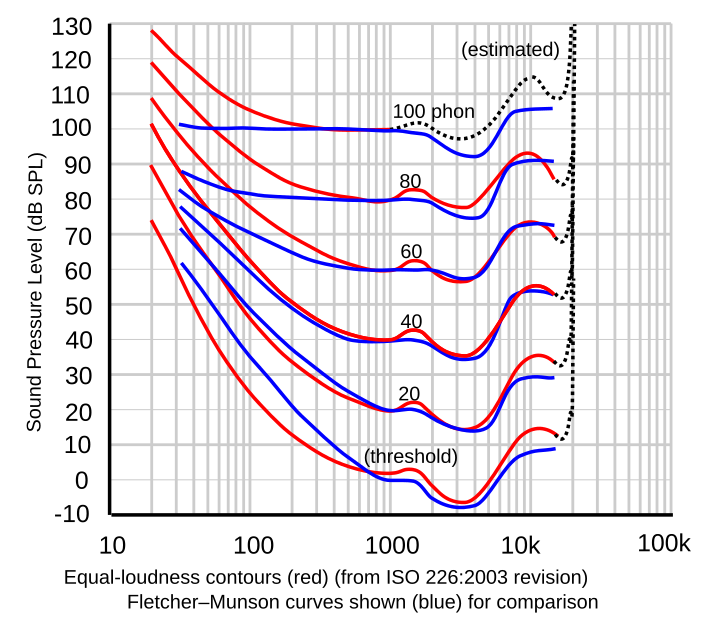
It all has to do with how the ear hears. Human hearing is subjectively 'flat' at loud(er) volumes. But, our hearing acuity drops off as volume decreases. Most of the drop off occurs in the bass frequencies, slightly less in the treble. So, the lower in volume, that you listen, corresponds to the diminished amount of bass and treble that are being heard. This phenomenon was studied and named the 'Fletcher-Munson curve', from the scientists studying the issue.

705px-Lindos4.svg.png

The Loudness button, being discussed, was developed to 'repair' our hearing, by applying an inverse EQ, to offset our low level hearing loss. But, as the amount of EQ applied, varies with volume, a single push Loudness button, isn't as effective as variable Loudness. A variable Loudness knob can be set to properly function at any low level volume, and be more effective, as a result.
 
Last edited:
Our house was built under the southern approach to Orlando International Airport and like all the houses in this area it has some extra sound insulation, this leads to some interesting effects.

My Onkyo receiver has no loudness button, my Yamaha has their variable loudness option.

Since I use the Yamaha with my near-field setup, and it is on my Study's common wall with my Son's bedroom, I do use the variable loudness because the listening level is usually relatively low.

The Onkyo is in the Master Bedroom and thanks to that extra insulation has no constraints as to volume level, I do have a 10 band EQ that is used to address some of the room anomalies, but loudness isn't needed.

Mark Gosdin
 
@StimpyWan, that was educational for sure! Never heard about it (maybe it was at a very low volume and mostly bass based hehe.... stupid joke), but now it makes perfect sense to think of the loudness switch for nighttime listening sessions for example... nice.
 
@StimpyWan, that was educational for sure! Never heard about it (maybe it was at a very low volume and mostly bass based hehe.... stupid joke), but now it makes perfect sense to think of the loudness switch for nighttime listening sessions for example... nice.

It probably has to do with evolving from cavemen! Up close, we'd run when we heard a wooly mammoth's bass-beat footfalls! We didn't want to get stepped on. But at night, the distant creature sounds, wouldn't wake us from our nightly slumbers!!! :rflmao::rflmao::rflmao:
 
As a novice - the education behind the responses were great and appreciated! Always had a question as to if I needed it on or not ... generally listened to it and toggled it on and off to make the decision ... thanks to all for the information!
 
I did not quite get that.
What does SPL (volume level?) has to do with using or not the loudness effect? Loudness makes a "thin" and "harmless" reproduction sound "full" and "engaging", at least that is how I hear it. On the other hand it does tend to muffle mid and high range frequencies. Do you mean that loudness is only present to compensate for when you are listening at low levels?

Jesus! You need more bass with a 12" woofer speaker? I would find that plenty for most people and usages.

Here is a primer on the Fletcher-Munson curve--just so you know https://en.wikipedia.org/wiki/Fletcher–Munson_curves

If your system doesn't sound "right" without loudness or tone controls involved, either you have crap gear (not meaning to be offensive), or they lack synergy or synergy with the room--which is the most important.

12" woofers don't mean sh*t. I have several pair of JBL Control Monitors with 12" woofers, and they all benefit from some sub support. It has more to do with the volumetrics than the driver. BTW--I slap the piss out of them with 300 wpc amps.
 
Worked here too!!! :thumbsup:


"It all has to do with how the ear hears. Human hearing is subjectively 'flat' at loud(er) volumes. But, our hearing acuity drops off as volume decreases. Most of the drop off occurs in the bass frequencies, slightly less in the treble. So, the lower in volume, that you listen, corresponds to the diminished amount of bass and treble that are being heard. This phenomenon was studied and named the 'Fletcher-Munson curve', from the scientists studying the issue.

705px-Lindos4.svg.png

The Loudness button, being discussed, was developed to 'repair' our hearing, by applying an inverse EQ, to offset our low level hearing loss. But, as the amount of EQ applied, varies with volume, a single push Loudness button, isn't as effective as variable Loudness. A variable Loudness knob can be set to properly function at any low level volume, and be more effective, as a result."
 
If your system doesn't sound "right" without loudness or tone controls involved, either you have crap gear (not meaning to be offensive), or they lack synergy or synergy with the room--which is the most important.

12" woofers don't mean sh*t. I have several pair of JBL Control Monitors with 12" woofers, and they all benefit from some sub support. It has more to do with the volumetrics than the driver. BTW--I slap the piss out of them with 300 wpc amps.

Well the only system I have is the one I use for background FM listening during the dreadful house tasks one has to endure every week!
I am talking about a tuner, at the moment a Toshiba SB-420 that talks to a Marantz 2238B that feeds a pair of B&W DM100i (saved from a long forgotten damp garage).
I gotta say for what it is and the money it cost (less than $300) I am pretty satisfied, those little minions of a speakers play very loud and very clear, I don't feel the need for more bass and I confess I don't ever do any tone controlling or loudness but I am still learning the sound signature I prefer so take it with a pinch of salt.

On the other hand I always associated a >10" woofer with deep bass notes reproduction, maybe I am wrong, hell I've never owned a subwoofer, not even on my living room home theater setup! I guess I might be missing on something...
 
Thank you--someone FINALLY got the science behind this. Rather than a pair of CV D-9's and a Pioneer SX-1980 with everything cranked "to 11".

Why Thank You! You're welcome. :biggrin: But, sometimes cranking "to 11", establishes a whole new level of physics, yet unexplainable by science! :banana::rockon::banana:
 
growing up with a pioneer sx-750 since i was a kid really turned me on to tone controls and the loudness switch. my ears have gotten used to them for the past 20-ish years. after being on this site and reading peoples opinions i have slowly weaned my self off the loudness button (and my pre doesnt have one now). i still need to use the tone controls. i dont know if i can ever go truly flat. im a product of the 90's music and like my over-exaggerated lows and highs though.
 
On the other hand I always associated a >10" woofer with deep bass notes reproduction, maybe I am wrong, hell I've never owned a subwoofer, not even on my living room home theater setup! I guess I might be missing on something...

Those of us that use subwoofers would say you're definitely missing something. Even those with large full range speakers know the benefits of multiple subwoofers. Take note that many of the all out assaults on the state of the art in speakers include subwoofers. Many of them include multiple subwoofers with their own dedicated amplifiers.

Thank you--someone FINALLY got the science behind this. Rather than a pair of CV D-9's and a Pioneer SX-1980 with everything cranked "to 11".

You act like no one else knows this. That's a very incorrect assumption.:oops:
 
for low volume listening its nice to put more watts into low db. if you make sure your bass is balanced, the loudness can bring out midrange and midbass that just wasnt available no matter how you set your tone controls

for instance, i was running my str-gx10es at +6 bass without loudness but id have to turn it up louder to achieve similar results as the loudness switch at flat bass or even negative 2 to negative 6 depending on what im listening to and at what level.

i dont think ill ever practically listen to this thing at the levels where loudness needs to come off to even out the eq to avoid clipping because it gets louder than i need it to be at a decent bit before clipping with loudness on
 
Back
Top Bottom