• The move to the new server is done. There are some software and database maintenance updates in process. This has us passing the hat around to help out. We appreciate any donations. Seriously, even a dollar helps. The payment page may be found here - https://www.audiokarma.org/support.html

Does recapping make an audible difference? The shoot out & you're invited

Wow what an interesting debate! Here is my take on recapping....

I have a Sansui 9090 that is uneven between channels when cold, but evens out once it warms up. Do you think a recap will fix it? Yes. Will the sound quality improve? Absolutely. But it 100% has some bad caps.

I also have a SX-1250 that is on "loan" from a fellow AK'er. It just sounds terrible. Not distorted, but just kinda lifeless. Dull. I found one of the big caps leaking all over the place inside. Will it sound better after a full recap? Absolutely! But again it 100% has at least one bad cap.

I have a G9000DB. It functions 100%, and sounds amazing. There is no distortion, uneven channels, tone controls work great, etc. Will it benefit from a recap? Only for piece of mind and reliability. Will it sound better after a recap? I bet noone could hear a difference. But remember this one probably does not have any bad caps.


Summary: If you hear a difference in sound after a recap, then you had bad/out of spec caps.
If you do not hear a difference, there was nothing wrong with the caps that you replaced beside being old and probably near the end of the life span.
 
Wow what an interesting debate! Here is my take on recapping....
Actually, I never meant it to be a debate but rather an opportunity for people to compare these two in a casual setting and perhaps draw conclusions of their own - pro, con or indifferent.

I especially related to your response because I have those 3 receivers.
My recapped SX-1250 and 9090db have me in a quandry - both are in the bedroom (oh, such a tolerant wife) and I can't decide which I prefer; both look and sound wonderful.
And then downstairs I have a 9000db which I don't want to touch - it's perfect as is!
 
Will you be publishing charts and graphs of the test results? Maybe one axis could show number of alcoholic beverages consumed and the other the ability to discern a difference in the two receivers.:lurk:


Here some of my earlier research in that regard...


funny-graphs-beer-bottle-distribution2.gif
 
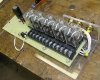
I built an A/B switcher this weekend to use in the SX-850 comparison test.
It is basically 5 DPDT relays. One is used to switch the RCA signal source and the other 4 are for the speaker connections - I have paralleled the contacts for the speaker switching (overkill with 10 amp contacts).
This will allow for the 2 receiver outputs to connect to a single pair of speakers and a single RCA source to go to the individual receivers.
The LED on the board switches between green and orange to indicate which is selected.
I still need to construct a simple remote box with a toggle switch to alternate between the selections.
I built this with parts from a scrap alarm system relay panel.


attachment.php
 

Attachments

  • AB_Switcher1.jpg
    AB_Switcher1.jpg
    147.8 KB · Views: 428
Neat work, but power relays aren't reliable when switching small signals. You will need one that's rated specifically for 'dry circuit' or small signal service, which generally means that it has gold contacts and a very low limit on contact current. Also, avoid routing low-level signal anywhere near power output circuits. There's way too much risk of hostile feedback.
 
Hopefully I'm good on keeping the signals isolated from one another but I'll use some copper tape around the preamp level signals to maximize the isolation.
I'll verify that the relay with the low level signals works properly - otherwise I'll replace it with something more "delicate".
 
Measure twice, but once...

old woodworking adage, but along the same thought. It would seem that if DC-offset and bias can't be adjusted correctly that would be cause to consider re-cap? Anything else that would be a subtle sign?
 
old woodworking adage, but along the same thought. It would seem that if DC-offset and bias can't be adjusted correctly that would be cause to consider re-cap? Anything else that would be a subtle sign?
Subtle signs would be a general dulling of sound. I would think an inability to properly adjust the amplifier stage could also be attributable to bad transistors, inadequate / unbalanced rail voltages dirty trim pots and I'm sure a bunch of other stuff.
 
Will this be a blind comparison?

Yes... Blind-drunk.

I read the results of a similar test last year, except instead of re-capping, I think they simply measured the 'aged' performance of 2 different receivers - One was a Sansui, and I think the other was the comparable ******. Anyway, they found that the Sansui was still putting out it's rated wattage while the other receiver's measured output had dropped several watts. I was sold after that... Scientifically-proven or not.
 
Last edited:
My experience after having my amp re-capped was a subtle, but noticable improvement in sound quality. The slight sibilance (that I had to listen for prior to the rebuild) was totally gone when I got it back, replaced by a cleaner, more detailed sound. That was 2 years ago. Now, I'm sure it's just like that super-fast computer that I bought and 2 weeks later was just a computer! Still, I wouldn't trade this system for anything (at least when it comes to listening to vinyl). YMMV.
 
Hopefully I'm good on keeping the signals isolated from one another but I'll use some copper tape around the preamp level signals to maximize the isolation.
I'll verify that the relay with the low level signals works properly - otherwise I'll replace it with something more "delicate".

I think it's important to pursue a higher standard. Here's how I see it: Without an upgrade, this will be pseudoscience at best. If you're going to invoke the concept of scientific inquiry, then you ought to observe the fundamentals instead of running roughshod over them. Experiments with major uncontrolled variables resulting from abandonment of engineering principles have only entertainment value. If that's the goal, then I'll butt out permanently. If not, then I'll try to offer constructive criticism because I hope to learn from the results of well-constructed experiments.
 
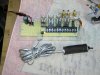
OK - here's my redesign.
I replaced the power relay for the RCA level switcher with a sealed dry contact DPDT relay. The modification also required a simple 7812 voltage regulator (the other relays are 24 volts).
Also shown is the remote handheld A/B switcher.

I may make the LED larger or brighter as well, got to think about that.

I'll put together some simple forms for people to comment on the A/B comparison.


attachment.php
 

Attachments

  • P1251163.jpg
    P1251163.jpg
    125.3 KB · Views: 1,720
The relay change certainly helps this project look serious, but unfortunately, the proximity of low-level signal wiring to high-power speaker circuits will never be acceptable. It's pretty much imperative to use a separate enclosure for the low-level signal relay and its wiring. Good work on that pickle switch, by the way!
 
I don't know about receivers but one capacitor in a speaker can make a huge difference, Just a cheap orange drop instead of an electrolytic will do wonders for a good speaker.
 
The big problem with this shootout is that you aren't dealing with brand new equipment versus "BRAND NEW" capacitors. What would if sound like if you got an SX-850 off the showroom floor in 197? and then recapped it? You will never know. The test is flawed.
 
The big problem with this shootout is that you aren't dealing with brand new equipment versus "BRAND NEW" capacitors. What would if sound like if you got an SX-850 off the showroom floor in 197? and then recapped it? You will never know. The test is flawed.
The test isn't flawed, it isn't even a test - it's more a casual demonstration to see if various individuals can determine (for themselves) if they can hear a difference in the sound and thereby get a feeling for what a recapping might do (or not do).
I'm not trying to make this the definitive test. Just a shared experience.
 
There are so many variables in comparing audio products that a strict test is impossible anyway. So what's left? The subjective. We all use subjective impressions and analysis everyday in our everyday lives, though we would never question ourselves like we do when we have conversations about audio. Why is that?
 
Back
Top Bottom