• The move to the new server is done. There are some software and database maintenance updates in process. This has us passing the hat around to help out. We appreciate any donations. Seriously, even a dollar helps. The payment page may be found here - https://www.audiokarma.org/support.html

Does your Turntable stack records? Do you use this feature?

Does your Turntable stack records? Do you use this feature?


  • Total voters
    189
I have one that would stack records IF I had a spindle for it, not about to pony up $100 or whatever the roaches out there try to sell them for.

Watch ebay faithfully.I got a 45 automatic spindle for 10 bucks for a 1019 and they usually go for 50 bucks or more.

Doug
 
I have one that would stack records IF I had a spindle for it, not about to pony up $100 or whatever the roaches out there try to sell them for.

I have a Garrard changer with the opposite problem. The single play spindles cost half a mint, people will give you stacker spindles. Kind of stupid since the single play one can be easily made with a lathe or probably even a drill press. I had one made, then later I ended up with the original part. The home made one fits better.
 
For Jeff (the original poster) - I started a conversation with you late yesterday and included my email (as requested in #119 above) but haven't heard from you. I'm interested in a trade.
Also,if anyone wants to trade an original multiplay spindle from a BIC 960 for an original single play, please contact me.
Bruce
 
alright, i see SEVEN pages that i won't read all the way through to see if what i am about to say. a lot of DUAL TTs had the ability to stack records and i wanted one but now, if i ever did, i wouldn't want the capability. i thought the dual method was cool, a three legged spider to do the job.

now, of course, i want the spindle to be stationary and possibly threaded to be able to use a record clamp. also, there is no effective way to clean each record with an AQ type brush to remove the surface dust just before the playing of said slab of vinyl.

i agree that the convenience was enjoyable but much more useful with the 45s i ruined (and promptly after purchase, threw away the outer sleeve, printed or not) on my first rekkid player.
 
It seems like many of the people here who are afraid to stack records learned that fear with record players from the 50s and 60s. If those record players damaged records it was due to worn needles or too heavy of a tracking weight, not due to the changer mechanism. My question is directed to people who use modern turntables from the mid to late 1970s and newer, such as Technics, Sony, Garrard, Dual, BIC and other models with modern cartridges and styli and lower tracking force in the area of 1-4 grams.

The modern turntable I've used the longest is a Technics SL-1650 that I bought new in 1977. I used a variety of Shure cartridges including the M91ed, M95, an Audio Technica TK7E and since the mid 1990s a Shure V15TypeVmr with several OEM replacement styli. This setup is still my daily driver. I can assure those who are afraid of stacking their quality records that they won't be damaged by stacking. Many of my favorite records I've owned for decades still sound like new even they they've been played hundreds of time with the Technics SL-1650. Records like the Eagles greatest hits, ELO, Linda Ronstadt's greatest hits and way too many others to mention. Nearly all albums have raised edges and the label area is also raised. When as some have stated, the record comes crashing down, the areas with the grooves don't touch the record above or below it. Hence, no damage. Stacking turntables often cost extra. If they were not popular during the hey day of turntables there would not have been so many manufacturers who made so many stacking turntables.

I listen to records often and don't like to have interrupt what I'm doing to change the record so that's one reason I like stacking records. Sometimes I do serious listening and may opt not to stack as well but that's because I don't mind getting up to turn over the record.
I don't know of any "modern" turntables that offer a record changing feature

Most of the better quality,higher end stereo consoles,from the likes of Magnavox,Zenith,Motorola,and the New Vista RCAs had tone arms with tracking weights of 2-4 grams,like most of the high end turntables of the day.I'm sure there were lower end brands and models that tracked heavier.Most of the heavier tracking record players were either the low end consoles,think Western Auto Trutone or worse,or record players meant for kids and teenagers.

There is a reason why there are so many mint condition Ray Coniff and Herb Alpert records at thrift stores.

There is also a reason console stereos have become popular again,I love console stereos,and own four of them,three Magnavox,and one three channel Motorola.One of the Magnavox is the very first Imperial,from 1958,called the Fantasia.It did not have the original changer when I bought it,so I replaced it with a slightly later Magnavox/Collaro changer from the 60s.I also own a Garrard Type A,in the metal cabinet.After I had the Type A restored,I went on ebay,and bought a NOS set of the original 45 adapter,and non-changer record spindle.They are interchangeable and can be switched.The seller actually threw in a second set free,$10 for both.As others have said,I don't like to use a changer function,because I like to listen to records all the way through.
 
I don't know of any "modern" turntables that offer a record changing feature
AFAIK the last new record changer that was made was the Crosley Stack-O-Matic, which was sold until 2010 or so. The mechanism looks like a BSR knockoff.

crosley1.jpg

maxresdefault.jpg
 
AFAIK the last new record changer that was made was the Crosley Stack-O-Matic, which was sold until 2010 or so. The mechanism looks like a BSR knockoff.

crosley1.jpg

maxresdefault.jpg
I had heard Crosley was making a record changer,but I had not actually seen one.There is no way you are going to compare that to something like a Zenith Micro-Touch 2g,or a Motorola Feather Touch in a higher end console of the day.More like a low end BSR of the 70s,or the cheapest GE changers of the 70s.Crosleys also have record grinding tracking weight.
 
I had heard Crosley was making a record changer,but I had not actually seen one.There is no way you are going to compare that to something like a Zenith Micro-Touch 2g,or a Motorola Feather Touch in a higher end console of the day.More like a low end BSR of the 70s,or the cheapest GE changers of the 70s.Crosleys also have record grinding tracking weight.
The cartridge it uses is rated for a tracking force of 2 to 5 grams:
http://www.thevoiceofmusic.com/catalog/part_detail.asp?PNumberBase=P189
 
That doesn't mean that Crosley and their wonderful QC have it tracking in that range. Their normal all in one junkers with the red ceramic cartridge track at around 7 grams, even though VoM lists it at 2-4 grams. http://www.thevoiceofmusic.com/cata...8&SearchType=GeneralType&MfgName=&Categories=
Those excessively high readings are usually the result of people not realizing that with a spring-balanced tonearm (which Crosleys use), you have to measure the tracking force at the same height as the playing surface of a record, or else you'll get an inaccurately high reading.

And the Chinese knockoff CZ800 cartridge that the all-in-one players use is rated at 4 to 6 grams, not the 2 to 4 grams that the genuine Japanese-made CZ800 is rated for.
 
I have a Technics SL-1650 that I've been using since I got it new in the late 1970s. Of of its features is the ability to install a stacking spindle for so you can stack up to 6 records. While I usually use it with the single play spindle, I also regularly use it with the album stacking spindle. . . I'm wondering how many other people have a turntable with this feature and if they use it.
Haven't had one since about 1984 when I replaced a Garrard GT55 with a Thorens TD146. I did enjoy using the stacking feature of the Garrard and the BIC 960 I had before that with no concerns about record damage. Before that, I stacked records on my parents' old Silvertone radio/phonograph.
 
Those excessively high readings are usually the result of people not realizing that with a spring-balanced tonearm (which Crosleys use), you have to measure the tracking force at the same height as the playing surface of a record, or else you'll get an inaccurately high reading.

And the Chinese knockoff CZ800 cartridge that the all-in-one players use is rated at 4 to 6 grams, not the 2 to 4 grams that the genuine Japanese-made CZ800 is rated for.
Wrong. I once owned an Electro Brand all in one player identical to a Crosley with the same lousy "turntable" and have examined Crosleys before. They have no "spring balance" mechanism in their crappy tonearm. Like I said in my previous post, they track at around 7 grams.
 
The only turntable I currently have right now that is capable of stacking records is my Dual 1214 that currently needs cleaning and lubrication. I have both the 45 and the LP stacker spindles for it. I am also in the camp that stacking records does them no major damage as long as they are clean. I used to stack them frequently on my old ceramic cartridge equipped BSR changer and they still sound fine on my current turntables.
 
Last edited:
They have no "spring balance" mechanism in their crappy tonearm.
The ones with an aluminum tonearm definitely do have a spring to set the tracking force. I know because I just modified one recently to increase the spring tension to get it down to its minimum spec of 4 grams. (There is no thumbscrew to adjust it like on old BSRs, but you can adjust it by carefully unhooking the spring and re-hooking it on a different loop.)

The really cheap ones with an all-plastic tonearm don't have a spring or counterweight, because the entire weight of the tonearm and cartridge is 5 grams, right in the middle of its recommended range.

Like I said in my previous post, they track at around 7 grams.
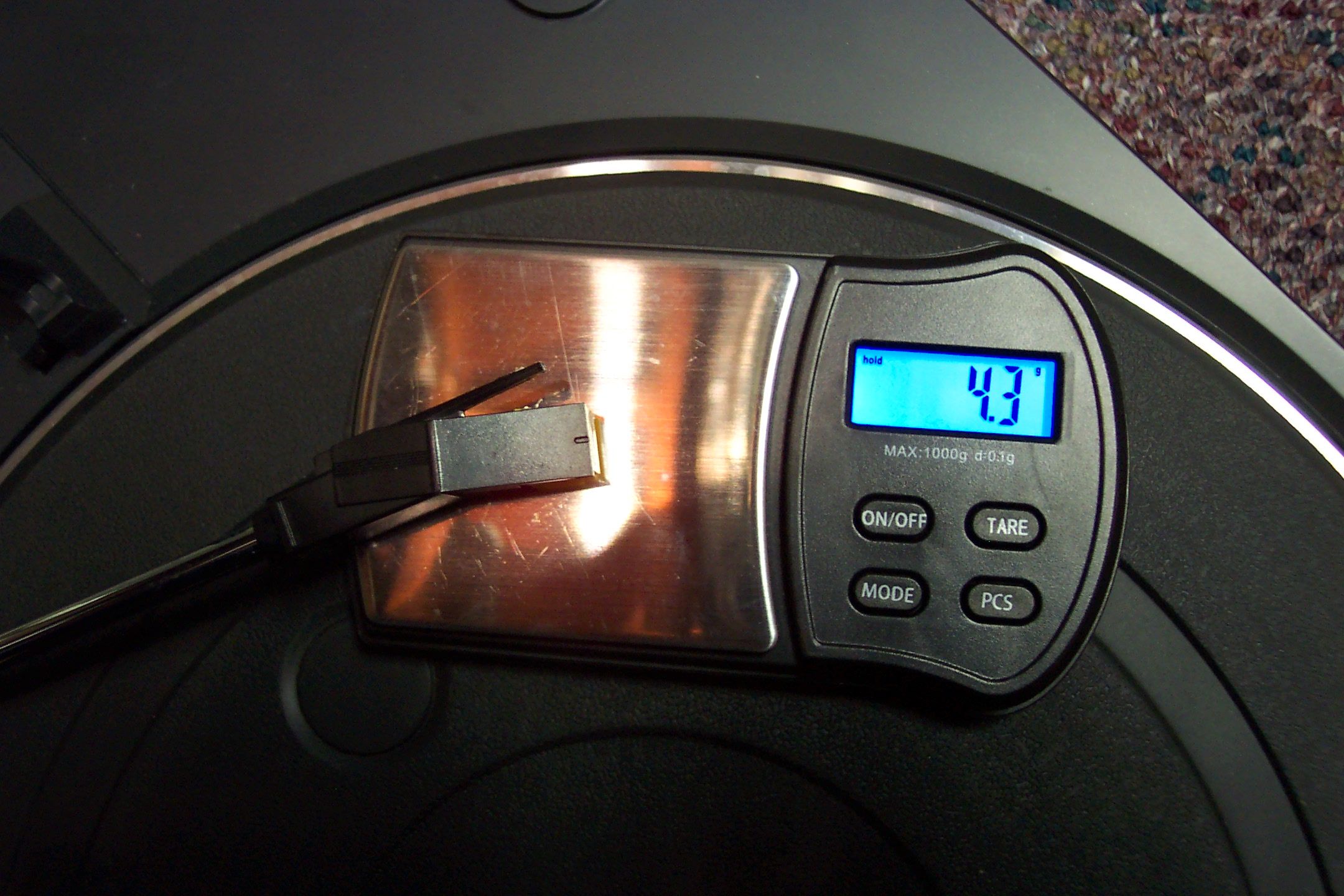
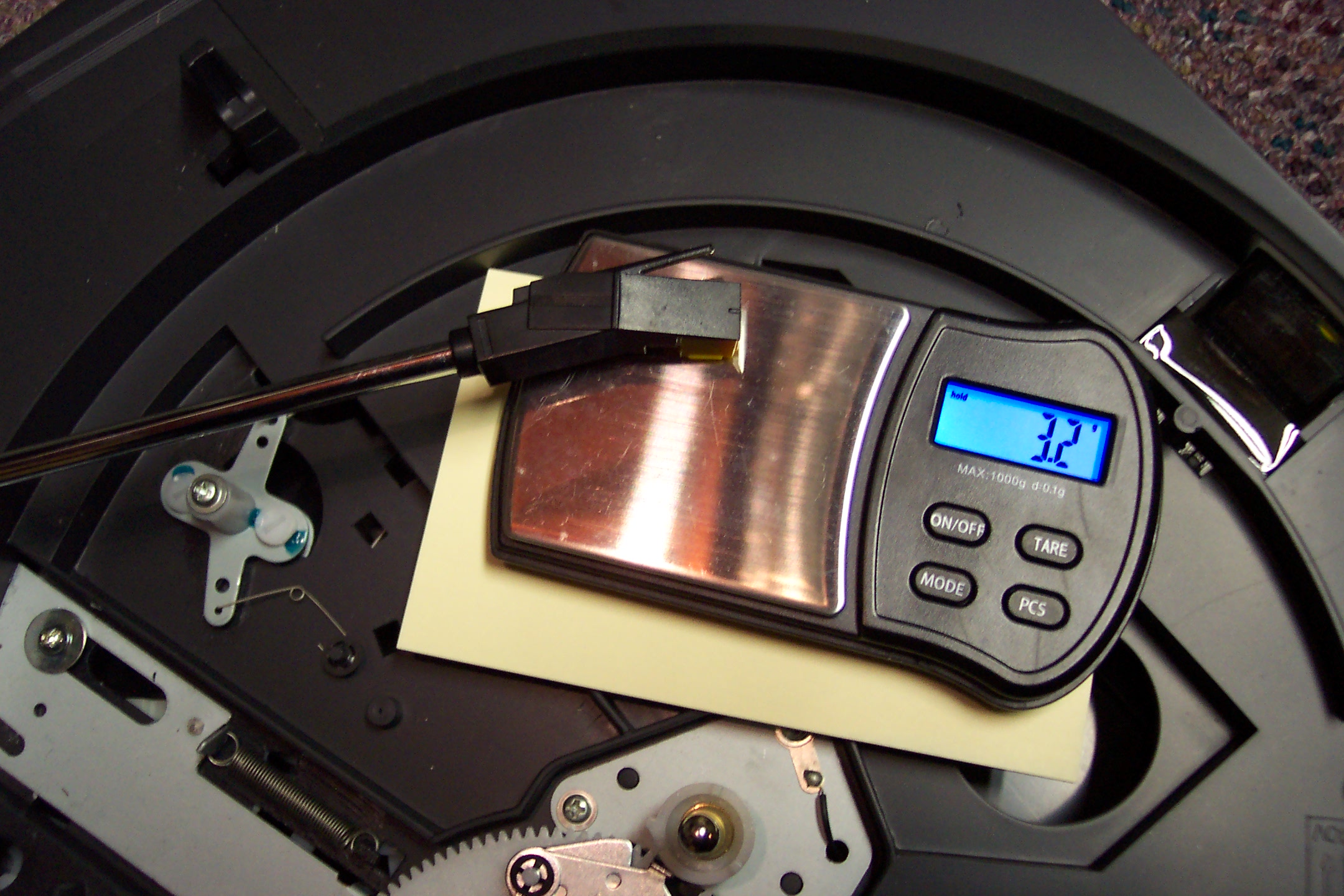
How did you measure it? If you placed a scale on top of the platter, you did it wrong.

I demonstrate it here with a Pioneer PL-990, but the concept is the same with any turntable that uses a spring-balanced tonearm:

Incorrect -- scale on top of platter:
tracking1.jpg


Correct -- scale at same height as the playing surface of a record:

tracking3.jpg
 
The ones with an aluminum tonearm definitely do have a spring to set the tracking force. I know because I just modified one recently to increase the spring tension to get it down to its minimum spec of 4 grams. (There is no thumbscrew to adjust it like on old BSRs, but you can adjust it by carefully unhooking the spring and re-hooking it on a different loop.)

The really cheap ones with an all-plastic tonearm don't have a spring or counterweight, because the entire weight of the tonearm and cartridge is 5 grams, right in the middle of its recommended range.


How did you measure it? If you placed a scale on top of the platter, you did it wrong.

I demonstrate it here with a Pioneer PL-990, but the concept is the same with any turntable that uses a spring-balanced tonearm:

Incorrect -- scale on top of platter:
tracking1.jpg


Correct -- scale at same height as the playing surface of a record:
tracking3.jpg
I obviously don't know (or care about) every single model Crosley has made. I DO know what mine measured at, and that my example and the ones I have had experience with had no tension springs. And at this point I really don't give a rat's ass because I won't even fool with that type of garbage anymore. Now I only own and repair high quality turntables.
 
Back
Top Bottom