• The move to the new server is done. There are some software and database maintenance updates in process. This has us passing the hat around to help out. We appreciate any donations. Seriously, even a dollar helps. The payment page may be found here - https://www.audiokarma.org/support.html

Does your Turntable stack records? Do you use this feature?

Does your Turntable stack records? Do you use this feature?


  • Total voters
    189
Many people (mostly younger ones) think that stacking records will damage their precious vinyl collections, but this is not necessarily true. I'm an audio engineer, who's been using record changers for 60 years and I can unequivocally tell you that if you own a proper changer, your vinyl records are totally safe. Of course, older 78 RPM records made of shellac are a different story. My extensive and well-played record collection is pristine.

Almost any stereo record changer manufactured after 1958, that doesn't mechanically man-handle the records (sliding, tilting, or using blades) will not harm your records one iota. Most changers made in the '60s and '70s, using a balance arm or an umbrella type spindle, fit this bill. This web site contains an excellent chart, listing which record changers are safe to use: https://midimagic.sgc-hosting.com/safchang.htm. It also explains and debunks many myths about how record changers could damage your records.

That being said, finding a record changer that doesn't damage your records, is only the beginning if you want to find one that can do justice to your vinyl collection. You'll probably want one that sounds great as well.

Over the years, I've owned hundreds of record changers. Some were better at handling the records and others were better at playing them, but only a few could do both well. One of my favorite record changers of all time, is the Dual 1219/1229
record changer. It was manufactured in Germany during the early '70s and the build quality was exceptional. I think it represents the peak of record changer technology. In the years following this model, record changers suffered a slow transformation into nothing more than a cheap novelty, before they finally disappeared entirely.

The Dual 1229 has a heavy, 12" platter that weighs almost 7 lbs. It's driven by a synchronous/continuous-pole motor with an idler wheel. Any modern 1/2" cartridge can be attached to its headshell via a removable slide with tracking force adjustable down to <1g. When the "multiplay" mode is selected, the entire tonearm raises up to accommodate up to 6 stacked records. This, along with an extremely long tonearm (about 9" from pivot to stylus), mitigates any significant change in VTA (<5°) when multiple records are stacked.

The point is simple, there are many vintage record changers that can handle your delicate vinyl treasures without damaging them in the least, and a few of them are serious, high-quality turntables as well. You just have to find them. Constantly handling individual vinyl records (putting each one on the turntable, flipping it over, then taking it off to put another one on), will put your records at greater risk of damage than stacking them ever would. Owning a quality, well adjusted and maintained record changer, but being afraid to stack records on it, is a sacrilege and unless you really need the exercise, there's no other feasible way to play 7" 45's.
45-J-2 Spacing Between Records.jpg
 
Don't disagree with any of the above, other than to point out that the other top changers of the time are on pretty equal terms with the Duals. Tastes differ, of course.
There are at least three issues with changers, all of which I am sure have been raised before: mechanical complexity, which is made worse by the effects of time on the lubrication of all the many parts, the resonance of all those parts, and (for me, the major one) the inability to play one track at a time, or to skip noxious tracks. You have got to want to listen the whole side for a changer to be satisfying.
I have been perfectly happy using changers in single play mode, listening to the tracks I want, or the whole side. I don't see that comparable single play turntables sound much better - I do have a fondness for the idler table's urgency which makes up for any possible higher noise floor compared to equivalent belt or direct drives. I do think that as you go up the price scale, single plays start to sound meaningfully better, but at the price levels they sold for back when they were made, and even now, the best changers hold their own.
 
There's no doubt that vintage record changers can be complex mechanical monsters (especially the Dual 1229), but that's the whole point. They were purposely over-engineered to squeeze some amazing specs into a consumer turntable that would last for decades. In 1971, when I purchased my first one, a Dual 1229 cost $250 (over $1,600 in today's money) and was sold as a "Professional Automatic HiFi Turntable". They were never intended to be amateur equipment and owners knew they needed to maintain them accordingly.

As far as skipping obnoxious tracks, that is the reason that the Dual 1229 made an excellent single play, manual turntable as well as a record changer. Also, back in the day, people (like me) would buy 7" 45 RPM singles, so they wouldn't have to buy the other worthless tracks included on the album.

I have hundreds (maybe thousands) of records. Most I enjoy listening to in their entirety and I happily play them on a record changer. Others I enjoy playing only selected tracks, so I play those on a manual turntable. My singles (45s) are always stacked on my Dual 1229 (using the AS-12 adapter).
 
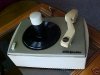
I have a Dual 1219 that is waiting for me to get around to servicing it. I have both stacker spindles for it, and I plan to use them. I also have a little RCA 6JY 1B changer that I am going to mount a MM cartridge in so I can hook it to my stereo. I also need to rebuild/replace all the rubber parts while I am at it.

rca 6-jy-1b.jpg
 
I also have a little RCA 6JY 1B changer that I am going to mount a MM cartridge in

Very nice 6JY beat_truck. I've restored quite a few of these over the years and, my only word of caution would be to make sure that your 6JY has a metal turntable (platter), not a plastic one, before you retrofit it with a MM cartridge. The plastic turntable is so light that the MM cartridge winds up amplifying the wow and flutter (caused by the cheap motor used in these units) to unacceptable levels. Metal turntables are hard to find, but they do exist. The 45-J-2 I showed in my previous message has been retrofitted with a metal turntable and works like a charm.

When you're done, you'll have a fun little novelty, but it will never be a serious piece of audio equipment. I still like them though. ;)
 
When you're done, you'll have a fun little novelty, but it will never be a serious piece of audio equipment.
Oh, I know. It'll still be perfect for playing a stack of old 45s in varying conditions. I have at least 1000 of them.

That's actually not a pic of my machine, but it looks identical.

I also have an RCA 45 EY4 waiting to get restored someday, too.
 
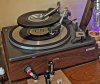
D46067F0-A992-41BC-84B6-767343A24247.jpeg +1 on Dual changers. I’ve got a Dual 1249 (with base and cover this retailed for $320 in the mid 70s). It cycles through a stack of 6 LPs like a champ. Makes listening to box sets super enjoyable! Plus simple back ground music. 6 records will play for a while.

I run a Dual 704 in my main listening room/rig. But in the general living room it’s a Dual changer all day long.
 
My issue with changers is that they only play one side of the album at a time, so unless you have a multi-disc album that is changer sequenced, you'll either hear several disparate half-albums or a shuffled up longer album. Granted, that's not really the end of the world, but I usually listen to a full album when I'm spinning vinyl, so it's just not a feature I use too much on my Dual 1229. I would use it more if I had the 45 stacker, but alas those are rare as hen's teeth.

Still, it's a fun little feature to have, and makes for a neat party trick, if anything.
 
Many box sets and double/triple album sets are purposely stamped for changer playback. For example Side 1, 2, 3 etc are on different records.

But in general when I am listening critically to records I’ll use my 704.
 
I would use it more if I had the 45 stacker, but alas those are rare as hen's teeth.

Yes, the AS-12 has always been hard to find. That's because it was never included in the purchase of Dual 12xx turntables, but instead was an optional ($5.00) item. Because the price of a Dual 12xx series turntable was rather high for the time, most of the American Dual purchasers were older adults, who didn't care much for playing 45s. Back then, 7" 45 RPM records were mostly for the teenage market. Added to the fact that the European market never embraced the 45 rpm "large hole" format and sold 7" 45s with a small, standard spindle hole that could be punched out for large hole applications (mostly jukeboxes) only if necessary, the AS-12 adapter was never a global hot seller. As a matter of fact, they were pretty much relegated to either being included with high-end console units (not very common) or to remain unsold on the shelves at Dual dealerships and record stores. With their longevity and current popularity, there are many 12xx series Dual turntables still in use today, but not enough AS-12 adapters to go with them, hence their rarity and associated high price when one can be found for sale.

This is why I purchased 10 of them at a liquidation auction a few years ago. They were part of the inventory of an audio outlet that went bankrupt in the late '80s. I paid about $12 apiece for them, brand new, in unopened boxes. These days, you'de be lucky to find a used one under $100. At that same auction, I picked up about 2 dozen brand new Dual 1219, 1229, 1229Q, 701, 704 and 721 turntables, still sealed in their original boxes. The 1229s even had sequential serial numbers. I wish I could find another auction like that. The spare parts I picked up there, lasted me for years and I still have (and regularly use) the TEAC A-2300SD R2R tape deck I bought there.

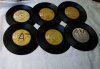
European 45.jpg DUAL-AS-12.jpg
 
The 1219 is a fine table, no doubt, but Dual calling it "Professional" means no more than Fisher calling their stuff "Studio Standard".
There are professional tables but they are used by radio stations, record and equipment makers and the like. Things like EMTs (which I think were sold as Gothams in the US), the big Technics, Thorens and Garrard 301/401, and then RekoKut, Russco, Sparta etc (the latter ones being very radio station oriented). These were all single play, and most needed arms and plinths.
Obviously there is some overlap in the markets, and amateurs/regular consumers can and do use the professional tables, and I wouldn't doubt some radio stations used a Dual.
The DJ market, which apparently is substantial, overlaps both the professional and amateur worlds, the later Technics SL 1200s being used in all sorts of settings.
 
Garrard did something similar with their "Laboratory" and "Synchro-Lab" series. It definitely gives them an air of prosumer mystique, but I highly doubt they would ever be used in any sort of laboratory setting. Perhaps they met some vague professional broadcast standards in their respective countries, but that's like...effectively meaningless, especially 50-60 years later. That being said, an SL95B would probably be my top choice for a 45 spinner, since their 45 spindles are far more common than the Dual ones.

I'll also leave this not-too-hot of a take-Dual probably would have fared better against Technics and their ilk had they made the 1229 a manual variant of the 1219, and kept the 1219 around as their deluxe autochanger model. As far as I can tell, the 1229 is just a 1219 with a neon strobe and a different platter mat, and came out right as the market shifted away from changers. I honestly use mine more as a semi-automatic anyway.
 
I spent 3 years as an Armed Forces Radio Services (AFRS) radio DJ (top 40) during the early '70s while serving in the Navy aboard the USS Independence (CV-62). All 4 of the turntables I used at my console were Dual 1219s, each fitted with a Shure SC35C cartridge and an SS35C stylus. The SC35C cartridge had just been introduced at the time, so we (the U.S. Government) got pre-market access to them directly from Shure. These 1219s were set up for manual, single-play operation only because DJ records included individual tracks from many different artists on them and the track "run-outs" and "run-ins" don't connect with each other. That's why it takes at least 2 TTs (4 is better) to keep the on-air music flowing smoothly.

The Dual 1219/Shure SC35C combo was the most professional turntable setup that any radio DJ could ask for back in the day, so nobody can tell me that the Dual 1219 was only a quasi-professional turntable. It was built like a tank and was professional all the way. It even met mil-spec standards back then.

I don't think that any other turntable (or cartridge) available at the time, could've taken the constant punishment these Dual 1219s were subjected to. They were abused 24/7. We were scratching (cueing records by turning the platter forward and backward by hand), pulling & dropping records while the platter was still moving (stopping it by hand), and spilling coffee (and other stuff) on them. We never even used the cueing arm. We just lifted the tone-arm and dropped it on the record as close as we could get to the start of the track. Then we just scratched it to get the stylus where we wanted. When ready, the TT was powered up (while the stylus was already "in the groove") and came up to speed (from a dead stop) before the abbreviated "run in" was over (what a great motor!). They never got a rest, yet they only required minor maintenance to keep them going. Of course, we did go through quite a few SS53C stylii, but the cartridges were amazingly durable.

My opinion of the Dual 1219/1229 remains unchanged, even though I've used almost every commercially available turntable sold during the last 50 years, at one time or another.
 
Last edited:
I use my Garrard AT60 as a jukebox, using records which are not new or in pristine condition.

Yesterday was a Strawbs singles day -

IMGP7882.jpg strawbs.jpg

I also use it for 12" singles which again are not too valuable, they do hit the platter with a thwack when they drop!

Lots of fun, I'll have a band/music genre/decade themed session quite often. The only real problem is some of the later 80s onwards vinyl lack the 'grip' pressed into the record resulting in slippage.
 
I don't stack for several reasons, but primarily because I like to clean each side before play, and secondarily, because I like to play a whole album. But in the "digital" world, there's a new reason. I use my TT to digitize an album, then use MediaMonkey as my virtual "Accutrac".

Another was the ADC Accutrac +6 from the 1970s. It couldn't play the other side of the records, but it could play tracks from them in any sequence, with a piston in the middle of the platter for lowering records from the stack, as well as lifting them back up so that tracks could be played from whichever disc you desired. Amazingly, it actually seemed to be working, unlike most of the Accutracs out there. Pretty cool, if you ask me! Now, I just need to track down a Thorens TD-224... :cool:
-Adam

I remember when we used to sell those. They were fun to watch. There's an episode of "Columbo", (S06 E03 · "The Bye-Bye Sky-High IQ Murder Case"), where one of these was used as part of the murder weapon.
 
No way....could you imagine stacking blue notes....good grief....Get off ur butt and change a record....:biggrin:

not to mention your VTA being all over the place....
 
Last edited:
More then [sic] once, I have had a record hang just long enough to fall in the tonearm. It occurs when the LP is a little thicker or thinner than normal and you just happen to stack them in a certain order that the spindle does nor properly grab them.

The truth is... this happens when your record changer needs some attention. Don't blame the changer. There's no such thing as a "thick" (or thin for that matter) record that causes a properly maintained Dual or Elac record changer to hang up and fall on the tonearm. For gosh sake, these things will handle old single-sided shellac 78s (not that I would recommend doing so) without ever doing that. If you purchased a new record that has never been played before, the center hole might possibly be too tight, but that would be a factory defect of the record and should've been corrected before playing. Either your spindle needs repair or replacement or your TT needs repair, adjustment, and/or lubrication. It's never "just a thing" that record changers sometimes do. The "thing" is, they occasionally need maintenance to keep them running flawlessly, which is something they can do.

My current Dual 1229 plays several thousand records a year, it's played almost every day (not necessarily by me). It plays old LPs and new LPs (weighing 120g,150g,180g & 200g), plus many 7" 45's (where thickness can really vary) and not once has it hung up and hit the tonearm. Because of this extraordinary use, I occasionally open it up, examine it, adjust it, lubricate it, and replace any worn out parts I may find (usually just the steuerpimpel and less often, the mode selector washer). I perform this maintenance annually, which may be a pain in the neck, but considering how much use it gets and the fact that my Dual 1229 has never fallen on the tonearm and damaged the stylus on my Shure V15 Type IV cartridge, I think it's well worth it. Of course, unless you use your record changer as much as I do, you would not need to service it as often, which would make it much less of a chore for you.

Sorry HTHMAN, but assuming that a record changer is just an inherently sloppy device that cannot be counted on to consistently and reliably operate, in such a manner as to not damage your stylus, is a ridiculous assumption. If it prevents you from using your changer, I'm sorry for that too.
 
My first two TTs, a bottom-of-the-line BSR and a BIC 960, allowed stacking. I did it very rarely. I think I tried it on the BIC to see how it worked. I couldn't stack on my Phillips GA-312 or the Rega Planar 2 listed in my sig, but I had no desire to stack records after I ditched the BIC.
 
I don't stack for several reasons, but primarily because I like to clean each side before play, and secondarily, because I like to play a whole album. But in the "digital" world, there's a new reason. I use my TT to digitize an album, then use MediaMonkey as my virtual "Accutrac".


I remember when we used to sell those. They were fun to watch. There's an episode of "Columbo", (S06 E03 · "The Bye-Bye Sky-High IQ Murder Case"), where one of these was used as part of the murder weapon.
Yep, I now own one of these wonders, and amazingly, it still works! :)
accutrac4000_open.jpg

Got the (dealer?) demonstration record which goes with it, too:
accutrac4000_demo1.jpg

Getting back to record changers, since I wrote my earlier post, I've learned that the Accutrac +6 does not, as I originally thought, have the ability to program different tracks from different records in the stack as the raising piston would seem to facilitate. Not entirely sure what the point of the +6 would be otherwise, but I think it's safe to say that ADC/BSR didn't put as much thought into these things as they should've... :dunno:
-Adam
 
Back
Top Bottom