• The move to the new server is done. There are some software and database maintenance updates in process. This has us passing the hat around to help out. We appreciate any donations. Seriously, even a dollar helps. The payment page may be found here - https://www.audiokarma.org/support.html

Double Advent System Advice Needed

Tell us, please, in what specific respects you perceive the doubles to be "better."
The single New Large Advents, while quite melodic, sound somewhat strained on the upper end, sort of vapid, the bass is tight and precise, and the midrange is harsh and somewhat weak in the crossover range. There doesn't seem to be sufficient or anticipated amplitude or air to the sound.

The stacked double New Large Advents on the otherhand seem to get rid of deficiencies of the single configuration. A spaciousness is created with them in tandem, the bass remains authoritative, yet is reinforced, while the mids open up and settle down, and the high end becomes more lively. The stacked double New Large Advents really begin to perform better than expected when they are fed sufficient power for the dramatic hair-raising peaks they are capable of, pulled out into the room per Cardas and sonically altered with a -6dB baffle step compensation circuit with a little high end boost. As has been said of the stacked double Large Advents they really "lock in" with the addition of BSC. Try it you may like it. Obviously not for everyone, especially those who let an overanalytical mind get in their way of enjoying what others have come to appreciate.
 
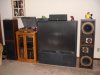
I have had stacked Original large Advents as my main channel speakers for about a year now. They are placed on the floor, upper pair upside down, and wired in parallel. My Sony "100 WPC" receiver hasn't had any problems, and I love the sound. Some of the scientific explanations in this thread are WAY over my head, but my nonscientific explanation is that the 2 pairs of speakers fill in the weak points of the single Advent. The crossover point is smoothed out, and the high end is extended. The bottom end, of course, rocks the frickin' house! I bought these already refoamed, and these 2 pairs cost me a total of $200. Try to do better than that.

Here's a picture:
 

Attachments

  • 001.JPG
    001.JPG
    138.7 KB · Views: 186
Is it necessary to stack them to derive most of the benefits discussed here, or can I get similar results placing them side by side?
 
Ray-

Try placing them any way you want, but I suspect that the best soundstaging will cime from the vertical staqck
 
Kudos to you, Adam, for your contributions to this thread.
I just calls 'em like I sees 'em. Or hears, whatever.

The inherent presumption being that the two are mutually exclusive? Not hardly. Measurers also listen, and have the same purpose.... :yes:

There's no inherent presumption. One goal has to be the primary purpose (and may be something other than these two).
And I would hope measurers also listen, and at some point would have no further need to measure while listening, they would know what their preferred response profile sounds like.
But what one cannot measure is what someone else enjoys, nor dictate what another should enjoy. It does not matter how much measurement data is used to justify this.

With that, I don't intend to have any further input on this issue as this thread has no need for it.
 
Jackfish when you added the BSC circuit weren't you smoothing the frequency response? That in my view is where this discussion should be going. How stacked Advents can achieve better sound despite inherent limitations of multiple drivers. I'll throw one out for advocates. The drivers don't work as hard at any given volume level so they don't heat up as fast. Excess heat will negatively affect sound quality. Does that overcome room interactions? Don't know but I'd like to. So its all good. We're just learning here. By the way what kinda speaker do you think Mr. Kloss could have made with modern tools and a higher price point back then!
 
Jackfish when you added the BSC circuit weren't you smoothing the frequency response?
Of course. Advents are known to have a peak at 1.2 kHz of about 10 dB, audible as a shouty, forward, harsh (mostly on bad recordings) quality, and also slightly boxy due to the shape of the bass/mid-bass response. This is over accentuated when the speakers are moved away from the walls. It is real apparent with single configurations, much less so with stacked doubles. That is why the BSC provides a definite improvement. But the so-called distortion caused by comb filtering due to like drivers in close proximity emitting like frequencies is not apparent. What are we supposed to be hearing if this distortion is present? From all I've read about comb filtering and my aural experience, it seems that it is not obvious in the stacked double Large Advents.
 
Is it necessary to stack them to derive most of the benefits discussed here, or can I get similar results placing them side by side?
Read this post by RayW in a previous thread:

http://audiokarma.org/forums/showthread.php?p=982267#post982267

And for those who would deny the import if the deliterious effects, this post:

http://audiokarma.org/forums/showthread.php?p=983713#post983713

Also read again the link posted by Jackfish @ #15, above. The effects are significant. Comb filtering generates an artificial phasey "ambience," and degrades imaging:

http://www.moultonlabs.com/index.php/more/about_comb_filtering_phase_shift_and_polarity_reversal/

Jackfish when you added the BSC circuit weren't you smoothing the frequency response? That in my view is where this discussion should be going. How stacked Advents can achieve better sound despite inherent limitations of multiple drivers. I'll throw one out for advocates. The drivers don't work as hard at any given volume level so they don't heat up as fast. Excess heat will negatively affect sound quality. Does that overcome room interactions? Don't know but I'd like to. So its all good. We're just learning here.
The benefits of lower distortion and increased dynamics have been well covered previously in this forum. Heat and power compression are probably minor factors; it's more likely that excursion limits prevail over thermal effects.

I offer this analysis of Jackfish's setup: Advents and similar "bookshelf" speakers were designed for use with boundary reinforcement to enhance the bass response. Once you move them out into freespace, baffle step occurs, but mutual coupling in stacking partially compensates for that.

Let's add it up. You've lost 6 dB of LF response by moving the speakers out from the wall. Stacking them gains 3 dB full-spectrum (ignoring combing,) but mutual coupling of the woofers boosts the bass by an additional 3 dB, restoring half of the stock balance. They play louder, but with 3 dB less bass response.

So, to restore the stock spectral balance, the mids and highs must be cut by 3 dB, which is what baffle step compensation does. Jackfish cuts them by 6 dB, instead, and then restores the highs by boosting them "a little." Raising the lower woofer off the floor may be a further factor in reduced bass response; the floor is a 6 dB boundary.

Bottom line: He's listening to his stacks nearfield in free space with both passive and active compensation revoicing the system with augmented highs, and perhaps lows, as well. Increased dynamics from stacking is not available at low frequencies; it's been traded for lack of boundary reinforcement....

Of course. Advents are known to have a peak at 1.2 kHz of about 10 dB, audible as a shouty, forward, harsh (mostly on bad recordings) quality, and also slightly boxy due to the shape of the bass/mid-bass response.
This would come as news to many AK members. I'll see again if I can arrange to measure some Large Advents.... :yes:

 
Hi Jackfish and thanks for the clarification. I rather let others answer the comb filtering distortion question. I'm more interested in smooth on/off axis response with speakers. You may enjoy these comments by Robert Greene of Absolute sound:

http://www.regonaudio.com/
 
My stacked New Large Advents and Advent/1s definitely sound better together than alone. Louder and better. Before stacking them I would have agreed with Ausjoe's assertions that the resultant "comb filtering" would degrade the sound. But, at least in my case they sound better. The image is rock solid and though not ruller flat there are no deep nulls.

How do I know there are no nulls? When testing a replacement woofer a few years ago actually did a slow frequency sweep through my speakers measuring for peaks and nulls. Though the response deviated from flat there were no sharp peaks or dips. Miked at about 8 feet centered between the speakers. The shirllness that sometimes pops out is tamed by the combination and the bass response is tighter as well as enhanced. My arrangement is standard stack, one upside down on top of the other, the bottom speaker has 1 1/2" spikes coupling it to a carpeted concrete floor. They are about 8" from the back wall. The room is about 13 by 20 with the speakers along the long wall. I drive them with any of several Marantz receivers, 2230, 2235B, 2240, 1060 amp, or a Yamaha CA610. Sometimes I use a second amp to power a third pair of Originals to the side.

That being said, there is no way I can, or could, explain why they sound so good to me. I do know that if there was horendous phase distortion or outrageous frequency response errors they would not appeal to me. Maybe it's the room, maybe it's my ears, I dunno. But, the only speakers I would give up my stacked Advents for are the Dahlquist DQ10s.
 
Hi Justw you don't need ruler flat response in IMHO. Most people seem to enjoy a smooth midbass rise. The key is smooth. FWIW. How to achieve that, now there's the rub. Back to doing taxes!
 
Maybe it's the room, maybe it's my ears, I dunno. But, the only speakers I would give up my stacked Advents for are the Dahlquist DQ10s.
From the just cited Robert Greene of Absolute Sound:

"The popular audiophile speakers of the early years were often far off the mark. The Dahlquist DQ-10 was almost a public embarrassment if one compared it to an actual instrument, live versus recorded."

http://www.regonaudio.com/Audio in Modern Times.pdf

[I think we've got chaos here.... :yes: ]

Hi Justw you don't need ruler flat response in IMHO. Most people seem to enjoy a smooth midbass rise. The key is smooth. FWIW. How to achieve that, now there's the rub. Back to doing taxes!
Do it with parametric EQ, not the speakers. Chances are your preference may change as soon as the next time you listen.

May we see a citation for your "midbass rise" assertion? Green certainly doesn't think so, and neither do Toole et al., Voecks, Thiele, etc.

From what you've said so far, it would appear that constant directivity and uniform power response should be high on your list of priorities....
 
Hi Zilch. I plead distraction due to the tax thing. I'm working on those at the same time in another window. Just popped in yo give a quick answer to Justw. I should have said some people do. Not most by any means. And I think it was someone quoting Paul Barton talking about Tooles research that said it besides any subjective observation I may have. Logic would certainly agree that flat on/off axis frequency response is best. And in my experience that is true. Jeez do taxes have to get harder every year.
 
And for those who would deny the import of the deliterious effects, this post:

http://audiokarma.org/forums/showthr...713#post983713
Ok, but he also says this later in the thread: http://audiokarma.org/forums/showpost.php?p=985114&postcount=68


From http://www.moultonlabs.com/more/about_comb_filtering_phase_shift_and_polarity_reversal/P0/
All this, so far, is straight-ahead no-brainer stuff, but it now begins to get a little weird. Two phenomena that we have to ponder out on the edge of the audio twilight zone are "the quality of out-of-phase-ness" and "how come we don't always hear out-of-phase-ness."

This leads to the second big issue: how come we don't always hear “out of polarity?” (or "out-of-phase-ness")

C’mon, admit it. You don’t.

Think about it. Phase shift and comb filtering are everywhere. In a typical room you are usually listening to several hundred delayed versions of original signals all the time, and every time you shift your head by a couple of inches, you are into big-time acoustical phase shifting and comb filtering. But you don’t really hear them, even though they are predominant in the environment. If you don’t believe me, run down to your local Radio Shack, pick up their $35 Sound Level Meter (one of the great audio bargains of our century and a necessity for every truly cool recording engineer), run back to your studio, put up a 2 KHz. sine wave in the monitors, stand back in the room and start observing the levels on the Sound Level Meter. As you slowly move the meter around, the levels will swing wildly across the range of the meter. These varying levels are due to the constructive and destructive interference patterns caused by changing phase shift between the direct signal and all the reflected paths as the meter’s location changes. But when you move your head around, you may hear a little change in level, but hardly any sense of phase shift at all -- certainly not like negative killer flange or other bozo effects so dear to us all.

The truth is that our magnificent hearing system doesn’t present the state of phase of sound waves to our conscious mind. It detects phase all right, but uses it to help with localization instead of timbre. We use all that phase shift data to localize sounds in space, but we don’t consciously detect it as a sound quality.
 
"Localization," yup. :thmbsp:

Again, like Ray, I encourage anyone and everyone to try this stuff as interest and opportunity arise, but having an understanding and appreciation of what is actually going on is an important part of the evaluation process.

What ARE the advantages and disadvantages of any particular approach? What tradeoffs am I, as listener, willing to make?

As part of that analysis, we should also ask ourselves what others whose job is to know this stuff do. What sound professional or loudspeaker manufacturer advocates this approach?

None? Why not?
 
From the just cited Robert Greene of Absolute Sound:

"The popular audiophile speakers of the early years were often far off the mark. The Dahlquist DQ-10 was almost a public embarrassment if one compared it to an actual instrument, live versus recorded."
:bs:

Now I know why I never cared for TAS. Stereophile and J.G. Holt were tops.
But, I've never lived with a pair of DQ10s....:scratch2: In any case I don't recall them ever sounding bad.
 
I'm thinking of hooking up my first ever double Advent system, & need some advice. I have a pair of Original Large Advents I'd like to hook up with a pair of New Large Advents. Is this a good idea? On paper, it seems that they would compliment each other, but I have no practical experience or knowledge of how this would actually work out. Has anyone here done this?


Absolutely!! Stack 'em three high if you like!!! Let us know how you like the sound, comb filtering, midbass bump, shrill tweeters, and all.

(this thread had drifted way off, just trying to get the right message through all of the hyperbole)
 
Warning Utter Nonsense Follows: "Advents are known to have a peak at 1.2 kHz of about 10 dB, audible as a shouty, forward, harsh (mostly on bad recordings) quality, and also slightly boxy due to the shape of the bass/mid-bass response".


I don't agree with the opinion that Advents need compensation to have flat response. I think it is about as uncolored as any speaker ever made. I think this article sort of supports my opinion..I suggest Qtips.

http://www.stereophile.com/standloudspeakers/171advent/
 
Warning an Accurate Statement Follows: "Advents are known to have a peak at 1.2 kHz of about 10 dB, audible as a shouty, forward, harsh (mostly on bad recordings) quality, and also slightly boxy due to the shape of the bass/mid-bass response".
spktwo.jpg

I suggest if you have your Advents away from the walls you need baffle step compensation. If you haven't tried it you aren't really qualified to comment, are you?

The top curve of the top chart shows the on-axis frequency response. There is a definite peak near 1.2 kHz. Source is CBS Labs for High Fidelity Magazine.
 
Back
Top Bottom