Quite a discussion here. I am new to vintage audio and having a great deal of fun. Advents looked like a great way to get my feet wet without spending a ton of money on something I know very little about. I now have 3 sets - 1 rev 1 walnut, 1 rev 2 walnut, and one rev 1 utility. I re-foamed the rev 1 walnut, and on both rev1 &2 walnut I recapped, replaced the linen on the grills, and cleaned and oiled the cabinets. They look and sound awesome! Alone or stacked. I spent some time on the room set up too. It's a multi purpose room so I did what I could and feel I have the optimal setup given limitations.
I have spent an inordinate amount of time stacking and un-stacking these things as well as repositioning them to compensate for the shape of the room and its contents as well as changing the switch position on each set. I also set them side by side, upside down, upside right, sideways with woofers on the inside woofers on the outside. The combinations are endless.
I started with the A/B parallel setup because it is the most straight forward and makes the most sense. And I stacked them vertically with the top one upside down. They sounded really great. Up to 1/3 volume. The problem I had was the receiver's B output is either bad or variations in the signals are causing so much interference that they cause a truly awful noise above 1/3. Not good.
So I reversed the polarity just to see what it sounded like. And yes the bass was there but much diminished. With the top one set to decrease and the bottom one set to extend the vocals and strings and quite a lot of it was stunningly clear and concisely placed. The separation between instruments and vocals - the sound stage - was better than the parallel A/B. I could turn it up loud without the awful noise. But it wasn't right because I need more bass!.
So I tried parallel configuration from the A output only. And presto - the awful noise went away and I could play them above 1/2 or louder without the awful noise! And they sounded great. Victory. But there was distortion in the low end at louder volumes. So I tried parallel with opposing polarity just for grins and that was bad. So I tried serial with opposing polarity and not good.
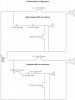
Then I tried serial with matching polarity. I connected the + from receiver to the 8ohm connector on the bottom, the 0 ohm connector on the bottom to the 8 ohm on the top and the 0 ohm on the top to the - on the receiver. I set the switch on the bottom set to extend and the switch on the top to decrease. In this configuration the distortion in the low end went away at any volume, the entire sound stage was big and wide, and the sound was full - there was clear separation between all the instruments and vocals. In this configuration, to my ear, the whole IS greater than the sum of the parts.
I am not an electrical engineer nor do I play one on TV. But I work with one. He confirmed my suspicion that the crossover in the lower speaker is modifying the signal that is going to the upper speaker or modifying the crossover. The first speaker is changing the second and maybe vice versa. He is really smart and it wasn't all clear but there is interaction that will not take place in a parallel configuration. As an illustration I tried flipping the top to Extend and the bottom to Decrease and it destroys the effect. He said I could calculate the total effect of that particular setup and design a single crossover to reproduce this effect. Which is interesting and beyond my ability but I get what he is saying. Anyhow.
So my point is this: it seems that setting up double advents in parallel is no different than stacking any two speakers. The result is louder and probably produces more distortion in the low end. At lower volumes it probably still sounds better than 1 speaker but nothing magical about it. It is simply pushing more air.
My ears however believe that the configuration I described above (see attached) produces something other than just more volume. My ears tell me this setup fundamentally changes the nature of the loudspeaker system (both the signal and the crossover networks) in a way that sending identical signals to identical loudspeakers cannot duplicate. I have tried substituting a couple different speakers and using different speakers altogether. Nothing comes close.
That said I haven't stepped up to the next tier loudspeaker but I feel comfortable enough now that I could do so without getting completely ripped off or losing a bunch of money on something that doesn't work and which I cannot fix. and most importantly I am having fun.
BTW - I still have them vertical with the top one upside-down. This seems to work best for my room setup. (and not sure why I made the diagram with the bottom speaker on top but oh well)