

You are using an out of date browser. It may not display this or other websites correctly.
You should upgrade or use an alternative browser.
You should upgrade or use an alternative browser.
dumptruck is finally building ewaves for real
- Thread starter dumptruck
- Start date
Oops, I didn't see that question. It's not ready. My mic interface started acting up, and I took the opportunity to upgrade (slightly) to a Tascam US-600, which just arrived. I'll let you know when it's tested.What is the new crossover schematic?
One day I'll switch to mini-DSP...
I attempt a summary
Anybody ever wonder what happened to this project? It never went in the bin or anything. In fact, I've been using these most of the time since posting ceased, but using an active crossover with some passive parts for EQ on both drivers, as mentioned earlier. That sounds complicated, but it's actually no more difficult than fully passive when you're already using your own measurements and simulating crossovers.
Anyway, I learned a whole lot on this project, which was the point in the first place. Since starting it, I've successfully designed several small speakers and redesigned some retail speakers with what I learned, all with much more ease than this project.
In the end, it is clear that this combo is a problem from the start. The acoustic offset of the drivers causes a never ending wrestling match in crossover design, and the 15" driver doesn't really want to run high enough to meet the waveguide either. The latter is not a huge problem, but I think it's a problem for a project with the parts cost involved here. I think I'm beginning to side with Geddes' take on this type of 2-way.
Pushing through those issues means choosing between an absurdly high crossover part count and poor phase tracking. To make matters worse, unless running flanking subwoofers into the midbass range (or perhaps shoving them in corners), the woofer response needs to be pulled down pretty hard. A normal efficient 15" running this high has a rising response that needs to be pulled down already, and this setup needed some extra shelving across the baffle step range too. In other words, I find myself taking an ultra-low-inductance woofer and piling a TON of inductance and resistance on top of it. Yuck!
So, my conclusion was that if you insist on passive for this speaker, it might as well stay relatively simple and sacrifice some phase tracking (still being in phase at crossover, just not good tracking on either side). Like this sort of thing:

Still a pretty nasty load, right? Not so easy on the HF either, but probably the worst problem is that the filter impedance starts to interact with the bass, which is why I ended up with this sort of circuit instead of the even-worse 5th order topologies that had better phase tracking and incorporated baffle compensation more elegantly. This problem could have been avoided with narrow cabinets. Lesson learned.
So, I moved on to DSP. Used custom filters from the measurements to equalize the drivers to flat(ish) to a bit beyond a 1350Hz xover range (including some midbass compensation) and then applied a 4th order filter, which results in phase alignment without any additional delay. Could probably use some more fine tuning, but sounds good, measures good. Possibly really good. I'm not really done with the measuring.
Now my problem is that I moved to a pretty tiny space (or tiny rooms, rather). So much for all the stable imaging magic I had in the old place, BUT really very consistent sound all over the room, so that's nice. It's even fairly pleasant to sit right next to one of the speakers at high volume, because you mostly only hear the far speaker, which is a neat trick.
I don't want to get too much into subjective descriptions, but I'll say the sound is what I think people often call "sterile", overall. Hopefully that only means accurate, but I'm still not making any final judgements. Three Blind Mice jazz recordings at high volume sound pretty excellent.
Anybody ever wonder what happened to this project? It never went in the bin or anything. In fact, I've been using these most of the time since posting ceased, but using an active crossover with some passive parts for EQ on both drivers, as mentioned earlier. That sounds complicated, but it's actually no more difficult than fully passive when you're already using your own measurements and simulating crossovers.
Anyway, I learned a whole lot on this project, which was the point in the first place. Since starting it, I've successfully designed several small speakers and redesigned some retail speakers with what I learned, all with much more ease than this project.
In the end, it is clear that this combo is a problem from the start. The acoustic offset of the drivers causes a never ending wrestling match in crossover design, and the 15" driver doesn't really want to run high enough to meet the waveguide either. The latter is not a huge problem, but I think it's a problem for a project with the parts cost involved here. I think I'm beginning to side with Geddes' take on this type of 2-way.
Pushing through those issues means choosing between an absurdly high crossover part count and poor phase tracking. To make matters worse, unless running flanking subwoofers into the midbass range (or perhaps shoving them in corners), the woofer response needs to be pulled down pretty hard. A normal efficient 15" running this high has a rising response that needs to be pulled down already, and this setup needed some extra shelving across the baffle step range too. In other words, I find myself taking an ultra-low-inductance woofer and piling a TON of inductance and resistance on top of it. Yuck!
So, my conclusion was that if you insist on passive for this speaker, it might as well stay relatively simple and sacrifice some phase tracking (still being in phase at crossover, just not good tracking on either side). Like this sort of thing:
Still a pretty nasty load, right? Not so easy on the HF either, but probably the worst problem is that the filter impedance starts to interact with the bass, which is why I ended up with this sort of circuit instead of the even-worse 5th order topologies that had better phase tracking and incorporated baffle compensation more elegantly. This problem could have been avoided with narrow cabinets. Lesson learned.
So, I moved on to DSP. Used custom filters from the measurements to equalize the drivers to flat(ish) to a bit beyond a 1350Hz xover range (including some midbass compensation) and then applied a 4th order filter, which results in phase alignment without any additional delay. Could probably use some more fine tuning, but sounds good, measures good. Possibly really good. I'm not really done with the measuring.
Now my problem is that I moved to a pretty tiny space (or tiny rooms, rather). So much for all the stable imaging magic I had in the old place, BUT really very consistent sound all over the room, so that's nice. It's even fairly pleasant to sit right next to one of the speakers at high volume, because you mostly only hear the far speaker, which is a neat trick.
I don't want to get too much into subjective descriptions, but I'll say the sound is what I think people often call "sterile", overall. Hopefully that only means accurate, but I'm still not making any final judgements. Three Blind Mice jazz recordings at high volume sound pretty excellent.
Attachments

Last edited:

donprice
Wound up workin' at a gas station....
In the end, it is clear that this combo is a problem from the start. The acoustic offset of the drivers causes a never ending wrestling match in crossover design, and the 15" driver doesn't really want to run high enough to meet the waveguide either. The latter is not a huge problem, but I think it's a problem for a project with the parts cost involved here. I think I'm beginning to side with Geddes' take on this type of 2-way.
Also interesting to note that Wayne Parham used the JBL 2226 in the 4pi and and the AE TD12(M?) in the 3pi. I suspect he encountered similar problems making the TD15M behave.
Still running the fancy passive crossover with no complaints.

fpitas
Committed dilettante
FWIW, I've had good luck using multiple smaller drivers in place of (for example) a 15" woofer. The smaller drivers work well to higher frequencies without cone breakup etc. The shallower acoustic offset of small drivers might also be easier to work with for Econowave purposes.
Last edited:

audiozaz
rtfm!? - tl;dr
Some interesting comments there DT! I think it mirrors my impressions of using these for just over a year now.
For me, going active with a miniDSP was mostly motivated by the economics and flexibility of it versus the kind of quality passive parts it'd have gone with. Even with good data to plug into PCD, seems like you always want to tweak this coil to a couple hundred µH more, this cap by a couple µF, etc... I also came to realise that the very-low inductance TD15M might be better served straight-wired to the amp. I like the miniDSP a lot and it does not ruin listening to vinyl records with its extra A/D and D/A stages.
I've also come to believe that baffle-step should be taken care of by either a cabinet so wide that room gain takes over where output starts to move into "full-space", or the thinest baffle in order to push it up, hopefully to the Xover point or at least to simplify the passive implementation at the top of the woofer's range.
I forget what my exact current DSP Xover settings are, I re-did some of it a while ago, but I always have trouble with gating in my room, barely getting it below the Xo point... Xo is at ~1250Hz or 1300Hz IIRC, I forget the slopes. I have very flat response to 20kHz, but am thinking to give it a small slant, as a lot of hi-fi speakers do, for a mellower sound, I'll see. Lots of pop/rock seems to come with its own "smiley" EQ and a flat system can sound too bright at times.
How big of a room do you have these in right now? My room is 13'x10'. The speakers are on the 10' wall, not especially close to the back or side wall, maybe ~2' each way or so. I initially listened with no BSC and it's generally good on high-quality recordings. I now have 2dB at 200Hz, which gives a better balance on a wider variety of recordings IMO. I might also call the sound "sterile". I think part of it may just be how low distortion actually is on that woofer. I think most smaller woofers will create lots of overtones and sound bassier as a result. Despite how light bass feels on the TD15M, I think it is very accurate and it does not miss a step tracking complicated music with good dynamic performance to boot. Or maybe I'm just trying to rationalize how a 700$ pair of drivers can't possibly sound bad?
Well-produced jazz recordings have a way of sounding better than most other music I think. One generally does not need really deep bass on these anyway and the TD15M is perfect. Techno and dance music will still shake the wall, but manages to sound tighter than anything with 8" bass drivers. I don't really feel I need a subwoofer here. Some dense and compressed rock/pop music can sound pretty bad here though. Neither TD15M and BMS 4550 are hiding much flaws IMO.
I still have not gotten around to sealing the contours of my vent drop-on panels and might have a bit of internal bracing to add, but that's pretty much it.
az
For me, going active with a miniDSP was mostly motivated by the economics and flexibility of it versus the kind of quality passive parts it'd have gone with. Even with good data to plug into PCD, seems like you always want to tweak this coil to a couple hundred µH more, this cap by a couple µF, etc... I also came to realise that the very-low inductance TD15M might be better served straight-wired to the amp. I like the miniDSP a lot and it does not ruin listening to vinyl records with its extra A/D and D/A stages.
I've also come to believe that baffle-step should be taken care of by either a cabinet so wide that room gain takes over where output starts to move into "full-space", or the thinest baffle in order to push it up, hopefully to the Xover point or at least to simplify the passive implementation at the top of the woofer's range.
I forget what my exact current DSP Xover settings are, I re-did some of it a while ago, but I always have trouble with gating in my room, barely getting it below the Xo point... Xo is at ~1250Hz or 1300Hz IIRC, I forget the slopes. I have very flat response to 20kHz, but am thinking to give it a small slant, as a lot of hi-fi speakers do, for a mellower sound, I'll see. Lots of pop/rock seems to come with its own "smiley" EQ and a flat system can sound too bright at times.
How big of a room do you have these in right now? My room is 13'x10'. The speakers are on the 10' wall, not especially close to the back or side wall, maybe ~2' each way or so. I initially listened with no BSC and it's generally good on high-quality recordings. I now have 2dB at 200Hz, which gives a better balance on a wider variety of recordings IMO. I might also call the sound "sterile". I think part of it may just be how low distortion actually is on that woofer. I think most smaller woofers will create lots of overtones and sound bassier as a result. Despite how light bass feels on the TD15M, I think it is very accurate and it does not miss a step tracking complicated music with good dynamic performance to boot. Or maybe I'm just trying to rationalize how a 700$ pair of drivers can't possibly sound bad?
Well-produced jazz recordings have a way of sounding better than most other music I think. One generally does not need really deep bass on these anyway and the TD15M is perfect. Techno and dance music will still shake the wall, but manages to sound tighter than anything with 8" bass drivers. I don't really feel I need a subwoofer here. Some dense and compressed rock/pop music can sound pretty bad here though. Neither TD15M and BMS 4550 are hiding much flaws IMO.
I still have not gotten around to sealing the contours of my vent drop-on panels and might have a bit of internal bracing to add, but that's pretty much it.
az
Last edited:
audiozaz
rtfm!? - tl;dr
FWIW, I've had good luck using multiple smaller drivers in place of (for example) a 15" woofer. The smaller drivers work well to higher frequencies without cone breakup etc. The shallower acoustic offset of small drivers might also be easier to work with for Econowave purposes.
I remember from another thread you are running 4x Peerless 830869, right? I'd like to see a pic of that speaker sometimes!
az
fpitas
Committed dilettante
I remember from another thread you are running 4x Peerless 830869, right? I'd like to see a pic of that speaker sometimes!
az
Yep; we built those for a friend. He just finished sanding & painting them, so it's about time he took some pictures. :yes:
I think Wayne's waveguide is not quite as deep, which would make things a little easier. He stopped using the TD12 (it was S) after finding some defective ones, though.Also interesting to note that Wayne Parham used the JBL 2226 in the 4pi and and the AE TD12(M?) in the 3pi. I suspect he encountered similar problems making the TD15M behave.
If you boosted the bass 3-4dB from 150Hz down, that one should fairly similar to what I've been doing with the DSP. IIRC, you've got them on the floor and in a built-in shelf, so you may have different results in that bass/midbass range. I think I also have the treble from 5kHz up 1-2dB lower (average) on mine, I'd have to check on a different computer.Still running the fancy passive crossover with no complaints.
In this case the woofer is already 10cm forward of the waveguide.The shallower acoustic offset of small drivers might also be easier to work with for Econowave purposes.
The room is 10'x23' (x9'H) with the speakers on the short side, but there is dividing arch in the middle of the long side, and all the furniture has to go in one 10x11.5 half with the speakers, so it's cramped. The front centers are about 2.5' from the side walls and 3.5' from the back. I designed the target filter for the bass in a space that was 26x18x9.5 or something around that and very open. It still seems to work okay where I have them now though.How big of a room do you have these in right now? My room is 13'x10'. The speakers are on the 10' wall, not especially close to the back or side wall, maybe ~2' each way or so. I initially listened with no BSC and it's generally good on high-quality recordings. I now have 2dB at 200Hz, which gives a better balance on a wider variety of recordings IMO.
Honestly, I've had no bass problems since raising the tuning a bit and figuring out how I wanted the filter shaped. Not subwoofer deep, but certainly not light. I'll post the woofer EQ curve in a bit.I might also call the sound "sterile". I think part of it may just be how low distortion actually is on that woofer. I think most smaller woofers will create lots of overtones and sound bassier as a result. Despite how light bass feels on the TD15M, I think it is very accurate and it does not miss a step tracking complicated music with good dynamic performance to boot. Or maybe I'm just trying to rationalize how a 700$ pair of drivers can't possibly sound bad?
Last edited:
audiozaz
rtfm!? - tl;dr
I can see how tuning higher would work for a room larger than mine. I like it at ~32Hz here, as it helps to dig deeper and yet avoids over-exciting the prominent room modes in the midbass. I also find myself liking an over-damped bass in general too, as far as large speaker go at least. I may break this rule for small fullrange drivers where they need a bit of cheerfulness in the mid-upper bass to sound full and balanced. My small TB W4-1320 in a DCR is an all-around success in this department. Needs no BSC or filter with wall/desktop placement.
az
az
Funny, I completely forgot that my last iteration just used a broad compensation shelf rather than a specific baffle correction. I remember now: simulating the entire enclosure in boxsim, the "speaker in half room" response cancelled the measured midbass drop exactly, so I figured that meant I probably got that measurement to work pretty well. On the other hand, the measurement down there is effectively highly-smoothed from the measurement window, and probably shows a combination of first reflection with baffle, so I wasn't sure if I should touch those humps. I meant to try it, though. I think I'll do that today.
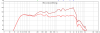
Here's what the EQ on the woofer looks like performed on the response (which is measured and then spliced to bass simulation around 100Hz) in REW. Note that the bass here is the highest-Q alignment that I would ever use. Tuning a little lower (they are, currently) would make it look more like a uniform response avg. ~96dB, except for the questionable 200-500 range I just mentioned:

And here's what that looks like in miniDSP:

Here's what the EQ on the woofer looks like performed on the response (which is measured and then spliced to bass simulation around 100Hz) in REW. Note that the bass here is the highest-Q alignment that I would ever use. Tuning a little lower (they are, currently) would make it look more like a uniform response avg. ~96dB, except for the questionable 200-500 range I just mentioned:
And here's what that looks like in miniDSP:
Attachments

Last edited:
Here's a couple of things I did last weekend:
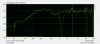
Here's a measurement good down to 300-400Hz, plus the inverse null, not smoothed, other than from the limited data at the lower frequencies. Note the scale - this is fairly flat. There are some peaks present that the driver EQ is supposed to be removing, though. I'll have to revisit that.

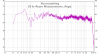
And this is what it says it is, all around the listening area, which is really almost the whole room in this case, and 3 heights (now we're on a 10dB scale):

I applied some EQ based on the averages. Didn't get to doing another 29 samples..
Here's a measurement good down to 300-400Hz, plus the inverse null, not smoothed, other than from the limited data at the lower frequencies. Note the scale - this is fairly flat. There are some peaks present that the driver EQ is supposed to be removing, though. I'll have to revisit that.
And this is what it says it is, all around the listening area, which is really almost the whole room in this case, and 3 heights (now we're on a 10dB scale):
I applied some EQ based on the averages. Didn't get to doing another 29 samples..
Attachments
Last edited:
Not too shabby right? May be difficult to get the bass smoother without more subs than I have, though (none are currently set up). If I drew a straight line between the points at 40Hz and 500Hz on that graph, that's about what we're looking for. Something like much the red line in this JBL measurement.

audiozaz
rtfm!? - tl;dr
Hey dumptruck,
Would you happen to know what the throat entrance angle is on the QSC waveguide? We are pretty much in the same boat with B&C DE250 at 14.6° and BMS 4550 at 14° exit angles. It looks like it may be wider than either driver's exit angle. I want to try some vintage Emilar drivers on the QSC and maybe I'll see if I can measure it when I do so. Might be tough as it's not exactly a straight section either; we might be looking at an equivalent tangential angle. The Emilar drivers look like they are quite a bit wider than 14° as well.
az
Would you happen to know what the throat entrance angle is on the QSC waveguide? We are pretty much in the same boat with B&C DE250 at 14.6° and BMS 4550 at 14° exit angles. It looks like it may be wider than either driver's exit angle. I want to try some vintage Emilar drivers on the QSC and maybe I'll see if I can measure it when I do so. Might be tough as it's not exactly a straight section either; we might be looking at an equivalent tangential angle. The Emilar drivers look like they are quite a bit wider than 14° as well.
az
audiozaz
rtfm!? - tl;dr
I suppose the multi-sub approach is best to make for an even power distribution down low, but it is a brute-force technique, though I don't know of another way to do it. Wayne Parnham's offset-sub trick looks like it'd be good. Short of that, the best one can do is to tailor bass response at the listening position with placement, if the room allows it.
az
az
audiozaz
rtfm!? - tl;dr
Anybody ever wonder what happened to this project? It never went in the bin or anything. In fact, I've been using these most of the time since posting ceased, but using an active crossover with some passive parts for EQ on both drivers, as mentioned earlier. That sounds complicated, but it's actually no more difficult than fully passive when you're already using your own measurements and simulating crossovers.
Anyway, I learned a whole lot on this project, which was the point in the first place. Since starting it, I've successfully designed several small speakers and redesigned some retail speakers with what I learned, all with much more ease than this project.
In the end, it is clear that this combo is a problem from the start. The acoustic offset of the drivers causes a never ending wrestling match in crossover design, and the 15" driver doesn't really want to run high enough to meet the waveguide either. The latter is not a huge problem, but I think it's a problem for a project with the parts cost involved here. I think I'm beginning to side with Geddes' take on this type of 2-way.
Pushing through those issues means choosing between an absurdly high crossover part count and poor phase tracking. To make matters worse, unless running flanking subwoofers into the midbass range (or perhaps shoving them in corners), the woofer response needs to be pulled down pretty hard. A normal efficient 15" running this high has a rising response that needs to be pulled down already, and this setup needed some extra shelving across the baffle step range too. In other words, I find myself taking an ultra-low-inductance woofer and piling a TON of inductance and resistance on top of it. Yuck!
So, my conclusion was that if you insist on passive for this speaker, it might as well stay relatively simple and sacrifice some phase tracking (still being in phase at crossover, just not good tracking on either side). Like this sort of thing:
Still a pretty nasty load, right? Not so easy on the HF either, but probably the worst problem is that the filter impedance starts to interact with the bass, which is why I ended up with this sort of circuit instead of the even-worse 5th order topologies that had better phase tracking and incorporated baffle compensation more elegantly. This problem could have been avoided with narrow cabinets. Lesson learned.
So, I moved on to DSP. Used custom filters from the measurements to equalize the drivers to flat(ish) to a bit beyond a 1350Hz xover range (including some midbass compensation) and then applied a 4th order filter, which results in phase alignment without any additional delay. Could probably use some more fine tuning, but sounds good, measures good. Possibly really good. I'm not really done with the measuring.
Now my problem is that I moved to a pretty tiny space (or tiny rooms, rather). So much for all the stable imaging magic I had in the old place, BUT really very consistent sound all over the room, so that's nice. It's even fairly pleasant to sit right next to one of the speakers at high volume, because you mostly only hear the far speaker, which is a neat trick.
I don't want to get too much into subjective descriptions, but I'll say the sound is what I think people often call "sterile", overall. Hopefully that only means accurate, but I'm still not making any final judgements. Three Blind Mice jazz recordings at high volume sound pretty excellent.
Designing a passive Xover for my own TD15M system and moving up to 2 channels of higher quality amplification is something that runs through my head periodically as of late. The issues brought up here are mostly what keeps me from making the move.
My passive Xo on the Peerless 8" and 6"x6" PT-waveguide also stretched things to their limit and I'm not entirely satisfied with this one, so I'm not too keen on taking this on again on another system. I'd do things differently from the start with the 8" speaker. miniDSP is kind of a huge advantage to nailing it all down in a more painless manner. Having to use a VC before or at the DSP will sometime keep me up at night with "bit-loss madness", in rare instances of audiophilia-nervosa, even though I find it pretty much all sounds good.
 A post-DSP VC would be a bit of a hassle with the need for 4-channels of attenuation, not to mention the need for excellent tracking in-between thereof. Probably won't be making a move towards passive anytime soon though. I'm also loath to stick a bunch of inductance and padding on the TD15M driver.
As for the Geddes approach, seems like his round WG's with generous mouth radii would have the same issues as the TD15M/QSC ctc spacing problem. Might this be why he seems not to produce his 15" Summa anymore? I can't say I've followed all of this closely. I guess the trade-off is not so bad for an earlier onset of constant-directivity.
It might have been mentioned before, but what amps are you using in your bi-amp scheme?
az
Just whatever, I'm not really a fancy amp kinda guy. A Rotel and a Sony ES at the moment, both a little over 100W.It might have been mentioned before, but what amps are you using in your bi-amp scheme?