• The move to the new server is done. There are some software and database maintenance updates in process. This has us passing the hat around to help out. We appreciate any donations. Seriously, even a dollar helps. The payment page may be found here - https://www.audiokarma.org/support.html

Dunlavy Audio Labs Archive - From the mind of a "Legend"!

This is the first of a seven part series of articles by John Dunlavy that was published on Widescreen Review just after his passing in February 2007. He was perhaps more interested in how speakers worked as part of a home theater system than many folks realize. I am fortunate to have the HRCC-I to complement the SC-IV's and all I can say is the HRCC is one of the finest center channel speakers I have ever heard.

In this article he lays the ground work for the case about how to measure "accuracy"! It is entitled:

"Loudspeaker Accuracy
The Quest For Getting Loudspeaker Design Right
Part 1—Philosophy
"

Enjoy the article!
 

Attachments

Last edited:
Hi Tom... this is a good article on "upgrading" the SC-IV/a Crossovers (if ever a thing was possible)... here is something to bear in mind from that author!

"I read everything I could find about Dunlavy speaker modifications at many different Internet forums. I searched in vane for schematics that could help direct me, but I was told by many that no such thing was available, and in fact if it was, it would not have values listed because Dunlavy designed each crossover circuit to match the drivers it was associated with."

So please view these as reference only... your crossover will vary! ;)

View attachment 922904 View attachment 922905

I have come across that article before when looking for a schematic; I've dismissed it out of hand because I'm running plain ol' vanilla IVs. That being said, even 10 months after I purchased them, I've yet to pull the XOs to take a look; I'm not willing to not have them up and running while I'm at home.

I've always thought some of the Dunlavy claims to be a little wonky.... I totally understand and believe that the time and effort was made to match drivers for each individual set of speakers. I'm pretty skeptical about the individually hand-tweaked crossovers though.... a lot of work and research was obviously done to create the crossovers that conformed to Dunlavy's notions of how speakers should 'present', but there simply aren't capacitors -or resistors- available in every single possible measured increment. I don't see them testing tens of thousands of capacitors, labeling and storing them, then making the slightest adjustments at .05 vs 0.1 or what have you, to shape the speakers at that level.
 
Last edited:
I have come across that article before when looking for a schematic; I've dismissed it out of hand because I'm running plain ol' vanilla IVs. That being said, even 10 months after I purchased them, I've yet to pull the XOs to take a look; I'm not willing to not have them up and running while I'm at home.

I've always thought some of the Dunlavy claims to be a little wonky.... I totally understand, even believe, that the time and effort was made to match drivers for each individual set of speakers. I'm pretty skeptical about the individually hand-tweaked crossovers though.... a lot of work and research was obviously done to create the crossovers that conformed to Dunlavy's notions of how speakers should be, but there simply aren't capacitors -or resistors- available in every single possible measured increment. I don't see them testing tens of thousands of capacitors, labeling and storing them, then making the slightest adjustments at .05 vs 0.1 or what have you, to shape the speakers at that level.
I tend to agree with you, once the ''perfect'' x-over for a given driver model is done, i don't think they ''matched them'' but still this guy's research gave outstanding, audible results!.
 
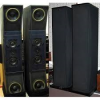
From 1992 until 2010, I was the proud owner of a pair of Duntech "Black Knight" speakers. I ran these with a Luxman PD121 turntable, modified Marantz 3600 preamp into a Krell KSA100.
This was the best system I had owned in 40 odd years of listening. Visitors to our home would come into my listening room which was about 5 metres wide by 8 metres long and ogle. I didn't even have to fire them up. They were the Darth Vader of HiFi. Luke Skywalker just didn't get a look in. The crappy photo shows them with and without the socks. Unfortunately, I had to sell them along with the Krell when I struck financial problems but #*!?# happens. One day..............
 

Attachments

  • Duntech Black Knight.png
    Duntech Black Knight.png
    61.5 KB · Views: 148
From 1992 until 2010, I was the proud owner of a pair of Duntech "Black Knight" speakers. I ran these with a Luxman PD121 turntable, modified Marantz 3600 preamp into a Krell KSA100.
This was the best system I had owned in 40 odd years of listening. Visitors to our home would come into my listening room which was about 5 metres wide by 8 metres long and ogle. I didn't even have to fire them up. They were the Darth Vader of HiFi. Luke Skywalker just didn't get a look in. The crappy photo shows them with and without the socks. Unfortunately, I had to sell them along with the Krell when I struck financial problems but #*!?# happens. One day..............

Hey AvSat... I'm sorry to hear you had to unload a system like that! I know I for one am very attached to my music and having to make a choice between eating and listening to Hifi Audio, would lead to drastic decisions. I hope one day you find your system again... Sincerely!
 
Here is the second in the series of articles John Dunlavy wrote for Widescreen Review. This was from March 2007 after his passing.

Here he talks about the "10 topics on how to objectively evaluate a loudspeaker for reproducing music and voices." It is entitled:

"Loudspeaker Accuracy
Parameters And Elements of Accurate Loudspeakers
Part 2"

Good stuff!
 

Attachments

Last edited:
I tend to agree with you, once the ''perfect'' x-over for a given driver model is done, i don't think they ''matched them'' but still this guy's research gave outstanding, audible results!.

Not sure... I pulled this info from another forum. The post was by a guy that sold Dunlavy's and bought a pair of SC-VI's from John. From what I gather in his post he knew the company and processes well. Here's his take:

"The pair of SC-VI's that I purchased for personal use spent about THIRTY HOURS in the anechoic chamber. Every single pair of speakers he built went into the chamber, one speaker at a time and unlike most other speaker companies, each crossover was hand built for that specific speaker and set of drivers and unless John personally examined the chamber results, the speaker would not ship."

And this piece of collaboration came from Audio Perfectionist Journal (2001):

Crossover Networks
The crossover networks in all Dunlavy speakers are engineered to provide frequency and phase compensation for the drive elements and to provide first-order acoustic transitions between drivers. All crossover components, internal wiring and circuit boards are of high quality.

The high sensitivity provided by pairing midrange and woofer drivers allows the crossover networks to provide lots of frequency response and phase response tailoring, while maintaining high overall speaker sensitivity. Response tailoring is accomplished by adjusting component values on the crossover boards during design and testing. Individual crossovers are partially assembled and tested, and then matched with a speaker for final tweaking.

Each speaker is placed in an anechoic chamber and measured using this basic crossover. Crossover component values are individually adjusted by a technician until the desired performance objectives for the complete speaker are met.

So I'm going to say there was a base design that allowed for certain components to be put in place to "tune" the cross-over!
Now which components were those? :idea:
 
Last edited:
From Audio Perfectionist Journal (2001), a bit more history detail:

Dunlavy Audio Labs was founded in 1992, making it the youngest of the three manufacturers we’ll examine in this issue. However, speaker designer and company founder John Dunlavy has been around quite a bit longer. He has headed two previous loudspeaker companies—both named Duntech.

The first Duntech was headquartered in Texas and produced a time- and phase-correct three-way speaker system, the DL-15, in the 1970s. The more recent and better-known Duntech speaker company was an Australian firm that made highly-regarded speakers in the 1980s and early 1990s. The Australian Duntechs were similar in design to the current Dunlavy products, which are produced in Colorado Springs, Colorado.

Before entering the speaker business, John Dunlavy designed antenna systems. He is considered an authority on certain antenna types and holds several patents on his inventions in that field.

This is an image of the PCL-15 which may or may not be similar to the original Duntech DL-15. Obviously it isn't a "Three-way" design.
Dunlavy22.jpg
 

Attachments

  • Dunlavy21.jpg
    Dunlavy21.jpg
    81.8 KB · Views: 19
Last edited:
I thought it might be worthwhile to have some rare pictures of DAL's last significant speaker design... The Millennium!

Dunlavy_Mill1.jpg Dunlavy_SF.jpg
 
Ohhh, i'd like to believe that they did test a single unit for thirty hours in the chamber but this is un-realistic really. Dont get me wrong, i'm a big fan of John's achievements but hey, the industrial world is what it is.
 
Should be interesting when I 'pop the hoods' here in the near future.... will both crossovers match? Did they spend even more time storing 'finished' speakers waiting for a mate or match 10 drivers then hope they all perform similarly in the chamber with little or no variation in crossover between the two? My biggest hesitation on even starting this process is that I feel the deep internal push towards recapping speakers now 25+ years old. Will I do them more harm than good, even if I just exchange part for part at the same listed value?
 
Will I do them more harm than good, even if I just exchange part for part at the same listed value?

Go slow and save your parts... I don't know much about these beasts and I'm just starting to really enjoy mine. I want to get my room treated to support the Bass presentation and then I have my KEF 107's to rebuild. I have more projects to do than time and I think re-capping the Dunlavy's will be the last thing I tackle.

But I'd be really interested to see what you find Tom! In fact, maybe we ought to start a Dunlavy Rebuild Thread to capture all of the information people have posted in various forums in one place. Sort of a one stop shop!
 
Here is the third in the series of articles John Dunlavy wrote for Widescreen Review. This was from April 2007 after his passing. And it's on my favorite subject... the harmonics or resonance (dare I say ring?) of the Enclosure.

Loudspeaker Accuracy
How Enclosure Design Affects The Music
Part 3
 

Attachments

To Simply Sound,
Thanks for your thoughts.
I still own the Luxman turntable and Marantz preamp. They now drive a Marantz model 140 power amp into a 3 way speaker system that I purchased not working from ebay. The tweeter was missing and the internal crossovers and wiring had been got at. I re-finished and re-lined the enclosures (6 cubic ft.), rebuilt the crossovers to suit what is in the cabinets now: Celestion G18C woofer (the 20Hz ones), Celestion D5 mid range and a Goodmans DLM2 tweeter. They are not the Black Nights by any stretch but they do go seriously low.
Cheers,
Andre
 
Here is the fourth in the series of articles John Dunlavy wrote for Widescreen Review. This was from May 2007 after his passing. This is entitled:

Loudspeaker Accuracy
How Impulse, Step, And Phase Response , Frequency
Response, Waterfall Measurements , And Input
Impedance Affect The Music—Part 4


Enjoy!
 

Attachments

Thanks for posting these SimplySound, very informative. I always question the
''competitors'' graphs tho as the arcticle writers (not only DAL), can submit a Sound Design speaker curve without us knowing...
 
Thanks Turboyam! Here is the fifth in the series of articles John Dunlavy wrote for Widescreen Review (with NO graphs!). This was from June 2007 after his passing. This is entitled:

Loudspeaker Accuracy
How Directivity, Distortion, Crossover Design, Input
Impedance, Dynamic Range, And Imaging
Affect The Music—Part 5
 

Attachments

Here is the sixth in the series of articles John Dunlavy wrote for Widescreen Review. This was from July 2007 after his passing. This is entitled:

Loudspeaker Accuracy
How Room Acoustics And Loudspeaker Positioning
Affect The Music—Part 6
 

Attachments

Back
Top Bottom