
• The move to the new server is done. There are some software and database maintenance updates in process. This has us passing the hat around to help out. We appreciate any donations. Seriously, even a dollar helps. The payment page may be found here - https://www.audiokarma.org/support.html

Dustcover Hinge Fix

boreas

"If it sounds good, it IS good." E.K.E.
There's a type of dustcover hinge used on some Yamaha, Sony and probably other turntables that have a characteristic sort of failure where the "tail" of the spring eventually breaks through the plastic "web" that is supposed to retain it. The result is a complete loss of spring tension so the dustcover can no longer stay up on its own.

I've seen fixes here where what remains of the web is reinforced with a metal plate held in place with epoxy. I've tried that in the past but didn't have long-term success. Eventually the epoxy holding the plate would fail and I'd be back to "square one".

I just picked up a Sony turntable with this type of hinge and, just my luck, both hinges had failed. My previous experience made me reluctant to try the epoxy and plate repair again so I began thinking about a different approach.

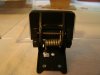
Here's what I came up with. Instead of reinforcing the web I completely removed it. Then I took a 1/16" drill bit and bored a hole in both sides of the hinge at the reinforcing gusset where the hinge pin joins the top and bottom halves of the hinge. I then took a 3d finishing nail, snipped off the point and inserted it through the two holes,capturing the tail of the spring underneath the pin.

The whole repair of both hinges took maybe 15 minutes. Remove remains of web, drill holes, insert pins and re-fix the other spring tail in the bottom half of the hinge. If I do say so myself, it works perfectly.

Unfortunately, I didn't take any "before" or "during" photos. If I had this post wouldn't have been nearly so long-winded. I did take an "after" photo of the repaired hinge. See below.

John
 

Attachments
  • Hinge Fix.jpg
    Hinge Fix.jpg
    51.7 KB · Views: 1,090
Last edited:
Register to hide this ad
I have hinges that are too strong for my sl-qx300, so the dust cover pops up - and stays up at 30 degrees: Any suggestions?
 
Nice work. I have a Kenwood T-Table that needs this fix and hadn't come up with an acceptable solution yet. I like yours.
 
I have hinges that are too strong for my sl-qx300, so the dust cover pops up - and stays up at 30 degrees: Any suggestions?

Add weight to the dustcover, the farther forward the better. Maybe a small lift handle at the front? The only other thing would be to heat the springs and allow them to air cool to de-temper them a bit. Of course,you run the risk of de-tempering them too much,to say nothing of melting the plastic.

John
 
Damn - nice and easy fix! Gonna have to remember that. :thmbsp:

BTW, that hinge looks exactly like a Linn hinge.
 
I like that fix and wish I could prove I thought of it first (I might have; I just can't prove it ;) ). I think once I did this I used a short stripped piece of household 14g wire. In that short a length it's stiff enough especially if you drill the holes just barely large enough.
 
Last edited:
Line up the broken piece and tape it and glue it with super glue. Super glue will not support the lid as a fix, but it will hold everything together perfectly while you drill. Carefully drill in line with the two ribs and then push a piece of larger size stiffer paper clip wire into the hole. Make sure to choose a bit that will allow a nice tight fit.

Once the dust cover is back in place, you can't see the repair.

Very clever and far simpler than my solution to the same problem and it's later iteration.

One suggestion I'd like to make. As you say, SuperGlue won't hold on that styrene plastic and the glue joints will be under some stress during normal use. Should the glue fail at some point, the only thing keeping things together will be the soft wire from the paperclip. In fact, the softness of the wire might actually lead to a failure of the joint.

It might be better to use small wire brads. These are basically tiny finish nails in very thin gauge, as small as 20 ga. So, the wire size is comparable to a heavier duty paper clip but the wire is much stiffer. That would give the repair a lot more support.

John
 
Instead of superglue (cyanoacrylate), which, even if it sticks, has poor shear strength, I suggest that you try some dicloromethane. In such a case, you might be able to make a plastic weld, which would be reinforced by the metal. I don't know if dicloromethane is a solvent for the plastic in your hinges. The way you can tell is to put a small drop on some hidden place. After a few seconds, take a jeweler's screwdriver and scratch around in the plastic under the drop. If it softened, it might work for you. Be careful. This stuff will craze any plastic that it works on, and it wicks and drips readily.

Enjoy,
Rich P
 
Don't know if you can tell what happened here, but these dust covers on Technics P Mount decks have a plastic tab molded into the dustcover. Problem is they break after a short time and the lid won't stay up and eventually totally breaks free. Super glue doesn't stick to this plastic and I haven't found anything that does in an amount that will not cause interference with the slot these tabs fit into.

So, sorry there is no before photo, but I drill with one of those hand hobby micro drills--the kind with no motor. This plastic cannot get hot at all, but it cuts very easily with a sharp bit.

Line up the broken piece and tape it and glue it with super glue. Super glue will not support the lid as a fix, but it will hold everything together perfectly while you drill. Carefully drill in line with the two ribs and then push a piece of larger size stiffer paper clip wire into the hole. Make sure to choose a bit that will allow a nice tight fit.

Once the dust cover is back in place, you can't see the repair.

Voila!

View attachment 666262 View attachment 666263

These dustcovers are made out of lucite/acrylic. To bond them, you need to use a special acrylic cement. The video below explains the how to and why the other glues don't work. Looks like we might could even use this stuff for fixing cracks in as well just by administering this stuff over the crack.

 
Instead of superglue (cyanoacrylate), which, even if it sticks, has poor shear strength, I suggest that you try some dicloromethane. In such a case, you might be able to make a plastic weld, which would be reinforced by the metal. I don't know if dicloromethane is a solvent for the plastic in your hinges. The way you can tell is to put a small drop on some hidden place. After a few seconds, take a jeweler's screwdriver and scratch around in the plastic under the drop. If it softened, it might work for you. Be careful. This stuff will craze any plastic that it works on, and it wicks and drips readily.

Enjoy,
Rich P

Looks like we were thinking the same thing at the same time. You know, great minds and all. LOL
 
These dustcovers are made out of lucite/acrylic. To bond them, you need to use a special acrylic cement. The video below explains the how to and why the other glues don't work. Looks like we might could even use this stuff for fixing cracks in as well just by administering this stuff over the crack.


Newer dustcovers are acrylic but most of the older ones and, I think, all Technics are polystyrene. Polystyrene is a harder and more brittle material than acrylic.

John
 
Back
Top Bottom