• The move to the new server is done. There are some software and database maintenance updates in process. This has us passing the hat around to help out. We appreciate any donations. Seriously, even a dollar helps. The payment page may be found here - https://www.audiokarma.org/support.html

ELAC Miracord TT -share all about 'em

#7 is the tracking force component used in the earlier models of the 10

why is that important?

okay, so what is the issue?
Okay so if the tracking force module changed, did the arm change? That's the part I'm trying to understand through all of these questions. It's important because you said "The 10H tonearm has neither of those attributes." But if my tonearm is different than what you're referencing, then it's important to know. That's been my main question on this because I cannot confirm the tonearm on my miracord.

As for what is the issue, you literally stated "There are two manuals, each manual shows a different way to set the tracking force on the 10 & 10H, you apparently have the wrong manual for your particular tonearm." I asked you for the other manual.

Do you know if the tonearms have the same specifications?
 
Okay so if the tracking force module changed, did the arm change?
no change other than the internal connection to the tracking force accessory, both tonearms, early and late, are two-piece hollow steel with the polished chrome section on top
That's the part I'm trying to understand through all of these questions. It's important because you said "The 10H tonearm has neither of those attributes."
the attribute I was referring to have to do with the weight of the onearm and the tone-arm bearings, neither of which are high quality in the 10 & 10H, that's why it is better to use a lower compliance cartridge than the one you have
But if my tonearm is different than what you're referencing, then it's important to know. That's been my main question on this because I cannot confirm the tonearm on my miracord.
all 10 & 10H tonearms are the same with the very minor change made in the tracking force adjustment
As for what is the issue, you literally stated "There are two manuals, each manual shows a different way to set the tracking force on the 10 & 10H, you apparently have the wrong manual for your particular tonearm." I asked you for the other manual.
I have both manuals and as far as I know, the only notable difference between the early and late versions of the 10 & 10H are the counter-weight accessory, both early and late versions are identical with the exception of that
Do you know if the tonearms have the same specifications?
same, same, same

if there are any differences, they would be extremely minor and not effect the type of cartridge you should use
 
no change other than the internal connection to the tracking force accessory, both tonearms, early and late, are two-piece hollow steel with the polished chrome section on top

the attribute I was referring to have to do with the weight of the onearm and the tone-arm bearings, neither of which are high quality in the 10 & 10H

all 10 & 10H tonearms are th e same with the very minor change made in the tracking force adjustment

I have both manuals and as far as I know, the only notable difference between the early and late versions of the 10 & 10H are the counter-weight accessory, both early and late versions are identical with the exception of that

same, same, same
This is what I've been trying to understand. Because as I said before, I'm happy to make changes. But I like to do my research and understand. But as most of the 10H information out there is vague at best, or more likely tribal knowledge.

I get the attributes of the tonearm and bearings, and that is the similar discussion I had with someone else. They talked about a low compliance cart, or even a DJ cart would be good. But they didn't know enough about the tonearm.

I'd definitely prefer to stay in something with a lighter tracking force than 3.5 grams. I'd be okay with something closer to 2.5 grams if possible.
 
But as most of the 10H information out there is vague at best, or more likely tribal knowledge.
Well I have given you very solid advice based on my hands on experience restoring and using my Miracord 10 for the past 30 years or so.

I understand your comment about "tribal knowledge", it is alive and well on the internet but there may only be a handful that have actually torn down and rebuilt the ELAC 10 tonearm like I have.

I get the attributes of the tonearm and bearings, and that is the similar discussion I had with someone else. They talked about a low compliance cart, or even a DJ cart would be good. But they didn't know enough about the tonearm.
What is it about the tonearm that is a mystery? It's made from steel, it's short, it has a strange tracking angle that is not adjustable, the tonearm bearings are somewhat crude and there is no anti-skate adjustment.

The turntable was designed to be a record changer. It can drop LP records as well as heavy 78's. To do so, it needs a robust motor, drive system and tonearm, just like many changers of that era.

I'd definitely prefer to stay in something with a lighter tracking force than 3.5 grams. I'd be okay with something closer to 2.5 grams if possible.
You can continue to use the RXT6 or something similar if it makes you feel better but in time, the short, heavy tonearm without anti-skate will wreak havok on the suspension of the cartridge. I would also expect more record wear, not less if using a cartridge with too light a tracking force in that tonearm, and in a record changer.
 
Last edited:
It is possible to make too much of arm mass and cartridge compliance matching. Plenty of what appear to be lousy matches can work very well, and plenty of what should be good matches sound blah. Some of this is that the measurements of compliance and of mass aren't always correct or in compatible units, but some of it is that reality and theory don't mirror each other.
Obviously some mismatches are disasterous, or simply not ideal, but if the previous owner was using a cartridge happily for years, that seems proof to me that the combination works. I don't see any reason to change it unless you want to. If you do decide to change, certainly the advice to go lower compliance would seem sensible.

If the turntable is tilting in the plinth, the first thing I would look at would be the plinth - the tops of the wooden bases of many changers were made of particle board, and over the years, they sag. Sometimes the whole thing sags, but more often one or more of the protruding sections that hold the spring mounts sags. You can either replace the cutout board with a stouter one - use the original as a template - or just glue it on top of the existing one, though then the turntable will be higher in the plinth, which may be aesthetically displeasing and may mean that the multiplay spindle hits the dustcover. Or you can cut blocks of wood to force the offending sections back up again and keep them there.
 
I agree that tonearm mass can be overthought. More important to me is tonearm geometry, quality of bearings, vertical and horizontal, and whether or not it has anti-skate.
 
I agree with you about those factors. But, for all the arm's apparent shortcomings, the 10 and 10H are nice sounding turntables, and I'm not surprised that Lorloff is enjoying his. Down the pike, he might want to change cartridges, but I doubt it would be worth the effort to change arms - most people who have changers like some level of automation, and changing the arm and retaining automation would be a daunting task. Even something more feasible, like polishing pivot points or whatever may be more effort than is really justified to a happy listener.
I say this as someone who is contemplating replacing the arm on a 40H because it came to me minus the piece that connects the arm lift to the autocycle, which has exactly the result you would expect.
 
But, for all the arm's apparent shortcomings, the 10 and 10H are nice sounding turntables,
compared to my Garrad Lab 80, the ELAC 10 sounds stiff, it lacks the liveliness of the Garrard.
and I'm not surprised that Lorloff is enjoying his.
not sure if he knows what to listen for
Down the pike, he might want to change cartridges,
I've tried a number of cartridges in mine, none of them can overcome the design of the tonearm
but I doubt it would be worth the effort to change arms - most people who have changers like some level of automation, and changing the arm and retaining automation would be a daunting task.
someone would need to be dedicated and talented to change the tonearm to make it sound better
Even something more feasible, like polishing pivot points or whatever may be more effort than is really justified to a happy listener.
I have been thinking about this since I rebuilt mine and was unhappy with the sound. I believe this to be a key factor in the poor sound I am hearing
I say this as someone who is contemplating replacing the arm on a 40H because it came to me minus the piece that connects the arm lift to the autocycle, which has exactly the result you would expect.
the 40, 40H tonearm, although much lighter than the 10, 10H, the vertical bearings are just as crude
 
Throwing in to share my recent Miracord experience.

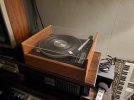
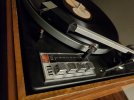
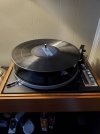
Found an Elac Miracord 50H at my local thrift store. It was superficially in bad shape (the mechanism was ajar and sitting outside the body of the turntable) but otherwise in good cosmetic condition. They wanted $10 as-is, no refunds. These tables were 100% off my radar so I had no knowledge about them whatsoever, but just from the weight and feel of it, I could tell that it was probably at least a decent table. I had been looking for a dedicated 78 player and assumed it was at least good enough to do that, so I grabbed it.

The table needed a full servicing: cleaning and relubricating all the pivot points and bearings in the automatic mechanism and platter, replacing the foam in the damping springs, bolstering up the motor mounts (they were sagging, which put the idler out of position on the pulley), new idler (the old one was chewed up, probably from the sagging motor mount issue), and, since it was still running a little slow after all that, replacing the idler tensioner spring since it didn't seem to be holding the idler in place with enough force and looked a little bent/fatigued. Other than that basic stuff the changer mechanism was damaged (I think from somebody dropping the platter on it) and needed to be bent back in shape and one of the captive screws was also bent.

I also sourced a changer spindle from Voice of Radio, since I've never owned a changer and have been wanting to try a good one. I didn't realize that the table I picked up was "one of the good changers" until after I bought it and read some reviews, so that was a fun surprise.

After getting it fully working, my impression of the 50H is overwhelmingly positive. Way more positive than I thought it would be when I picked the table up, to the point where I can't use it as a dedicated 78rpm table anymore. It's too good for that.

The noise floor is dead quiet to my ears. Speed is dead-on accurate. All of the automatic functions work flawlessly and, with a few minor exceptions, are very well thought out. I mounted a Grado gold to it since that was what I had available (it came with an STS-444 but the stylus is damaged), and it's the best I've ever heard the Grado play on any table, maybe because the hysteresis motor isn't using 60hz line current so it doesn't induce any hum.

I have it running next to a Technics SL-1200 MK2 with fluid damping modification. Despite the Tec-12 beating it in every specification on paper, I honestly don't think the Elac sounds any worse in practice.

On top of that, it's just fun to use. So many shiny buttons and little bells and whistles!

The whole thing has been a wonderful surprise, and I'll definitely be keeping the table. I'll still get it configured as a 78RPM table if I can find another good headshell, exclusively for 45RPM records from now on since the changer capability is so necessary to the experience, and 33rpm records whenever I feel like using them in a changer or just having a fully automatic experience.

Image gallery
 
Followup on my Miracord 50H:

I'm loving this thing more and more. Right now it's going to run alongside my SL1200 MK2, and probably get more use than it.

The MK2, which is fit with an AT VM540ML stylus and KAB fluid damper, is now my "reference" table. It's for when I'm not distracted, want to listen critically, want to pull as much detail as I can out of my pristine records, digital transfers, and maybe in the cases where a microline bypasses damage that gets picked up on other types of styli.

The Miracord, which is currently fit with a much cheaper AT3600, is my "jack of all trades" table. This is for when I want to do anything EXCEPT critical, reference level listening. The 3600 is great in that you can easily swap on a 78RPM, conical or elliptical stylus. The replacement styli are all cheap and sound "pretty good", so this table can be set up to play anything I feel like throwing at it, including 78s, without having to worry about damaging an expensive microline.

I'll use it for when I just want music in the background, when I might be distracted (because it's automatic unlike the SL1200), when I want to stack records, when I want to listen to records that might be in less than perfect condition, when I want to listen to styrene 45s which might not work well with a microline, when I want to listen to 78s, etc.

In other words, all casual use is being offloaded to the Miracord. It still sounds good enough to where I don't feel like I'm missing too much except when completely undistracted, and the fully automatic nature of the table just makes it better for this sort of setup.
 
Followup the third (on the Miracord 50H):

In just over a month this has gone from being something I didn't even know existed to my favorite turntable ever. It's inspired me to listen to more music than I have in years.

Not just the same old stuff in my collection either; it's somehow pushed me into genres I never had any interest in before. I'm picking up all of the good to excellent condition classical sets I can find at the thrift store. I've picked up the occasional Reader's Digest compilation set. Heaven help me, I even own a few operas.

The Miracord makes even the thickest record sets approachable and enjoyable, because the automatic changer functions actually work! I can just throw any stack of my not-most-valuable records onto the changer spindle, press the shiny chrome button, and the Miracord churns out music for me all afternoon with no complaints! Occasionally it interrupts with some mechanical clicking and a gentle dropping of another record but otherwise it asks for nothing.

Maybe I'm naive? I grew up after changers were already dead, even deader than vinyl records themselves, and my exposure to them was limited to my parent's broken BSRs and dire warnings about how terrible they all were, so owning a changer that actually functions has really opened my eyes to what they add to the experience. I never imagined that not having to get up every 20-30 minutes could make this much of a difference in my listening habits, but it really does.

LPs can now carry a whole afternoon, and singles can become any playlist that I want. I don't think I'd even bother with 45s ever again unless it was with a changer.

That all wouldn't be worth much if the Miracord didn't sound good, but it really does! After the admitted headache of actually getting it in working order, it has rock steady pitch, it has no issues tracking with modern carts at lower tracking forces, and it's dead quiet! My SL1200 MK2 beats it out in every regard on paper, but my ears can't hear any difference in the wow and flutter, speed accuracy or noise floor. Given the sterling reputation that Technics DD tables have earned over the last few years, it's extremely impressive to me that Elac managed such great results with a motor, a bit of rubber, and no microelectronics.

On top of all that, this table can handle 78s exceptionally well! With the 3 mil stylus, combined with mixing down to mono and fiddling with my graphic equalizer settings, I've been able to get impressive results out of the few records I've been able to find in good condition. I'll admit that using the changer at that speed feels a little dicey to me, but so far it's worked as intended without any complaint, even with eight 12 inch shellac records on the spindle.

So the Miracord can seemingly handle any almost any record you throw at it, and play it well. Only the 50H II and its pitch control might theoretically have a better range for those early not-quite-standardized 78RPM records. The 50H gets close enough for my needs.

Now I can't lie and say that it's all been 100% perfect, because I've encountered issues with the changer in two specific but notable situations. One is with many brand new releases, which seem to have a tendency to leave plastic sprue in the spindle hole from the factory. This makes them fit too tightly on the changer to drop, but is easily fixed by carefully removing the sprue with a plastic deburring tool. The other problem records are the super thin releases from the 1970s, which often simply won't sit flat on the spindle and refuse to drop at even the tiniest angle. The only hack I have for these is to put a heavy record on top of them to level them out, then just skip that last record. They will play fine in the middle of a stack.

These are the only failure cases I've had, and they both have fixes. Otherwise the changer works flawlessly.

If it isn't apparent yet, I really love this table.

I had been very checked out of listening to records the last few years, because I felt that I had achieved the best that vinyl had to offer with a dead-on accurate DD table paired with a dead-on-accurate microline stylus. That setup pulls amazing sound out of my records, sometimes indistinguishable to high-res digital to my ears in ideal conditions, but it required constant intervention and somehow wasn't fun, which I just considered to be limitations of the medium. It turns out that I was just looking in the wrong direction for what I wanted out of my records, and this Miracord 50H adds a new dimension to my listening that I didn't even know was missing. A literal, vertical dimension.

Wonderful table. Ten stars. Best record machine that nobody has ever heard of.20250208_185622.jpg20250208_185804.jpg20250313_151348.jpg
 
Last edited:
Glad you are enjoying the 50H @Stack, it's a great turntable.

With the exception of the tonearm, it's essentially the same as the 10 which came out in 1962. The 50H came out in the late 1960's and there were a number of models after the 50H that still used the same turntable/changer design. That's solid proof how successful of a design it was.
 
Glad you are enjoying the 50H @Stack, it's a great turntable.

With the exception of the tonearm, it's essentially the same as the 10 which came out in 1962. The 50H came out in the late 1960's and there were a number of models after the 50H that still used the same turntable/changer design. That's solid proof how successful of a design it was.
Thanks! As I said I'm very happy with it.

If a friend specifically had an interest in owning a "vintage turntable" but didn't know where to start, I'd probably point them to a Miracord. If they specifically wanted a trouble free record changer, this is what I'd recommend after a Technics SL-1650 or the like.
 
I have a 40C that I am trying to put the finishing touches on and have not been able to find one part (posted in Barter Town to no avail). It is the rubber nipple that the suspension springs have at their interface with the plinth holes. I have attached a photo. From my research these nipples were common to many models. Any help is appreciated.
 

Attachments

  • IMG_0932.jpeg
    IMG_0932.jpeg
    157.7 KB · Views: 9
Thanks! As I said I'm very happy with it.

If a friend specifically had an interest in owning a "vintage turntable" but didn't know where to start, I'd probably point them to a Miracord. If they specifically wanted a trouble free record changer, this is what I'd recommend after a Technics SL-1650 or the like.
I've never used the changer function, due to not having the spindle, but honestly my 50H since purchase years ago has been a solid performer. Quiet as heck and has performed flawlessly no matter what cart I've thrown at it. The cool quirks, cart alignment adjust by screw and dust brush, for the stylus, built in is genius. The idler motor can tow a small camper while keeping the record speed spot on. Did I mention they look cool as heck?!
472480682_1437102203673049_3988116355884944830_n.jpg
 
I've never used the changer function, due to not having the spindle, but honestly my 50H since purchase years ago has been a solid performer. Quiet as heck and has performed flawlessly no matter what cart I've thrown at it. The cool quirks, cart alignment adjust by screw and dust brush, for the stylus, built in is genius. The idler motor can tow a small camper while keeping the record speed spot on. Did I mention they look cool as heck?!
View attachment 3527513
That is very attractive! Never seen that one...
 
Back
Top Bottom