• The move to the new server is done. There are some software and database maintenance updates in process. This has us passing the hat around to help out. We appreciate any donations. Seriously, even a dollar helps. The payment page may be found here - https://www.audiokarma.org/support.html

EMIT & EMIM Tweeter Diaphragm Repair How To

I thought I'd throw in here. IIRC, Eastman Air Devices who owned Infinity and KLH at the time, test marked EMITs in the X-Series KLH speakers.

Might be a source of spares? Maybe all you knew that too?
 
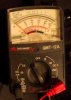
Here is a picture of the meter. The ohms are at the top in green. When I tested a 5.6 ohm resistor the needle went right where it should, between 5 and 6 on the meter. Shouldn't the diaphragm be the same reading?
 

Attachments

  • Picture 049a.jpg
    Picture 049a.jpg
    29 KB · Views: 88
TLgibbs

You have one of the analog meters that you set the scale using the dial.
Usually you pick the scale you won't, short the leads together, and adjust it to zero. But if you are reading a 5 ohm resistor correct then you have it set correctly.
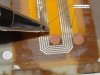
Try measuring it from the actual etched trace as shown in the picture but be carefull and don't use the sharp tips of the test leads or you may punch a hole in the mylar. Turn the leads at a slight angle and try it. If you still get zero then you have a short somewhere and you will have to find it.

banff
 

Attachments

  • dmg2.jpg
    dmg2.jpg
    54 KB · Views: 197
TLgibbs

You have one of the analog meters that you set the scale using the dial.
Usually you pick the scale you won't, short the leads together, and adjust it to zero. But if you are reading a 5 ohm resistor correct then you have it set correctly.
Try measuring it from the actual etched trace as shown in the picture but be carefull and don't use the sharp tips of the test leads or you may punch a hole in the mylar. Turn the leads at a slight angle and try it. If you still get zero then you have a short somewhere and you will have to find it.

banff

That's quite right. But first zero the meter movement.

BUT FIRST, sometimes, like in winter, static electricity will affect the movement. To discharge any static on the meter lens moisten your fingers, shake off any water, place your fingers on the lens. Static discharged!


Now to zero the movement, turn the meter off. See if the meter goes to zero. If not, adjust the movement screw VERY SLOWLY, VERY CAREFULLY. This screw is to the left of the meter model number, in the center of the meter.

Classic traditional "high accuracy" meters had a mirror on the meter face. You would get the most accurate reading with one eye closed and reading such that the meter needle covered its reflection.

But that was another day. Yeah, I know :boring::boring::boring:
 
I can't believe it! I actually fixed a blown EMIT tweeter (and saved my trusty Infinity Qb) with some clear nail polish and some "rear window defogger repair paint" (which seemed to be clear nail polish with powdered copper in it). I tested it in mono and couldn't hear any difference between the tweeters!
 
I finally got my ohm readings correct by using another meter. All my diaphragms read 5.6.:banana: However, what prompted me to pull my emits in the first place is that several of them were significantly lower output to the ear. 3 of the 8 were so low that they were barely perceptible. When I had the diaphragms out I used a hair dryer on the yellow mylar to even them out a bit. The hair dryer doesn't make them perfect, but it helps. Since the ohm reading was correct I did not remelt the solder tabs. I did, however, melt the solder where the wire attaches to the diaphragm when removing the tweeters and when I re-attached the tweeters. I added some fresh solder during reattachment. After getting everything hooked back up all the tweeters were virtually the same level. My conclusion? The melting of the solder where the wire attaches to the membrane is at least as important as the solder tabs where the racetrack attaches. I took ohm measurements at both the tabs and the wire connects before reattachment, and there was about 1.5 to 2 ohms difference. That is the tabs measured 5.6 (like they should) but the reading at the wire terminals was 7 to 7.5. I attribute this to corrosion in the solder where the wires attach.
I would suggest anyone who notices different tweeter levels in their speakers to try this "tune-up". It certainly made a difference in my speakers.

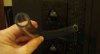
One last note: With eight emits in each speaker it was very difficult to determine relative levels with just my ear. Even putting my ear right up against the emit was problematic because it was hard to tell if I was hearing that emit or the one right above or below it. I solved this by using a piece of plastic tubing about 5/8 inch in diameter and about 12 inches long as a "hearing aid" of sorts. By putting my ear at one end of the tube and putting the other end of the tube right in front of the emit, each tweeter could be distinctly heard, and relative levels could be compared very easily. Attached is a picture of my "hearing aid". Levels were checked by using constant test tones of 5, 6.3 and 8 thousand kilohertz.

I now have happy tweeters!:thmbsp:
 

Attachments

  • Picture 050a.jpg
    Picture 050a.jpg
    14.1 KB · Views: 224
do you think the solder melt process would work on my delta 40,s? as they are the round style. i,ve had some luc in the past replacing square style foils in my old qb,s. isaved 2 emit r,s complete with housing after i got new ones from harmon kardon shipped for around 75 bucks. of course i will have to test first to see if they are still alive. thanks ,alvarez
 
The nails keep everything lined up when removing the top cover. UNFORTUNATELY, one should NEVER have to continually disassemble speaker components in order to repair them. This drove me absolutely nuts on my QLS-1s and I'm very glad I replaced them with speakers that sound better and don't require this insane maintenance, especailly now that Infininty is owned by the conglomerate Harman.
 
The nails keep everything lined up when removing the top cover. UNFORTUNATELY, one should NEVER have to continually disassemble speaker components in order to repair them. This drove me absolutely nuts on my QLS-1s and I'm very glad I replaced them with speakers that sound better and don't require this insane maintenance, especailly now that Infininty is owned by the conglomerate Harman.
1) Any speaker, hell any piece of electronic gear, that's pushing 40 years old is going to require some maintenance.
2) Some people (myself included) derive great pleasure in owning, restoring, and maintaining these vintage pieces, not only for the historic value but also because some of them sound incredible. I am comfortable knowing that there are few, if any, speakers available today costing less than $5K that will sound as good as my vintage Infinity's.
3) Not sure what the current ownership of Infinity has to do with anything. Believe it or not, Infinity is still turning out some good-sounding, high-value products.

If ownership of vintage equipment and the maintenance that goes along with them is not your cup of tea, that's cool, and I'm glad you found something that you like that sounds great to you. And that is what it's all about isn't it...what sounds good to you???
 
I think I will try this procedure. Two of my four are inoperative. The worst problem is that Polygraph mid. I also don't care for those funky looking polydomes. I think they are sort of messed up, as they don't really look like domes anymore, but rather an old shriveled up latex thing

Does anyone know od good replacements for the Kappa 8 mids?
 
I think I will try this procedure. Two of my four are inoperative. The worst problem is that Polygraph mid. I also don't care for those funky looking polydomes. I think they are sort of messed up, as they don't really look like domes anymore, but rather an old shriveled up latex thing

Does anyone know od good replacements for the Kappa 8 mids?
The Polygraph and Polydome are not the same driver. The Polydome is a 3" midrange driver, whereas the Polygraph is a mid-bass/lower midrange driver. From what you describe, you are referring to the Polydomes. When new, the Polydomes used in the early-model Kappas were more or less translucent in color.
Kappa_8A_1.jpg

However, they had a tendency over time to turn yellowish-white and become especially if exposed to sunlight. Unfortunately, Infinity does not make them anymore. But, you are in luck. Orange County Speaker sells a drop-in replacement dome midrange driver that by many accounts is an improvement over the original Polydome.
 
My polydomes are wrinkled, so I will be ordering the Orange county replacements. The polygraph that was vibrating turned out to be a cracked plastic housing that I epoxied last night at 2:oo AM lol. It works fine, but I will watch for one that is REASONABLY priced to have a spare in case other issues develop. As for the four Emit Ks, the two in front are working and one rear is inop. Two problems on the left rear: Something wrong in the crossover, and also a bad speaker was relocated to that dead position. Actually the problem was with the front Emit k, but I pulled the rear wiring through to the front, to make use of that location rather than the back. I really would like to get thet working though, because I can hear the reflecting porperties of the good one, and I do like it. The bad Emitt looks corroded at the center of the ribbon, and reads open on the meter, so it's going to have to be replaced.
 
So i am testing all of my EMIMs and one of them is 2.7 ohms but i get no sound out of it. The others test at around 3.5 to 2.9. What would be the case the 2.7 reading? I am new to this so i need to ask many ?s. I have re foamed the woofers on my 4.5's and have one playing. All i can say is WOW! I took the advice on the amp and am using a Acurus A250. I am following this thread and trying to fix them all myself. Thanks
 
I have one Qa emit that isn't putting out as much as the other -- the real high frequencies are subdued. Any thoughts on why? I have recapped them and cleaned the pots. The subdued emit measures 2.6 ohms and the other measures 3.0.

With all these great posts I'm getting psyched up for a repair attempt, but I'm ify on three things:
1. What are the magnets glued to? In some of the photos it looks like they are glued to the front face.
2. Since a Qa emit only has four screws, not six, can I safely remove one at a time to get an alignment nail in?
3. Is it best to disassemble with the front face on the bottom or on the top?
 
Mission accomplished!

After reading this very informative thread, I set out to repair four emits that were toast! The "race track" part of the diaphragm on all of them had split in more than one spot and were by far the worst ones I have seen to date. For this reason I chose to simply replace the diaphragms with used ones out of a similar Emit rather than to try the Loctite window defogger repair thing.

I took much precaution with the break down of these as I have read much about the dreaded "10 lb. clam on steroids" effect. When taking them apart, I opened them up like a hinge after removing the screws and applying pressure with hands as to not let them twist on the diaphragm. After opening them up I simply switched the diaphragms. Next, I layed the face of the tweeter face down preloaded with the screws (threads pointing up). I then put the diapragm and its back plate slowly down onto the screws acting as alignment pins, applied pressure while in hand started the screws. I placed it back on the bench at this point and tightened it all up. After a check for proper impedance, I then put a dab of glue on each thread end of the screw on the backside of the tweeter as it was from the factory.

I am writing about this in hopes of helping others and NOT to say this is the best way. I just thought it went relatively smooth and wanted to offer my experience with this. Thanks to all who wrote there ideas /experiences down, I was able to pull this off. Thanks again for all the preplanning tips! :thmbsp: Mission accomplished! :banana:
 
I have a set of Qa's and one emit plays sometimes and sometimes not. It starts crackling and going on ang off. When this happens an increase in the volume gets it going again. The other one doesnt play at all, and fuse is good and I messed with the pot by turning it back and forth seveal times and tapping it to no avail. I will check resistance on the non playing one. Any advice on the intermittent one?
 
Great thread!

What does everyone think of a subforum called: "Repair and Parts"? If there's enough interest, Scott or I can ask the admins to clutter up the server just a little bit more...

Great idea for a subforum.


:bigok:
This thread is a keeper....excellent work on the tweet!
 
Back
Top Bottom