• Please note that Audiokarma will be offline briefly for updates early on Monday morning, September 28th.

ESS AMT-3 Rock Monitors - Yet Another Automojification!

nazdackster

New Member
I'm the happy new owner of some ESS AMT-3 Rock Monitors... They're in need of some work, so I've been asking Porkloin and Automojo some questions and thought I should start my own thread rather than continue tagging along on theirs... I'm probably going to follow the Automojo recipe but mine are a little different, having an older crossover and I may make some other changes (haven't decided yet). Just posting this to document for anyone else what I'm going to try and how it turns out.

The original post where I joined in is here:
http://www.audiokarma.org/forums/in...e-automojification.678534/page-4#post-9144634

but just in a couple of days there's been a lot more info added, and all of Automojo's and Porkloin's posts about the AMT-3 are very worthwhile reading... I'm picking this up where that thread was left off (discussing how my crossovers and mids are different)

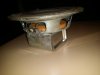
Here are pictures of my midranges, (one with rubber surround, one with cloth)

Rubber surround, mesh cap:
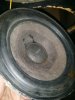
20151024_153459.jpg

Cloth surround, solid paper cap with gap underneath:
20151024_153436.jpg

My crossovers are a little different too... This is the one that looks pretty stock (as opposed to the one with some accidental changes / series / parallel mistakes by a previous owner)
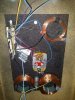
20151024_151500.jpg
The reason I think these are totally stock, even if early 3 coil designs, is that all of the caps are of the same vendor, and match all of the caps in the modified crossover, except where the 3x16uF caps were used in series instead of parallel (in an attempt to replace the 51.5uF).

In the crossover posted here by Automojo, http://www.audiokarma.org/forums/in...e-automojification.678534/page-4#post-9150248, If that's really how it's wired, I don't understand it, too complex and unfamiliar with mixed RLC for two drivers at once. I don't think my values will match up to that crossover, it really is quite different.
 
Register to hide this ad
Naz', the three caps in a bunch look like they're wired in parallel. I zoomed in on the photo as good as I could before pixelation, and it looks like all of the leads at one end are joined together as are the leads at the other end. If that's the case, it's a parallel assemble where the value is the sum of the individual capacitor values.
 
Those mids look quite a bit different than the ones I pulled out. What is the outside diameter?
Midranges.jpg
The Alpha 6a's (Right) would've been a bolt-in replacement if I'd have kept the orginal baffles.
 
Those mids look quite a bit different than the ones I pulled out. What is the outside diameter?
View attachment 635566
The Alpha 6a's (Right) would've been a bolt-in replacement if I'd have kept the orginal baffles.

The rubber surround one is 6.55, the cloth surround one is 6.625 (it barely fits). Yeah, yours looks like a hybrid of the two I have. Sorry, I didn't realize you can't zoom in on the pictures. In the original you can see there are 4x3.5 in parallel, which adds to 15uF. On my other one, it has the same brand, but 2x7.5 in parallel, also 15uF. I can't tell whether that would be crossed higher or lower than the other drawing that was shared without doing some serious math since the similar 33uF cap is influenced by both the mid and the tweeter circuit... I made an excel sheet to do the polar math on simpler crossovers but that one makes my brain hurt just looking at it! I would guess I'm somewhere above 1500Hz crossover.

It's the lower cap on the other one that was mistakenly installed with 3x16uF, which no doubt has messed up the midrange response on the other speaker. I didn't know it by listening before I took both speakers down, but they were sitting in a very sub-optimal position. But still imaged like crazy. Maybe I should keep the mids and test them with the new woofers even though they don't look the same. Maybe they perform so close I wouldn't notice. But you guys like the Alphas that much better I might just do that too.
 
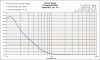
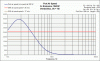
Here are some comparison response charts just using T/S parameters of the various speakers I was considering. This doesn't consider the actual response curves so I'll have to manually compare those since I don't have a good way to incorporate those... Would be nice if you could get some kind of standardized file when looking at speakers that you could plug into some of the calculators out there.

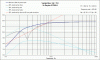
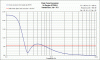
VB Response Dayton ST255-8.gif
Down 3dB at about 65Hz but starting from about 118dB at 200W

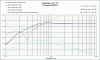
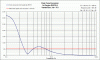
VB Response Dayton DS270-8.gif
Down 3dB at about 43Hz using 115dB as a reference

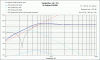
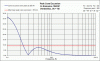
VB Response Eclipse W1038R.gif
Down 3dB at around 37Hz starting from 114dB The little hump compensates for a lower SPL there in the actual curve. Might be pretty flat.

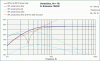
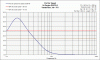
VB Response Eminence 1040SF.gif
Down 3dB at about 44Hz starting from 116. 9mm xmax.

Next: max excursion.
 
Excursion:
VB Excursion Dayton ST255-8.gif

VB Excursion Dayton DS270-8.gif
Both Dayton's exceed xmax a little at really high volume, but they're mostly controlled (most of the coil would still be in the field and that would not be a huge impact in distortion I wouldn't think since all but the extremes are fully powered). At that volume, the room, your ears, and everything else is probably distorting. Xmax goes out the window at around mid 20's Hz
VB Excursion Eclipse W1038R.gif
Even the 9mm xmax Eclipse exceeds xmax a little, but is more controlled. xmax does better at subsonic too.
VB Excursion Eminence 1040SF.gif
The 1040SF doesn't exceed its 9mm xmax at high volume but does at around low 20's too. I like the idea of a large xmax.

Next: port speed
 
Port speed:
VB PortAirSpeed Dayton ST255-8.gif
The 255s are really easy to port because they want to be ported. This particular program doesn't specify the optimum port well so take this with a grain of salt.
VB PortAirSpeed Dayton DS270-8.gif
The 270s are hard to port. I had to use 2x 2" ports 23cm long. Port speed is going to be high below 30Hz. Nothing much I could do. Larger ports require really long ports. I finally realized that this speaker can be either ported or sealed and this is part of the issue with the weird configurations. If you seal it, you give up bass response and exceed xmax earlier.
VB PortAirSpeed Eclipse W1038R.gif
This was hard to port too. I had 2x 5mm ports 27mm long. Port speed will be high below 32Hz. I think response on these will be flattest of the bunch though, but SPL is low to start with.
VB PortAirSpeed Eminence 1040SF.gif
These were easier to port, but were similar to the others. 2x Small ports, long tubes. Could probably use original ports but that would be even more air speed.

I think Automojo tried these but likes the transient response of the 255s better.
 
Those are different from BassBox Pro6, especially concerning the x-max, and port velocity.
Seems you have the tuning too low for them as well, but that still would not make that much difference.
Small tubes induce port resonance.
The problem with Bass Box, is that it impossible to import the graphs, I would have to scan.
I have fine tuned all my box parimeters, including the amount of damping with Bass Box Pro.
The maximum vent velocity is 17 m/s at 500 watts
The woofers begin to exceed x-max at 37hz with a 500 watt input-fairly loud I would say.
At 200 watt input, around 34 hz.
This is not x-damge-if you look at the old specs for this woofer, x-damage was speced at .247 inch-6.27mm. As MattP from P.E. has pointed out to me-these are very conservative figures
Either way, I would recommend a subsonic filter 18 db/octave.
At 500 watts into the woofers, most won't be listening on a regular basis. If you amp can even put out that kind of power.
You want to tune the Daytons between 45-50hz, to maintain their power handling (not just x-max-voice coil temp) and preserve their excellent transient response. All woofers have trade offs in these area -response extension, power handling etc. That's the jugging max.
Room gain will give you the rest. You can't get too obsessive about anyone area.
Those simulations aren't playing music.
Personally I won't obsess too much about response beyond this, most music doesn't have that much information below that.
They Dayton's excel in their tactile feeling bass, and midbass response. Clean, detailed, and uncolored. What I was looking for anyway. Quality of bass IMHO then ultimate extension.
The rest IMHO is better served by a subwoofer. In my experience you will not get that real tactile feeling bass, were you can almost touch the bass strings etc, with a speaker that goes into 20's. Those are the tradeoffs.
Your goals may differ.
Yes-the Daytons are not for sealed boxes.
Sealed boxes require more woofer excursion as the general rule. vented boxes have the problem of over excursion from subsonic content below box tuning because the cone motion is not controlled, and are susceptible to damage by record warps etc-.
You have one early Peerless-should be 4 ohm, the other I don't recognize. I would remove them, and try to take a better pic perhaps.
So you have a mixed bag on the mids-hopefully you mid tubes are the same diameter.
All the simulations unfortunately are just that-gives you a general idea, but you really don't know how it will sound till you get down and do some of the dirty work.
Yes it would be nice to have response curves one could plug in-maybe at some point.
The Eclipse woofer requires a very long port, plus it's a poly cone-hard to get good midbass detail with a plastic cone.
From what I have heard Eminence and BassBox pro are probably better programs them most, and give more accurate results-LEAP another one.
I found a huge difference between Bass Box Pro and Madisounds free calculator.
None of these let you really fine tune box perimeters, or driver parameters-that's why you have to buy them. I found a slightly used copy for a bargain-so went for it.
One also has to realize that using the suggested tuning for the flattest response-does not always give you the best results-those tradeoffs rearing their ugly head again.
Group delay-for one thing-which hasn't even been brought up, is a trade off up too deep tuning in a vented enclosure. Makes the bass sound slow and fat.
From discussing about these woofers at length with MattP @ Parts Express-when tuned right these woofers can take a beating @ high outputs without being damaged. They see very little warranty issue with them-and why he has recommended them for years, and is sorry to see them go.
And they won't be around much longer-currently they have 35 in stock-and that's it.
That's why I just bit the bullet and tried them out on my own-nothing like letting your own ears be the judge.
Maybe the Designer Series would meet your goals, how they would sound-hard to say much from a graph. I don't like the idea of a notch filter-but that may not bother you. The 1040SF need one as well. I wanted a free flowing crossover and speaker with low ESR, and high output. And that's what I ended up with. Couple them with a amp free of coupling caps, and you have a system that can breathe and sing. It makes a positive audible difference in how well the amp controls the bass and midbass IMHO, but yours may differ. I thinks that's a big part of the Automojo" version (my personal version anyway), and shouldn't be discounted.
I'm not saying follow me to the T-what I'm saying is that I think it's getting overlooked here lately, and needs to be brought up again, and the whole reason I went all out on the second crossover revision "hardwired". All components chosen for their low E.SR, including the drivers.
In a nut shell, the quality of the bass and midbass-vs stock was what I was trying to correct.
A lot of this simulations won't tell you.
It's a crap shoot to some extend, and some risk will inevitably have to be taken but that's part of the hobby, and part of the fun IMHO.
 
Last edited:
If I was going to do this upgrade-woofers and mids, I agree with Will, and would just overhaul your crossover completely, and follow the 3 coil setup I posted on Will's thread.
If you can figure out you coil values, if not I would not waste too much time.
So you need .83;.33, and 2.40 mh coil for each speaker.
The hard wire diagram I provided makes it easy, and avoids easily made mistakes.
 
Last edited:
As you are probably finding out the ST255-8 currently is the best compromise for the stock enclosure.
The tight bass response of these woofers matches well IMHO with the Great Heil.
It has the right amount of damping (surround-cone treatment) to negate the negative effects of paper cones, excessive resonance.
Your really getting the best of both worlds. The great tight transient response of properly spec'd sealed woofers, but with the greater output and extension of a vented system.
I went through a lot of the same research-and IMHO the Dayton's can't be beat-unless you willing to increase the internal volume, or do a lot of notch filtering.
I wanted to more or less use the same basic design-just improve on it-not totally redesign the speaker.
 
Last edited:
Does changing the woofers deviate too far from the Automojification™ specs to use the moniker? I feel fortunate that I didn't have one of those vicious, greasy lawyers you keep on retainer at my door threatening to take my house for using Acoust-X instead of VB-1X. Could this be the birth of Nazdacksterization™ ?
 
I'll second Automojo's "Your really getting the best of both worlds. The great tight transient response of properly spec'd sealed woofers, but with the greater output and extension of a vented system". The original setup with its tiny port and firm stuffing was for all intents and purposes sealed. The ST255-8s with comparatively lighter stuffing and bigger ports still sounds tighter with a cleaner low end. You may not be happy with the low end if you've become accustomed to the subwoofer sound from the home theater, especially if you have the subwoofer volume level cranked up.
Someone advised me to be patient when I first fired up the rebuilt lower end and I started bemoaning the lean bass. It only took a couple of weeks of an hour or two here and there for the tight suspension to loosen up and turn the frown upside down.
 
Does changing the woofers deviate too far from the Automojification™ specs to use the moniker? I feel fortunate that I didn't have one of those vicious, greasy lawyers you keep on retainer at my door threatening to take my house for using Acoust-X instead of VB-1X. Could this be the birth of Nazdacksterization™ ?
No-I could care less.....you have my permission to call it what you may.
If you find a woofer that works as well or better- go for it.
And given the discontinuing of the ST255-8 it would not stand either way.
You guys have my permission to carry forward the "torch". I need a break from the internet anyway-recovered-for the most part and back to work..
For the more budget minded it may amount to a 1040SF with notch filter in the future.
I think adding a notch filter defeats some of my personal goals, (such as the aforementioned ESR-a high end goal-but it's a high end speaker-why not?) but more or less your going down the same path.
Just trying to help the OP not get too distracted with specs and graphs-I did as well, and you can easily deviate from your goals.
I played that game as well. There are better woofers that will work @ $150 plus on up (Audex come to mind/a Vifa or Seas/ would have to look). A stiff bill when looking at redoing 8 woofers. I may have gone that route if I just had one pair.
But the ST255-8 IMHO seems to fit in well with the type of speaker the ESS AMT3's was/is/or more likely should be. Big, bold, but sweet and accurate. A throw back, for a throw back. Perfect!
As MattP mentioned in our discussions, it seemed to work well for a number of mid to high end high efficiency vintage speakers.
As a side note-P.E. has really dropped the coast of their acoutic foam. You can easily foam a set with 1 1/2 (6 sheets)and 2 1/2 (2 sheets) behind the woofers for less then $35 w shipping. The precut sheets save a lot of time.
As I found out Auralex does too much damping when applied to the walls.
I just think it was too darn thick and took up too much space. Works great, and look cool for the foam wings on the Heil.
I still recommend Auralex behind the woofers-but either way you should be fine.
I'm glad you all appreciate the work I put in these-really these are all just suggestions-
to help avoid the pit falls many have encountered when trying to upgrade these to something that will easily rival modern high end speakers.
The classic means business 70's look only adds to addictive nature of these speakers. People take notice-What are those?.
They have that 'it" factor, in that 70's grand fashion.
Like the Starsky and Hutch Grand Torino-The Bullet Mustang-Classic GTO-sweet sounds-but in your face when called for. Take notice my friends, take notice.
Pair them with a corresponding big amp, and prepare to be amazed at the color, feeling and emotion that was previously hiding in you music collection.
The good, the bad, the sweet, the harsh, the textures, all laid out there in a addictive wall of sound. (as it should be).
Harbeths need not apply......
Everyone of course is free to go their own way as it should be..
In general if you follow a path to reduce midbass and lower bass distortion, and increase efficiency (this goes along with the ability to play at satisfyingly high volumes with low distortion) you should be satisfied with you end result. Regardless of the componets you use to achieve this end result.
That in a nutshell is the Automojo Edition of the AMT3.
 
Last edited:
Wills makes some good points.
Yes these aren't subwoofers, but they can shake your floor never the less. But not with sloppy subwoofer bass.
They require a break in period, they are stiff cones and suspensions.
And even his aren't fully broken in yet.
They are made for music, not really movies.
If you add a sub, sure-but why not go to a theater?-get out of the house once in awhile.
Sorry, never got HT very well.
 
Wills makes some good points.
If you add a sub, sure-but why not go to a theater?-get out of the house once in awhile.
Sorry, never got HT very well.
Good Lord, if I watched as many movies in the theater as I did at home, I'd be destitute. As much as I enjoy the cinema, it's limited to "date night" now.
 
If your into electronic music-you Might have some content below 38-40hz. Most music-except organ music just doesn't. Run it through a frequency analyzer-a lot of the content you may see is jus plain subsonic trash.
The thump people get is from 40-70hz or so response from their subs, not subsonic information.
If you focus on a clean, transient/quickly responsive low distortion bass response in the audible ranges, you are really increasing the efficiency of your system by not wasting power on content that's not there.
I think this is a much better match for the Great Heil then fat warm bass with kind of "fakey" extension, or midbass humps.
I fallen into the same trap, worrying about bass extension-that I will probably never really use-at the expense of transient response, group delay, and other distortions, and power handling.
A side by side listen is usually the swaying factor, more then a graph.
Ok, this was one woofer I was really impressed with and would have been a easy choice if they were $100 cheaer ea. or so.....
http://www.parts-express.com/aurum-cantus-ac250-75c2c-10-woofer--296-454
Why I mentioned the ST255-8 are a real bargain for the AMT3 upgrade.
The 9" inch vent l would need a elbow, but do able.
However I still standby paper cones mating up best to the Great Heil.
 
Last edited:
Thanks guys. Here are more pictures of mids: Cloth surround:
20151025_214852.jpg

Rubber surround:
20151025_215004.jpg

I'm still not fully sure about what I want to do with woofers (as you can tell). I called ESS today and the guy said 25% of their business is fixing old speakers back to stock. He can do my 4 woofers for $89 each. Remagnetized, and reconed with new paper cones,coils and rubber surrounds, to original specs. Then put into an AMT-3 enclosure and tested. And if I send the crossovers, he'll test for free. Said he had never heard the difference between electrolytic and poly (but has heard many of each). I told him I'm only doing it so I never have to worry about degradation again, and that they're rated to 400V (!). He said he thinks 1,000,000 AMT-3s were sold (!). Don't know if that is pairs or speakers, but that's a lot. ESS used to have 500 employees in total. He said he fields questions like this all day and that there are A LOT of old ESS speakers out there, and people just keep them going.

What do you think of that? From what I've heard reading what I can, the bass is pretty marginal even as stock, but I'm not sure of that. Others say the stock ones are the only way to go, or at least describe how unfortunate it is that they are not original... I'm not a vintage purist but it's hard to make a decision when I can't listen to anything first. Mine are definitely very bright, way too bright, even at dull setting, but that might be the woofers. He thought they would come out pretty flat and reach really deep. He said the new Heil is 95dB and some of their new speakers are at 96dB as stock and can take anything and sound clean. He thought the old Heil at 94dB is probably about right.

As far as the crossover is concerned, I'm keeping the stock version I have. I know it isn't like the drawing you have, but I understand it, and with how blown away I was with the imaging detail (and both mids connected as + to +), I'm not risking changing anything there. If I wanted to tweak it for whatever reason, I would be able to model it easily. With the shared inductor on the other version(s) I've seen, I'd have to re-make my model to accommodate that (which would be a fun exercise but I don't have time to do it). I did find a .pdf on their support page of every stock crossover made and the service manual, but it doesn't show the hand wired one, just the circuit board one. He thought the hand wired one was more common, if older. I think the circuit board may have been used on others but only glanced at a few and saw some similar shapes. The AMT3 is the only 3 way ESS has ever made.

For the woofers, hopefully I don't sound too bull headed, but I am seeing a real risk of having a "pro-sound" sounding speaker if I don't get the full spectrum of bass. Probably a very good pro-sound sounding speaker nonetheless, but that's not what I typically look for. I don't know whether I'm right, but I do see a risk. I realize there may not be much content below, say, 65Hz, but to me, if it is in the content, I want it reproduced, and at the right volume. The same could be said about content above 10kHz, but we all know the difference the Heil makes in that octave. I don't consider a speaker audiophile grade (or that it sounds really great) if it isn't flat to something pretty low, and to something pretty high since I think the whole thing should be reproduced. I was hoping to show some more charts by tonight about what my concerns are so you can see they have some basis in specs I'm reading, but I haven't made it that far. What I'm thinking I'll see on paper when I do that is that the 255 will be very loud in the upper bass, 250Hz range to 100Hz. Too loud at 92.7dB+6dB for parallel and 2x speakers =98.7dB, compared to 94db for the Heil on bright. I haven't looked at the other drivers, but for just trying to verify things on paper before I jump, I'm seeing some risk there. That's just a quick look at my concern about it. For the 1040SF, was the overall level correct, and what were you trying to correct with the notch? From what I see on the similar Eclipse driver, I'll get a cabinet hump of +1dB toward 60Hz which is not a pleasant area to have a bump, but this should complement the declining response curve in that area. And 1dB isn't much, barely detectable. Plastic cone, yes, but supposedly a drop-in for legacy audio models... I could see that being very positive too - some of their drivers do look like that. Have you ever seen their stuff, holy cow! So 88dB on the eclipse +6dB = 94 which should match the Heil, at least in decibels. So those were my thoughts making me lean toward Eclipse. Going toward low frequency will introduce other compromises I'm sure, as you mention, and most efficient speakers I've heard do indeed sound clean at high volume, but typically lack bass too. So I'll have to figure out where to compromise there.

Please don't take my questions as slights on your design or think I don't believe you. Unfortunately, I'm afflicted with engineering... So it might be some time before I satisfy myself that what you are both telling me makes sense on paper and the risk is low of it not satisfying my tastes. Estimating response seems to be a good start for choosing drivers and setting crossovers. Nor do I see it as your job to educate me, but I do have to understand it or be able to at least think I can predict the outcome, even if I turn out to be wrong in the end... Just part of the process for me. I'll just have to plug along and do more research while I take your suggestions into consideration, which I do appreciate very much! I do want it flat if possible though. Do you have any measurements of the Automojo version? I bought the PE mic that is capable to 127dB for $14, but I don't know whether the software I bought can do a response curve on just a few milliseconds of input (to avoid room gain). Cool device I hope to try to make useful soon.

I now have one cabinet braced and the edges repaired with bondo to at least give me a flat, sealable surface. The baffle is very weak for sure between the woofers, but it is solid as a rock now! Will do caps tomorrow night. Thanks again!
 
Dayton ST255-8 Update: I'm not in any great hurry to open these things up for further refinement as the positive so drastically outweighs the negative. At the peak volume that I will allow, the bass is excessive on newer rock recordings with the speakers in the corner of the room. I had to put them there in the past to bring the level up to what I wanted. Modern string bass recordings are also a little overpowering from the corners..
Move the speakers inboard a bit and they're perfect. They're fine in the corners at lower volumes. Extremely clean and tight. I'm not sure if that's a tribute to the higher damping factor of my amp or the suspension of the Daytons. Probably a combination of the two.
Although it seemed a bit of a gamble shelling out the $75 each based on the preferences of an individual 2000 miles of internet cabling away, Automojo's logic was more sound and research based in more knowledge and measurement than I could put out. The money and time needed to figure this out for myself would need to be spread across more projects than I plan to do to make it worthwhile. My process of incorporating someone else' research into my project resulted in a comparatively economical product that is now giving me hours of entertainment.
.....which is my cue to to spin up a Buddy Rich disk.
 
Last edited:
Please don't take my questions as slights on your design or think I don't believe you. Unfortunately, I'm afflicted with engineering... So it might be some time before I satisfy myself that what you are both telling me makes sense on paper and the risk is low of it not satisfying my tastes. Estimating response seems to be a good start for choosing drivers and setting crossovers. Nor do I see it as your job to educate me, but I do have to understand it or be able to at least think I can predict the outcome, even if I turn out to be wrong in the end... Just part of the process for me. I'll just have to plug along and do more research while I take your suggestions into consideration, which I do appreciate very much!

I hope all pragmatism doesn't take a leap out the window in your final decision. Surely the real world testing that Automojo put into determining the qualifications of the ST255-8 for this application will hold the proper weight against the comparatively theoretical readouts that titillate the engineering compulsion.
I suppose the only resolution would be to A/B different drivers in the same room with the same amps and the same sources.
 
Will, don't forget all the cabinet improvement work that you engineered into the rebuild.
With the bracing, absorptive materials and new baffle your new-rebuilt cabinet is a large part of the improvement you've noted.
Let's be fair, the materials of the time period could definitely be improved upon.
Nice work!
ENJOY!
 
Back
Top Bottom