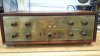
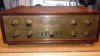
Tube Rolling in the phono stage
The phono stage consists of two tubes in the V1 and V5 positions at the far left of the chassis. This is in a modded phono stage listened to after Dave's tests in #
http://www.audiokarma.org/forums/showpost.php?p=7154187&postcount=124
There's an input selector switch shared, in concept if not exact execution, with the X-202, X-202-B, 400-C pre, 101-ST and possibly a couple of TA receivers where there's an input selector switch with multiple sets of standoffs and wafers inside and two phono tubes on top, always on the extreme left of the chassis when the chassis is right side up.
I did my homework to verify that Dave did not change the function of these 12AX7 tube positions.
He changed the functions of V2, creating recording output buffers.
He changed V3 to make the channel A and B line amp.
He changed V6 to make the linestage/control output buffers.
As far as I know, he did not change the functions of these two positions, V1 and V5.
That takes care of all five 12AX7 positions in this amp.
I will state up front that the changes were relatively small and I found this section only lightly to moderately sensitive to tube rolling.
The track I used was a 45 RPM version of XTC's "Grass" from the album Skylarking.
Tubes used and impressions:
1. RCA USA made 60s style short plate 12AX7s labeled CM with 1964 date codes:
These tubes went with the amp and came back with the amp.
Good quiet linear tubes.
2. Psvane 12AX7-1 triple-mica
I bought these on BT.
Very quiet smooth tubes. Good bass and extended treble. Very smooth and linear. A top choice.
3. Raytheon triple-mica black plate 5751s.
I bought these on BT:
Great smooth bass, extended treble with lots of shimmer. Not the best choice in this circuit, these tubes would shine in a darker sonic environment. Possibly the best bass in the group for this phono stage.
4. Sylvania triple-mica 5751s:
I bought these on BT.
Good even Sylvania presentation, but did not take particular advantage of the eerie holographic sonic image these tubes can throw in certain circuits.
5. Eico/Mullard 12AX7s:
Surprisingly lively for the supposedly dark Mullard tubes. I was looking to tame the treble a bit but these tubes did not do that as much as expected. Great bounce and body. Kick drum not as distinct as most other tubes.
6. Telefunken 12AX7s:
Good overall balanced presentation with just a hint of that Tfk sparkle, but not glorious enough for me to think these have to be the tubes in this position.
7. Heath/Mullard
These are my favorite ECC83 style Mullard tubes with codes 846 and 1022 stamped sideways. These are my reference Mullards since I don't have any 10Ms.
Rich in body and texture with great treble. Same issue as the Eico/Mullards on the bass . . . not quite as distinct and tight.
8. RCA '50s style long chalky black plate 12AX7s labeled Silvertone.
Silvertone is right. Great tubes. Did nothing wrong. Also added nothing exceptional.
9. Sylvania long gray plate 7025s. These look like every long plate sylvania with yellow, green or red ink and have long been my go-to tubes in Fisher phono stages. Well, this is no exception. I continue to be astounded at how overlooked these tubes are.
I left them in because 7025s are supposedly tested for low-noise and I just love the presentation they give.
10. As a spoiler, I put my Tim DePavarincini designed EAR 834P phono stage with three of my favorite RCA triple-mica black plate 5751s in as an outboard phono stage. I ran it into the Aux-1 input.
This was another BT purchase.
This phono stage, as one would imagine, has just so much poise, depth of bass, sweet extended but not forward treble, superior imaging, fabulous midrange, and utter silence in the absence of input, it did two things:
1. Show the exquisiteness of what phono can provide, to this day, when the recording is good, the playback equipment is good, and the phono stage is good.
2. Show just how good the Fisher phono stage is.
I've said for quite a while that, when tended to, the Fisher phono stage can be quite good, though it is not world-class in this day and age. I still find that true. It gives up some bass extension to the best, and shows that additional attention is possible on the shades of imaging in treble for those discerning listeners with a pocketbook to match, but it's a good phono stage.
How good is it?
Well, let's just say that with the outboard EAR phono stage out of the circuit all afternoon while I listened to vinyl, I made no move to put it back in because the Fisher phono stage was fine. To impress my friends on the reference system? Well . . . that might be a different story.
That's all for now.