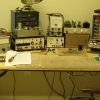
Ferninando -- That particular bench is where I thoroughly document a unit's performance, and perform alignments as well. As for the HP stuff, it is all such wonderful gear. Built like a small tank, and does what it does sooo well without any muss or fuss. In that pic, going from left to right (as best as possible):
1. The black case with the lid closed is a B&K 747 tube tester. I use it to validate if a tube is even worth further testing (since it's so ease to set up), and also use it for an indication of shorts and grid emission.
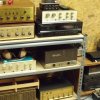
2. Above the B&K is the auction save Custom Electra VII tuner/preamp chassis with the small power supply next to it that I built to power it, and posted as a mini project recently in a thread on this Forum. It was being sold as is as a parts only unit, but is now the best lab music source for background listening that I could ever want. Great Fisher AM/FM/FM Stereo performance, Aux and Mag Phono inputs, and a full array of the usual Fisher controls. Basically, it's a mini 800C -- without all the weight!!
Out of sight on the bench (behind the boxes on top of the B&K), is a 15 watt/ch (PP 6BQ5s) power amp I had built some years ago into (I think) an old Philco chassis I ended up with, which drives a pair of Minimus 12 speakers at either end of the table. You can just see the top right corner of the right speaker poking out on the far end of the table. In all my years, this is the finest lab "entertainment" system I've ever assembled. Thoroughly enjoyable leaving really nothing to want. Cranks as required when needed.
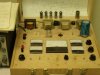
3. To the right of the B&K is a homemade stereo load box I built -- capable of 4-8-or 16 ohms @ 200 watts per channel. It also provides connections for external monitoring devices (scopes and meters), so that only one pair of wires needs to connect to the output of each channel being tested. It is based on the large 8 ohm 50 watt non-inductive resistors that were offered in the Heathkit load box kit, but configured more appropriately for my needs. I originally tried to buy that kit, but they were out of production at the time. However, parts were still available, so...... This was before the internet even existed to consider finding a used one.
4. Next to the load box is one of three power strips that supports the bench. That particular one is the main one, homemade with 10 sockets, with a small line voltage monitor next to it. The whole bench is powered through this strip.
5. Next to the power strip is an HP 3466A DVM with calibration traceable to NIST standards. It has a True RMS function to it for all AC voltage and current measurements, and ultra low scales for voltage, current, and ohms functions.
6. Piggybacked on top of the DVM is an HP 5381A 80 mHz frequency counter, also with calibration traceable to the NIST. It is indispensable in ensuring highly accurate alignments for AM and FM tuners.
7. Next to the piggybacked pair is a Fisher Model 300 multiplex generator. It allows for alignment of Fisher FM Stereo gear using the exact alignment process laid out by Fisher.
8. At the end of the table on the wooden block is my bench bucking transformer. This 5 volt 10 Amp transformer takes the rather standard 122 VAC of my home, and provides 117 vac @ 10 A to adequately power any device being tested on the bench at a line voltage that is appropriate for the day and age that the equipment of our hobby was produced.
9. Up top next to the Custom Electra power supply is a Tek 475A 275 mHz dual trace scope, which is more than excellent for any needs I have. Like most of my other test equipment, its a discontinued item, but built like a tank, and provides performance that the designers of the equipment we love could only have hoped for during the day, in a package of this size.
10. Next to the Tek are an HP 400 EL analog AC voltmeter with the db option, which makes db measurements so easy . I much prefer analog meters to digital readouts (guess I'm showing my age), as it is so much easier (for me) to discern information by a needle swing, rather than from dancing digits. This unit is accurate up to 100 kHz, and is my go to meter for simple measurements of sine wave audio signals.
11. On top of the 400 EL is an HP 3400A True RMS analog AC voltmeter, featuring a tube (nuvistor!) front end. I use it for accurate RMS measurement of complex waveforms. For power output measurements, it guarantees accuracy even with distortion present in the waveform.
12. Next to the voltmeter stack is an HP 339A THD meter test set. It provides a very low distortion test signal, as well as auto nulling distortion measurements down to .001%. As an all in one contained unit, the frequency selection not only changes the test frequency, but the analyzer section frequency all at the same time, which makes testing go very quickly.
13. On top of the 339 is a general purpose Heath IG-5218 Sine/Square wave generator. Great for everyday sine wave use, and generation of square waves for response testing.
14. On top of the Heath is a Heath IM-4180 FM Deviation Meter. I use it for testing the modulation of FM signals to ensure that no over-modulation is taking place when working on the FM carrier wave generator portion of MPX generators that contain such sections.
15. The stack next to that has a Heath IM-5248 IM Distortion test set on the bottom, used for making IM distortion measurements.
16. On top of the IM distortion test set is the Heath IM-5258 THD distortion meter. It too is auto nulling, but does not include a signal generator, so therefore, it is not considered to be a "test set". Its a great backup THD meter, and for accurate general purpose use.
17. On top of that is a Heath IG-37 FM Stereo Generator. I can use it for multiplex work if needed, but mainly use it for the crystal controlled 10.7 Mhz output it provides for yanking FM receiver IF strips back into the ballpark when they've been hopelessly tinkered off the planet by those with good intentions, but without proper equipment.
18. Finally, there is a SWR field strength meter sitting on top of the Heath FM Generator, which I (occasionally) use to check the adjustment of the dipole antenna connected to the output of the Fisher 300 Multiplex generator. The Fisher has the ability to transmit a high quality FM Stereo signal to the dipole antenna, that is mounted atop the PVC mast that you see extending up from the back of the riser. It makes for an excellent final check of all multiplex work since it has external inputs for transmitting any source material desired. There is a second dipole antenna mounted to the mast that serves the Custom Electra FM section as well.
So there you go. There's other equipment on my other benches, but as I said, this is the bench I use to verify/document, and aligned the units I work on. It takes time to collect the test gear you really want. I've been fortunate enough to be able to get most of it at this point in my life, and the Internet has been central in achieving that. I've got my eye on a couple of other pieces, but beyond that, the bench really serves my needs better than I think I will ever need.
For all you solder slingers out there, get the best test equipment you can for the level you desire to work at. If your test equipment isn't accurate for your needs, then your efforts won't return very good results, either.
Thanks for the interest!
Dave




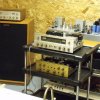
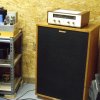
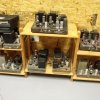

 Heres Dave.