
• Please note that Audiokarma will be offline briefly for updates early on Monday morning, September 28th.

Fluoroscans - do they ever burn out?

Well, best guess here; A Fluorescent display that shows the radio scan(station)...but that's my guess.

And while yes, they can go out it's kinda rare, although far more likely than leds. I have a old calculator with a flourescent display that's still nice a bright...it's from 1976 I belive.

Here's a picture from the vintage calculator site; (at the time, small leds were used, and were very hard to see, theflourescent didn't have this problem, I don't think Ti ever switched from led, but the flourescent was used commonly in rockwell calculators)
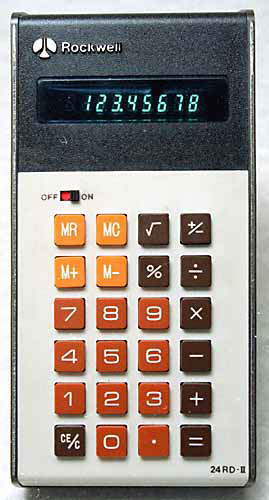
Rockwell24RDII_1_b.jpg

I remember looking at calculators like that at the Fort Belvoir PX. They were under the locked glass, and cost over $100. :yes:

The displays on my DT-400, CTF-750, and TX-9800 are very bright. I don't think I have ever seen a dim display. The DT-400 is LED ...yes?
 
Last edited:
They operate on exactly the same principle & technology as the 'magic eye' in old tube radios. Those too had limited life - much shorter than the other tubes in the radio. It's to do with ion bombardment of the target I think, rather than low cathode emission. The 'fix' there is to increase the anode voltage - usually its around 250V, and pushing it to 350V or more helps.

The VFL displays use a much lower anode voltage - around 30V to 70V I believe. But it might be easier to increase that - and less risky - than increasing the filament voltage.

The best solution is to replace them entirely if they start to dim - IF you can still find the right one.

My Panasonic VCR display is looking notably blotchy after being on permanently for 17 years. I wish they'd use them in calculators still! So much more visible than liquid crystals.
 
steerpike2...you must have the same VCR. I can hardly see the display on my Panasonic VCR anymore. It was a very thin blue diplay to begin with...and never was very bright.
 
steerpike2...you must have the same VCR. I can hardly see the display on my Panasonic VCR anymore. It was a very thin blue diplay to begin with...and never was very bright.
That's usually caused by a power supply problem, failing electrolytics, not a problem with the display tube itself.
 
Ed is right. There's often one or two electrolytics in series with the - voltage supply for the display circuits. I've seen those degrade many times, in many products. Change 'em out and the display comes right back.

Of course, this is a different problem than the overall degradation of the tube, but it's a common problem in older products that use these.
 
Conversely, the VFL display on my Teac TT2 audio timer has been on permanently since 1982 and is only showing very slight uneveness, and no sign of dimming.
Some were just better made than others.
 
The Fluroscan display tube in my 30 year old Pioneer DT-400 timer that's been plugged in running for 30 years...where it's had a coffee maker and counter light plugged into it since new. Pretty amazing how long they can last, if you calculate the hours (over 263,000 hours of continuous operation!)

That is asking something out of that unit. Possibly well beyond the rated capacity on the back of the unit. Glad to read about this long term test of this timer at what could be above the 400watt (IIRC) capacity. They built them better back then.
 
The Fluroscan display tube in my 30 year old Pioneer DT-400 timer that's been plugged in running for 30 years appears to be as bright as ever. Lights up my whole kitchen at night, where it's had a coffee maker and counter light plugged into it since new. Pretty amazing how long they can last, if you calculate the hours (over 263,000 hours of continuous operation!)

That is ironic. One night my girlfriend kicked me out of bed, so I went to sleep in the computer room that has a DT-400 and DT-510. Those bright displays kicked me out of the computer room and onto the living room couch. :yes:

Yes, mine seems as bright as ever as well. I did inherit a CT-F900 that had a dead display. The counter came back nice and bright, but the VU meter is not where it should be.
 
My SA-8800 Integrated Amp has a noticeably dimmer fluorescent display than all the others (CT-F850, CT-F900, CT-F950, CT-F1250, RG-2, SX-3900, SX-D7000). All the others have a bright but varying intensity of display. The comparison is easy when I have them all on at the same time. The CT-F1250 is the brightest. Given all the possible manufacturing/time/use variables, I am not surprised they are all slightly different.
 
Last edited:
Sorry for bringing up such an old topic but I think it's better to have all posts in 1 topic than start a new one.
I have several Pioneer units with VFD display which I've completely taken apart to clean and noticed that different units have slightly different filters in front of the VFD.
I'm currently working on a GR-555 equalizer with greenish display and noticed the display is very dim. However, when looking at the display without the filters it looks pretty bright. It's almost like the grey filter (to tone down the brightness of the display) turned out too dark.
I know this has got nothing to do with an ageing display, it's just something I've noticed.
I've also tested with different Lee filters to see if the color of the display can be changed and it's pretty easy to change a greenish display to an amber display without losing much of the brightness. As you may know, some models were produced with greenish VFD while in other regions the same model had an amber VFD. All they did was use a different filter.
 
My ctf 900 and sa 8800 are bright as New, stunning if u think both built în 70 s,...... But my pd 7700 is fading away daily, and i think that says all about quality components în The 90,s.....
 
The VFDs rely on a phosphor on the glowing surfaces, which burns off with use. If you have a dimmer, run it less than full brightness, it will last longer (much longer), filaments typically do not burn out (but a severe drop can break it I suppose).

We designed a lot of VFDs into automotive displays in the '80s, typically ran them at the max. acceptable voltages (brightness) but they only had to last a couple thousand hours of use, so the reduced life of high brightness wasn't a concern.
 
it is a good idea to dimm them but i dont think there is a way without modifying something in pcb s , maybe a resistor .....
 
All my fluroscan units still display perfectly. Also note that my SX-D7000 and SX-3900 have a dim switch for the display.
 
So being a vacuum tube, filled with gas, there was a company that does this for this, therefor there is a company that still does this I imagine for some product somewhere. Could it be used to send the tube, open the seal, refill the gas under vacuum and reseal it? Good luck getting Pioneer to help. They don't even know what they're old typeface was called when I contacted them and said it was so long ago they have no idea. But I'm SURE there has to be someone still doing this I'm sure.
 
Back
Top Bottom