• The move to the new server is done. There are some software and database maintenance updates in process. This has us passing the hat around to help out. We appreciate any donations. Seriously, even a dollar helps. The payment page may be found here - https://www.audiokarma.org/support.html

FM-200-B Refresh

Who makes those yellow caps? When I first started working on tube gear I used orange drops but noticed different brands used in Jim's kits now I see you using the same yellow ones as him. I want to use the best parts and am wondering if the yellow ones are better than orange drops.

Those are probably Illinois MPW caps, I bought the same for my completely stalled Scott 340B refurb project because they looked the closest in format to the caps that would be replaced.
 
Clear, thanks again.
You know a lot about the FM200 (and probably more Fisher models). Nice that you share your knowledge and experience, that sort of altruism is seldom seen nowadays. Especially the fact that you take the time in answering so extensively in fact describes your character.. :-)
This morning the unit came to live with the left channel up and running. Happy with that. When the replacement caps come in, I will take out the old ones.
Did you ever notice a difference in sound when recapped?

Rob
 
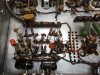
Do you know what the brown wires' function is coming out of the metal box? It is not attached anywhere and on other pictures it seems the same? I can not find it in the service documentation.. is it some kind of antenna or should it be connected somewhere?
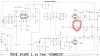
To add to Dave's post...........
Also known as a "GIMMICK". It's TEST POINT 1 as shown in the Service Manual. See below.
FM-200B RF Section.jpg
 
...... When the replacement caps come in, I will take out the old ones.

Did you ever notice a difference in sound when recapped?

Rob

I'll share with you my experience with my 200-B:
When I purchased it it worked but it was far from fully functional as designed. Before I decided to go full out on it, I played it to see what exactly needed addressing and I recall that the sound was as if in a large chamber, albeit in a pleasant kinda way. I went ahead with a full recap and immediately noticed the chamber/distant effect was gone. At first I was disappointed but that lasted less than a day. The "new" sound was more in line with a clean delivery of music and so I attributed to what I heard before as the byproduct of an almost 50yo instrument. In my mind at least, the recap/re-alignment just brought back the piece to factory spec and what I heard before were just artifacts of age.
 
I'll share with you my experience with my 200-B:

Thanks! Funny thing is that I recognise that effect! By cleaning the relays it kinda disappeared..
FWIW my unit has been partly restored. Some of the caps are replaced, most of them not. Also the previous owner replaced one of the 12AT7 output tube sockets and -modified- the output stage to a plate-follower (not the best solderslinger as you can see). Before slowly bringing it back to life (to let the electrolytics reform and check for leakage) I changed that back to original. I had to put in a new 5nF cap as that one was missing.
Quite happy with this unit. It plays little more to my liking than the KM-60, which is a loaner.

What brand/type coupling caps are best to put in? I still have the brownish original(?) caps in place..

BR
Rob
IMG_1506.jpg
 
To add to Dave's post...........
Also known as a "GIMMICK". It's TEST POINT 1 as shown in the Service Manual. See below.

Thanks! I spotted it as well after Dave mentioned it.. one should expect something different than a loose wire.. ;-)

Rob
 
Dave, great work, as always! I have a couple of questions about this restoration and how these issues may apply to my own work on my FM-100-B. I understand from posts 14 and 15 here that DC bias doesn't play well with non-polar electrolytics. Is that true of non-polar film capacitors?
My apologies if these are overly rudimentary questions, as you know, I'm still learning...
I am wondering if having replaced the 1uF electrolytic in the MPX section with a film capacitor will be an issue. My hunch is that it might be, since the schematic is marked with the polarity orientation. Applying the same matters-if-it's-marked logic, I need a polar 8uF for C65 (located at Test Point 3). Is this accurate?

Extending that logic, I reason that non-polar film caps are appropriate, or at least acceptable for the 2uF (C63) and 0.5uF (C70) capacitors to ground associated with the mono timing circuit. Is that correct?
For reference, my unit is covered in the 40xxx to 49xxx service manual. for the FM-100-B.
 
Thanks for all the kind words! I'm hardly trying to put my skills on a pedestal, as that's not my style, and the fact that there's sooo much talent here at AK that we're ALL learning something from somebody else all the time!

I do try to go into a unit however, and perform my work while keeping the underside looking as true to the original build as possible -- which is to say that other than the obvious appearance of the modern replacement components used, the installation of them is entirely in keeping with the original build quality of the unit. In other words, the work in fact should NOT draw attention to itself! With Fisher equipment, working to achieve a high level of execution is just one more part of the effort to help preserve the qualities that went into making up what Fisher equipment represents.

The FM-200B is likely one of the very best FM Stereo MPX tuners ever produced back in the heyday of the Stereo/Hifi craze -- virtually as good performance wise and immanently more practical than the top of the line, but studio monitoring oriented FM-1000. It, as well as all of Fisher's products stand proud representing an era gone by, and deserve the finest effort we can give them to help preserve their mark on the history of high quality vacuum tube sound reproduction.

Dave

Hi Dave I just discovered this thread! I have an FM-200-B and a FM-1000. For the B I did what I though was a thorough rebuild then had my local tech check the unit out and do an alignment. He ended up replacing an additional capacitor and said I did good work.I have been listening to it for several years and it will occasionally squeal so I figure it's a tube other than that if it tunes a station in all the way it sounds good, however not nearly as good as my new FM-1000. The difference is not subtle. The 1000 pics up way more stations and with great reception and a very quiet nearly silent background. So far the 1000 has only had a power section rebuild, see my thread. So I wish I new what to do to get the B sounding better. Since I have the 1000 in it's place at the moment I'm going to check back under the hood. Let me know what you think.
Thanks!
 
Dave, great work, as always! I have a couple of questions about this restoration and how these issues may apply to my own work on my FM-100-B. I understand from posts 14 and 15 here that DC bias doesn't play well with non-polar electrolytics. Is that true of non-polar film capacitors?
My apologies if these are overly rudimentary questions, as you know, I'm still learning...
I am wondering if having replaced the 1uF electrolytic in the MPX section with a film capacitor will be an issue. My hunch is that it might be, since the schematic is marked with the polarity orientation. Applying the same matters-if-it's-marked logic, I need a polar 8uF for C65 (located at Test Point 3). Is this accurate?

Extending that logic, I reason that non-polar film caps are appropriate, or at least acceptable for the 2uF (C63) and 0.5uF (C70) capacitors to ground associated with the mono timing circuit. Is that correct?
For reference, my unit is covered in the 40xxx to 49xxx service manual. for the FM-100-B.

Film capacitors are all non polar. And it usually won't hurt to replace a polar lytic with a non polar Film, especially at values below 4.7uf. Above that SIZE becomes a BIG FACTOR! Very few caps below 1.0uf are polar lytics. These are normally replaced with films.
The 1uf MPX cap (C210) is customarily replaced with a 400V 1uf film. C65 is replaced with a 10uf 50V lytic.
 
I've tried both film and electrolytic for the Composite coupling cap in the MPX section and honestly, I can't tell a difference either way. Either will produce excellent sound quality, with neither having an advantage performance wise. Now whether that's because modern electrolytic caps are so much better (have less inductance being smaller than older types) or not, who knows but you can use either in this location.

Film caps have no polarity and could care less which way they are installed in the circuit, other than the circuit itself possibly being sensitive to the orientation of the cap due to one side representing the outside foil.
In general, a film cap of the correct value can be used in place of any electrolytic cap as long as the darn thing is not so big that it won't fit in -- or if it does, that it's not so crammed into place that it causes circuit interactions that did not exist before.

The problem with using a NP electrolytic cap in a polarized circuit is that a NP cap is effectively made up of two internal polarized electrolytic caps of 2X the indicated value, connected in series, back to back. When a polarizing voltage is placed across this cap then, one of the internal caps has a reverse voltage placed across it, which is not good for its long term health.

Sruddy -- If your FM-1000 is outperforming your FM-200B, then something is clearly wrong with your FM-200B. Both use the same RF front end and therefore the same amount of RF amplification before IF conversion -- and this is only slightly superior to the RF front end used in the FM-100B.

The difference between all three of these receivers primarily lies in the limiting portion of the IF strip. The 100 and 200 use 5 active stages in the IF section, while the 1000 uses 6. In all three tuners, the first two stages are active IF amplifiers, with the remaining tubes all configured as limiting stages -- the 100 and 200 having 3 active limiters, and the 1000 having 4. The differences in the limiter sections amounts to:

1. The 1000 uses a special 6BN6 tube in the 3ed stage of its four tube limiter section. This tube is a Gated Beam Limiter Tube, designed expressly for this type of service. It has the quality of providing effective limiting even with very low input signal levels. As such then, it is a sort of super limiter.

2. The 200 uses conventional tubes in its three tube limiter section, but also uses a voltage doubler circuit in the 2nd limiter transformer (not used in the 1000), to maximize the effectiveness of the last limiter stage.

3. The 100 uses conventional tubes in its three tube limiter section, and conventional limiter transformers.

No doubt limiting performance improves from the 100 to the 200 to the 1000. Honestly however -- and this is not to take away from the 200 or 1000 units at all -- but for all practical purposes, the limiter circuits of the 100 get you 90-95% of the performance provided by the 1000. The 200 gets even closer. This is why I have said that the 100 is the best value in Fisher tuners. I don't have an FM-1000, but have serviced 4 of them. There was certainly no day and night difference between those and my 100 or 200, and in fact, any difference was hard to discern. Again -- I truly mean to take away nothing away from the 1000. It was the cost no object version of their station monitor tuner -- often used for relay service back in the day between stations, with options for a crystal controlled front end, and of course, the 4 tube limiting section -- beyond which no meaningful limiting improvement could be had back in that day. Having as noise free reception as possible was important in station relay use, and so the extra active limiter stage is provided in the monitor, and resulting FM-1000. In the home environment however, the practical differences that will be observed between any of these three tuners in terms of sensitivity and selectivity -- even on weak stations -- will be rather hard to discern in use.

As a result, I would suggest you have a re-look at your 200 to make sure it's not getting short changed!

Dave
 
I've tried both film and electrolytic for the Composite coupling cap in the MPX section and honestly, I can't tell a difference either way. Either will produce excellent sound quality, with neither having an advantage performance wise. Now whether that's because modern electrolytic caps are so much better (have less inductance being smaller than older types) or not, who knows but you can use either in this location.

Film caps have no polarity and could care less which way they are installed in the circuit, other than the circuit itself possibly being sensitive to the orientation of the cap due to one side representing the outside foil.
In general, a film cap of the correct value can be used in place of any electrolytic cap as long as the darn thing is not so big that it won't fit in -- or if it does, that it's not so crammed into place that it causes circuit interactions that did not exist before.

The problem with using a NP electrolytic cap in a polarized circuit is that a NP cap is effectively made up of two internal polarized electrolytic caps of 2X the indicated value, connected in series, back to back. When a polarizing voltage is placed across this cap then, one of the internal caps has a reverse voltage placed across it, which is not good for its long term health.

Sruddy -- If your FM-1000 is outperforming your FM-200B, then something is clearly wrong with your FM-200B. Both use the same RF front end and therefore the same amount of RF amplification before IF conversion -- and this is only slightly superior to the RF front end used in the FM-100B.

The difference between all three of these receivers primarily lies in the limiting portion of the IF strip. The 100 and 200 use 5 active stages in the IF section, while the 1000 uses 6. In all three tuners, the first two stages are active IF amplifiers, with the remaining tubes all configured as limiting stages -- the 100 and 200 having 3 active limiters, and the 1000 having 4. The differences in the limiter sections amounts to:

1. The 1000 uses a special 6BN6 tube in the 3ed stage of its four tube limiter section. This tube is a Gated Beam Limiter Tube, designed expressly for this type of service. It has the quality of providing effective limiting even with very low input signal levels. As such then, it is a sort of super limiter.

2. The 200 uses conventional tubes in its three tube limiter section, but also uses a voltage doubler circuit in the 2nd limiter transformer (not used in the 1000), to maximize the effectiveness of the last limiter stage.

3. The 100 uses conventional tubes in its three tube limiter section, and conventional limiter transformers.

No doubt limiting performance improves from the 100 to the 200 to the 1000. Honestly however -- and this is not to take away from the 200 or 1000 units at all -- but for all practical purposes, the limiter circuits of the 100 get you 90-95% of the performance provided by the 1000. The 200 gets even closer. This is why I have said that the 100 is the best value in Fisher tuners. I don't have an FM-1000, but have serviced 4 of them. There was certainly no day and night difference between those and my 100 or 200, and in fact, any difference was hard to discern. Again -- I truly mean to take away nothing away from the 1000. It was the cost no object version of their station monitor tuner -- often used for relay service back in the day between stations, with options for a crystal controlled front end, and of course, the 4 tube limiting section -- beyond which no meaningful limiting improvement could be had back in that day. Having as noise free reception as possible was important in station relay use, and so the extra active limiter stage is provided in the monitor, and resulting FM-1000. In the home environment however, the practical differences that will be observed between any of these three tuners in terms of sensitivity and selectivity -- even on weak stations -- will be rather hard to discern in use.

As a result, I would suggest you have a re-look at your 200 to make sure it's not getting short changed!

Dave

Thanks for the info Dave, I was afraid to hear it again, but I’m sure your right about my 200. Hopefully I can find someone to help or look at it for me.
 
Thanks again Dave for a great post. I’ve slowly been upgrading my FM-200b I acquired last year. Deep cleaning, new jewels, brass knob caps. Tonight I changed out the can capacitor, bridge rectifier, added 100ohm 5 watt resistor. Turned it on and it sounds better than ever and quiet. I just had to follow your steps. You And the other guys gave me the confidence to try this new hobby and it is life changing. I just want to thank you guys again.
 
yeah, dave, i so appreciate you for this. i picked up an fm-200b and an x-202b this summer, and they sit and wait. but i bookmarked this thread, for sure, as well as your gilded x-202b post. finishing up my new workspace before diving into anything new...
 
Back
Top Bottom
