• The move to the new server is done. There are some software and database maintenance updates in process. This has us passing the hat around to help out. We appreciate any donations. Seriously, even a dollar helps. The payment page may be found here - https://www.audiokarma.org/support.html

Full range vs two-way or three-way

This Barnyard Animals Experience Is

a preference for a single driver speaker with a subwoofer on the bottom end. I owned single driver speakers for quite awhile, and a few years ago tried living with a good three way speaker. That Mourdant Short 880 did some fine things, but I never could get past their ability to fully integrate the drivers, and comparative lack of dynamics. Now these speakers are fairly efficient, and the crossover well thought out, but it still lacks the integration a single driver speaker has.

Now single driver speakers are typically paired with low powered tube or chip amps, as this combo of amplification simplicity plays to the strengths of the speaker. But most high efficiency speakers really only extend down to 50 hertz, which is the case of my Fostex drivers in back loaded horns. So a subwoofer really is required to fill in the bottom end. This is logical plan since the sub is going to have its own amplifier, and brings the power where its needed in the audio spectrum--the bass. The trick is getting a sub thats agile enough to keep up with the full range driver, as a good one is very quick. Typically you run the main speaker full range, and then bring the sub up to fill in the bottom end. That way you don't run the Single Ended Triode amps through an active crossover, which typically will degrade the sound quality of the main amp. In practice this type of set up works well.

Super tweeters are a point of contention. Many feel that they are not needed with a well designed full range driver. There are certain drivers that will extend into the 18K range, and this really is acceptable for audio playback. The mythical 20K plateau doesn't need to be reached. However, its difficult to get a super tweeter crossed in seamlessly, and the good ones can be very expensive. Also you lose the point source presentation, and have a different radiation pattern of another speaker, which compromises the integrity of a single driver speaker. So I don't use them.

Just the take of a barnyard animal on this subject. Got to get off the computer as the farmer is due back from the auction any minute. He doesn't let us barnyard animals into the house to access the computer. We gotta sneak in when he is gone.

Regards
Mister Pig
 
I guess I don't know. What other purpose does a subwoofer serve? Even the best subwoofers I have ever heard were used for this single purpose. What other purpose would they serve?

Gee its too bad thats all you have seen them used for. Too bad indeed.

marc mc
 
Touche. :)

All the above being said, it doesn't take a 3-way to go 30 - 20000 -- plenty of good 2-ways can do it too. Full-rangers are out of the game at both ends, though.

I have a pair of 60 year old full-range Jensens. The drivers are 12" in large bass-reflex cabs. They are definitely not out of the game at the low end. (No sub needed!) The mid range is just incredible. They are probably missing out on the high end, but my 60 year old ears can't hear up there anyway. :D (It's been at least 15 years since I've heard 15K.) I think a large full range may be the perfect configuration for the over-the-hill gang. :thmbsp:

Bobby Dipole
 
I don't know about the rest of the people, but for me it all depends on listening space.... I don't have he room to build the couple jherico horns that i've been eyeballing; i need something more compact, which means not relying on the speakerbox so much for bass extension as much as relying on a driver dedicated to reproducing those low frequencies... chances are, as soon as i own my own space i'll have my (soon to be made) three-ways+sub for my tv and videogaming and a set of backmuonted horns for my turntable...

like everyone says (and i say about computer OS's all the time) every speaker has an intended purpose that it excels at, and right now, a multi-way system excels at not taking up my entire room for a pair of speakers, hehe.

Your post addresses the needs of us married guys. In my mancave I can have whatever I want. However, we still need to build it on our farm in Kentucky, and in my condo in Seattle the stereo is in the living room. It means I use a couple of ADS L300's in aluminum cabs and a sub that is hidden out of sight.
 
I used to run Lii Audio FAST-10S wide banders with super tweeters and W15 woofer in a large open back cabinet and that was lovely though I really did have a great deal of trouble getting the super tweeters to blend well. In the end I found it largely came down to the quality of the cap as Aurum Cantus G3Si ribbons are super revealing. The Duelund CAST Cu-Sn were not cheap though certainlt worked well for this purpose. Currently running Lii Song Fieke speakers which use a single Silver-6 driver in a back loaded horn. I find a sub is needed down low though treble is almost though not quite where I want it. It lacks the sparkle of a good aluminum ribbon. My next speakers will be based around Lii Songs Platinum-10 fullrange drivers in some massive floor standing cabinets..... I'll be building a new home in the next few years with the living room area specifically catering to fitting these large speakers in, as well as dedicated mains circuit etc.
 
Again there is no best dictated by the design of the speakers. It really falls upon budget and execution of that design whether it be a single driver, 2 way, 3 way, 4 way, or beyond.

History has proven that there have been cutting edge speaker designs using any number of drivers. It all falls down to your ears. Bottom line, the number of drivers does not equate to a better speaker or design on absolute terms.

For anyone to say a speaker design consisting of a certain number of drivers is better than another is absolutely absurd.

As a matter of fact, yes it is absurd, fine if a matter of opinion though
 
Dave has provided a very good checklist that goes a long way toward simplifying an audition/evaluation process.

I think that one additional item might be needed:

Do vocals sound convincing?

I believe that the sound of the human voice is "the" sound that most are familiar with, from just about day one.
The midrange is the heart and soul of music, the rest is merely an adornment.

I don't think it's a secret that I hang out with many "fullrange" types, but very few that I know are adverse to complementing their "extended range" speakers with subwoofers or supertweeters. The role of crossovers is often downplayed with a desire to use the least intrusive topography possible, usually a first order crossover in the treble region, with bass augmentation using an active, lowpassed subwoofer amp and driver. The best results are commonly where the "fullrange" driver handles the frequencies between, say 300 Hz, and 3500 Hz or above.

I've heard a number of 3-way and a few 2-way speakers that really resemble what's described above. I believe that RayW's Big Bob speaker (I haven't heard it, but the people that have, rave about it!) utilizes a rather wide frequency range for the midrange and I know for certain that Gary Gesellchen's "Best of Show" (The Puget Sound! DIY Speaker Contest-2010) 3-way used a wide frequency range for his midrange. My entry to the contest (1st Place, 2-way) had the series crossover at 450 Hz (and would have been even lower if I could have done it) in order that the mid/vocal range wouldn't be incumbered by a crossover.
There are other examples, but I hope this is enough to illustrate what I'm trying to get across.

Best Regards,
TerryO

What would the (full) 'range' of an optimal midrange cover Hz to Hz? How much lower than 450 Hz?
 
IF you are sensitive to timing issues you probably prefer a full range. If you are interested in full range 20, to 20,000 with much lower distortion you will prefer a 3 way providing the crossover and arrival times have been fully worked out for best performance.
 
I've oft
Some would argue that they are physically or mechanically divided by virtue of the cone being constructed of differing materials each of which is intended to independently reproduce a different segment of their BW.

Western Electric did a similar thing with the 755/756 loudspeakers. They have a compliance near the middle portion of the cone surface. In some technical documents this compliance is referred to as a "mechanical" crossover as it divides the inner and outer cone sections which reproduce different portions of the audio spectrum.

Interestingly, both the Ohms and WE's are still sought after and highly respected to this day.

I've often wondered what the best approach to cone material should be. The common train of thought seems to be light and stiff, but I can't help but think that a stiff cone would suffer more from interfrequency modulation, as the entire cone would have to be moved for each sound. A cone that is more flexible could produce various frequencies by resonating the various frequencies on different parts of the cone at the same, in my mind:dunno:
 
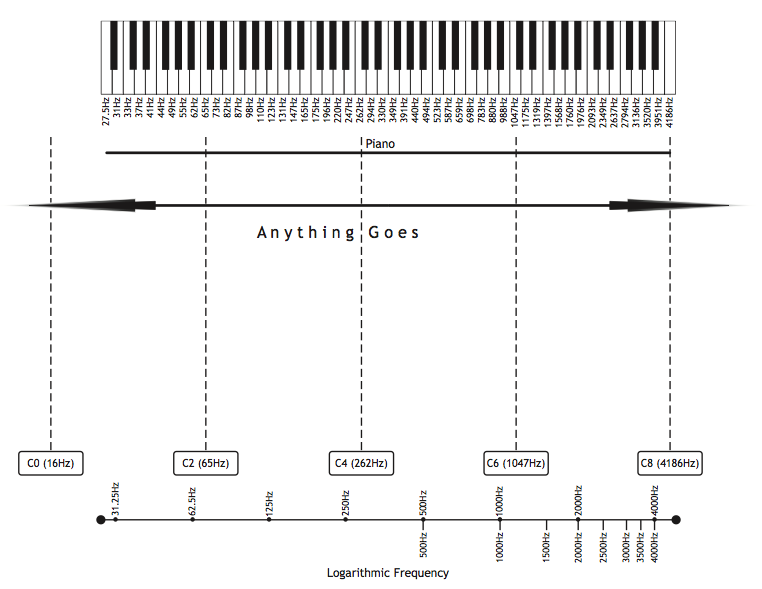
This might be helpful.
piano-piano.png

https://recordingology.com/in-the-studio/piano/

Or, for broader context, including voice:

Frequency-ranges-of-several-musical-instruments-30.png

https://www.researchgate.net/figure...several-musical-instruments-30_fig3_228446442

So just to cover voice, we're looking at from around 95 Hz to around 18k Hz. Would not have guessed that. Thanks for the information! That sort of explains why a well executed single driver (full range) to cover that range would be desirable
 
On the link provided by JB1962, the 1973 vintage Stereo Review article has some very good information.
It has a good explanation of how it works.

My Carver TFM 35x easily powered my F speakers without working up a sweat!

Room placement is very important to keep secondary reflections in check.

It’s not a speaker for headbangers!!!
 
The only problem with the Ohm F Walsh driver is low sensitivity. Gobs of power required.
EDIT: And, if memory serves, somewhat limited SPL. So they need a lot of power but not too much -- sort of like the original Quad electrostatic loudspeaker (the so-called "ESL-57").

This looks like an approach to get a little more SPL out of them ;)
index.php

Nice to know things like this exist, keeps the search interesting. I have power, if the Hafler P500 doesn't push them the (one or two) 700W into 8 Ohm or 1300W into 4 Ohm karaoke amplifier(s) would. No idea what the budget on a set of those are but I already like them
 
Sunday, I took my four-year-old daughter to a local high school's production of Seussical the Musical (which, essentially, put Horton Hears a Who to music - speaking of hearing things no one else does...).

Anyhow, the production featured close to a full orchestra in the pit, including a concert bass drum (one o' them big suckers that's like four feet in diameter). The sound of that bass made me glad that a) I have a subwoofer, and b) I took the time (a lot of it) to dial it in properly. There was a physical sensation with each beat of that drum that went way beyond the auditory response that was missing from my system.

Subwoofer guys talk about pressurizing their listening rooms, and it's that sensation that I think I experienced listening to live orchestral music. That "whoomp" feeling.

My mains are three-ways (B&W DM603 s3), and those fall firmly, I believe, into the realm of mid-fi. B&W supposedly engineers minimalist crossovers and, accordingly, enables most of their speakers for bi-amplification. I don't know how much of that is true and how much is just marketing speak (and I know there are lots of B&W haters around, but that's another issue).

The speakers are rated at 42 Hz to 22 or 23 KHz + or - 3 db. They do a really nice job with music and with movies, but adding that subwoofer (an Earthquake SuperNova MK5-15) really adds a physical presence to the music that wasn't there before, especially at high listening levels. The deep bass notes, for instance, at the beginning of Pink Floyd's DSofM's Time, hit you and make you feel like your the meat in a sandwich that someone's pressing together with their hands. It's not boomy at all. It's the pressure in the room. It's just catching the lower end of notes and fleshing them out.

I have both two-way and three-way speakers in my system, but within my budget, I think that three-ways give the best audio performance. That's my limited experience. My B&Ws image like crazy. When I run them in stereo, they do an amazing job of putting stuff right in the middle. So much so that you'd swear that I was running the center channel and might, like me, occasionally feel compelled to get up and listen to make sure you're listening in stereo.
Similarly,
After I restored my Ohm Model H speakers and gave them a listen, I was impressed with the extra low notes that I was missing. Flipping around FM stations, I listened to a few hip hop stations. Great for a demonstration!
Some songs did pressurize my room. (21x15) The 12” passive radiators DO work!
 
Back
Top Bottom