• The move to the new server is done. There are some software and database maintenance updates in process. This has us passing the hat around to help out. We appreciate any donations. Seriously, even a dollar helps. The payment page may be found here - https://www.audiokarma.org/support.html

Fulton Musical Industries

That RTR ESL power transformer has a stated 1:8 turns ratio. Pretty simple. That's about 960VAC on the secondary (only at very low current) with the volume control set to 100%, which then results in ~1300VDC after the rectifier. The tweeter volume pot only can reduce the primary AC voltage to this transformer, thereby changing the DC bias on the stats. Pretty crude, but it works.
 
Thanks for the reply, I did what you suggested and here is a few more pics of the J's I have. I places bowls the exact size of the outer flat ring of the surround. They are laying flat , now just a wait for a few weeks.:thmbsp:

Hey triode4' any feed back on the 12" after removing the sag...?

I'm getting ready to pull mine out try it out myself. I should have my listening space back shortly and finally getting them out of the garage :D

Jim
 
I got them to what looked flat to me and replaced the weatherstripping on the back panels. I went with wider weatherstripping than the original.They do have alot more bass but not overpowering at all. I have some JBL 4430's and some Von Schwieckerts VR-4 's that deliver more bass but I am not sure these were originally to have authorative bass.
While open I also deoxit'ed the pots.
I would like more bass out of this big enclosure!
 
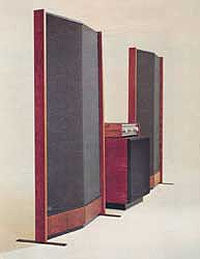
FULTON Model 80 & "J-Modular" loudspeakers

My name is russell about your fulton speakers did you ever get them set up and how do they sound, do you have any more pictures of the insides of the woofer and mid bass sections and would you ever be interested in selling them???? I would like to speak with you if possible my phone no is 225 292 7501 or email stereo70bees@hotmail.com.
 
It has been a while. Those speakers sounded amazing when they were new, and are definitely worthy of a restoration. Bob was a very friendly approachable guy. He liked the Transcriptors Vestigal/Rabco SL-8E I was demoing at the CES show so much that he asked if I would move the entire rig to his room, which I did.
 
Wroinkers! :) And I thought squawkers was a weird term...?!

JBStemp yours look like mine, except for not being beat up and missing badges. :sigh:

FMI-80 and 100 grills can be pulled off with a butter knife at the edges. There are steel placement pins (not nails) through the grill frame material holding them on.

Just to badger some people again the green encroachment into the ends of those speaker cables is oxidation. Do not use this, it's a fire hazard--especially with high powered amps. It creates more resistance and therefore heats up. Also there's likely toxic heavy metal oxidation on the woofer baskets. Plan to paint mine before adding an anti-resonant coating or clay.

Speaking of hazards the Infinity e-stats sometimes set the insulation material on fire inside the model 2000A. Could explain why I've never before seen insulation behind the RtR-6 panels where the high voltage power supply lives...and why Infinity stopped using e-stats. :para:

Okay now the fun stuff...

I haven't seen an owner's manual yet for the J I have, or much promotional material; only reviews. So I don't know the exact placement for stacking the modules, or if there were MDF panels stacked between the driver modules like my single-woofer Modular E.

There were so many versions. Early J bass cabs, reviewed in Stereophile, had 175 liters. Around 1975 the larger ones with 300 liters came out. Mine (SN 304R and 304L, 2-woofer type, very close to your SN 340) are mirror-imaged, even the downward-firing vestibule and base supports are asymmetrical with the outside edges closed, inside edges open to the woofer.

Don't know what year the Premiers with 3 woofers appeared. The hifi-manuals.com info shows a 280 lb 7-way version, listing a preposterous 13-56kHz range :eek: apparently without E-stats. It has the FMI-80PJ with separately controlled single tweeter; all other 80s I've seen have 2 square-edged (Peerless?) AlNiCo cone tweeters and an ~8" woofer with breathable dust cap. Some 80s have black front baffles, others brown. Tweeters are black or brown, but that might be a coating; I can't tell.

I have a white texture coated FMI-100 with a 10" and 4 tweeters in a diamond pattern. I think the veneered version was called Nuance.

Measure the caps. That's one thing that might have to be replaced even if you're reluctant to mess with the xovers. They do drift out of spec over time, and sometimes fail. Working 80s measure 4.9-5.1 ohms.

The e-stat panels in there were originally developed by Dr. Arthur Janszen in the 50s. Could consider it a spin-off since he was doing research for the navy. Later RtR (initials of Richard T. Rohorst (sp?)) bought the tooling for making them. Electronics in Janszens are more reliable than the RtR-sourced types in my experience. I heard a rumor there were larger arrays than the 15s but haven't seen a picture.

Since the volume pots get very scratchy expect somebody already bypassed them which is easier than trying to find replacements. With bi, tri, or tetra-amping you don't need the control on the module anyway.

That's all I know.

There are some people who have experience troubleshooting/refurbishing these; advice for the spectators here try to do some preparation since high voltage e-stats are NOT for the casual DIY'er.

 
Last edited:
Modular bass cabinet dimensions.
These are external (internal is the more interesting volume figure).

---My Es, single 12", about 80 lbs:

31.6" x 16.25 x 16.75 ~ 5 ft^3 (140.9 liters).

---Early Js (from the reviewed specs page):

33" x 18" x 18" ~ 6.19 ft^3 (175.2 l.)

---Later, post-1975 Js, larger cabs:
33.75" x 25.5" x 21.625 ~ 10.77 ft^3 (305.0 l.)

---Largest Premiers: 225 lbs, 280 fully set up

33.75" x 26" x 26" ~ 13.20 ft^3 (373.9 l.) (dimensions not verified) [edit- disputed, so if you have Premiers please measure, TIA]
 
Last edited:
"Why are things so heavy in the future? Is there a problem with the earth's gravitational pull?" -Dr. Emmett Brown /Back To The Future/


Capture1-297x300.jpg


Christopher Lloyd, 1999 movie remake of the 1963 TV series. The orig BTTF was set in 1955/1985--so this was 8 years in Doc Brown's future, during which time he aged 14 years. :D

Heavy?

Haven't weighed them yet. But they are double-plus heavy...at least Symphonies heavy.

My SN 304R/304L is stamped on, not magic marker'ed on the label.

What do the initials P.A.H. mean? One place on the web calls the post-1975 "PA" without the "H". Could be a misprint but who knows.

Most sets' top covers haven't survived. Mine are beat up but fixable.

The top is hard, not soft like JansZen Z II CF grills. Backs may be hard, or soft to allow the tweeter modules dipolar dispersion. Haven't seen RtR-6 or FMI-80 grills ever used with the outer top covers. That would constitute double-grilling; a violation of certain international treaties. :scratch2:

.
 
Last edited:
The earliest J Modular bass unit was probably built around an existing RTR woofer cabinet. It was not made in very large quantities, and the J version usually referred to is the larger, later one.

As I understand it, "PAH" was not really an acronym (although Fulton teased by putting in the periods), but rather an onomatopoeia. It signifies the sound of the lower registers of the trombone that Fulton felt needed more "ummph" than the Js were capable of delivering, but which he achieved with the PAH and Premieres. The PAH is a transition model between the Js and the Premieres. Fulton's supplies of Peerless cone tweeters and the wonderful 8" driver in the 80 and the RTR electrostatics were drying up and he had to start redesigning the mid and tweeter sections with new drivers. I may be wrong, but I believe the Premiere's bass cabinet was the exact same size as the J (the later versions of J). They are all about 25" wide, 33.75" high and 22" deep. The "cover cube" has a partial wooden frame for support, but is mostly open on all sides, including the top.

I have to get the Fulton website up soon or my buddies are going to disown me.
 
Ooomph---PAH ha ha!

...but is mostly open on all sides, including the top.

Well not all. My SN 304 Js have a hard top on the uber-cover cube, but I have no proof it is original. There were so many variations, how do we track them all? I see why J Gordon got frustrated. I thought it was only the xovers but I know now there was a lot more shape-shifting going on.

Unlike the later Cylons (only 12 models).

Battlestar_Evolution_Cylon.jpg


"J" for J Gordon Holt? OR....

3542-ent_meninblack3.220w.tn.jpg


.
 
Last edited:
Power and Timbre

pt. 1: Power

Wonder if Bob F might scoff at the critics mealy-mouthed rationalization/pandering directed toward $$$spendy, masterfully finished, but anemic bass response such as this :

"The [Sony] AR2s do not quite go down literally to the bottom of the audible range .... But in practice, this won’t be a problem. ... Only pipe organ enthusiasts might want a subwoofer. ..."

What pipes are they smoking? :screwy:

Hey how about rock and blues enthusiasts? And, yes, what about classical? Heard a full 104-piece orchestra live? Yep, iPod listeners, I can tell you there is dynamic range, power, even the occasional onslaught of thundering bass in classical music.

And finally how about listening to Pipe Dreams--a program dedicated to afficianados of E. Power Biggs & co?

link

---

Returning back to the 70s timeframe...when the reviewer said the competition's bass in the "Class A rating" category (Infinity SS-1 CV servo-sub 'commode') was superior to his Modular Js, Bob didn't gripe and moan*; he made them better. :D Even if it meant they became bigger, heavier, harder to build and transport. He could have made them porty, boomy and all west-coasty. But then how could you tell an acoustic bass from an electric?

* (Well maybe he did complain! But the point stands...)

infssiapic1.jpg
 
You may not know this if you don't have the manual: Wire the midrange (the FMI-80) in REVERSE polarity ("out-of-phase", or plus-to-minus) relative to the woofer and the electrostatic tweeter array which are both connected normally.

This was a later try. First, I'd check to see if somebody rewired your 80 mids. One web source says (AudioCircuit maybe?) this was in direct response to brighter, flashier showroom comparisons where often the brighter speaker seems better to untrained potential buyers and did not last long (in the long run, as Vandersteen knows, listenability at home is more important...).

So, try it both ways. Trust your ears and do a Polarity vs. Phase vs. Time Delay test if you have a mike & the software.

Were any two sets exactly the same?? (I preferred it in-phase on my set, but I'll try it again the other way because you raised the point. On your set I may like it better reversed...) :hdphones:
 
Last edited:
Regarding the FMI-80 electrical phase connection, by all means please your own ears. But unless you have the three boxes in the J Modular positioned in the exact peculiar manner described in the owner's manual, the phasing exercise would be shooting in the dark anyway. The crossover (in all of the variants that I know of) is designed to work with the 80 in "reverse" phase connection. More than one version of the owner's manual states that connection. I wonder how many people have bought used Js without access to the manual and hooked them up wrong, then wondered "what's all the fuss about this speaker?" Most probably. By the way, inside the 80 itself, the 8" woofer and those two tweeters are hooked up in reverse polarity to each other. The woofer has no crossover; the tweeters only a cap in series. So reversing the polarity of the whole 80 brings the two tweeters back "in phase" with those ESL tweeters. If the tweeter box is positioned on top of the 80 correctly, the result is surpringly seamless and natural. I will try to publish the manual and link to it later. It's too big to attach here.
 
This is quite helpful.

First, my cover cubes were upside down--so I thought could place them over the top of the mid/tweet stack open end down. Now I see, the guide bar is on the base! Eureka~!

Does that mean anybody without the covers should raise up the 80s with a spacer the thickness of the cover base (which was specified on Mod E's)?

Will report back.

Say! The manual also talks about placing FMI-100 in there, will try that too! Thx again all.

Also just re-read the 2009 thread on my E modules...had forgotten some details there too.
 
Last edited:
First, my cover cubes were upside down--so I thought could place them over the top of the mid/tweet stack open end down. Now I see, the guide bar is on the base!

There ya go! Sorry, I should have figured that out for you from what you had been saying.

Yes, the 60 and 100 can also be used, but the 80 is the sweet-spot midrange for the J Modular. The thickness of the floor of the cover cube elevates the side-laying 80 tweeters to a good average ear height above the floor.
 
Will report back.

Expected an extended laborious process, couple of days listening maybe. Nope! One try with Dave Brubeck and it's all locked into place and more coherent already.

Reverse polarity rules. :banana:

Thx AK'ers you are the best...:king: ...glad you told me only days after I got the Js. Strange to think this forum started with a Grumpy guy... :confused:

-- test 1: --

Tweets/mids: Threshold S/200 (my sweetest amp).
Bass: Peavey CS-1000

Listening room 'very live', concrete floor, 30' x 40' -ish, (irreg., 22' tall middle atrium/arboretum). Too far from the wall. Laundry baskets on floor at 1st reflections... a lot more to try out here. Tetra-amping, heavy curtains for the windows, etc.
 
Last edited:
Regarding I will try to publish the manual and link to it later. It's too big to attach here.

There's a Digital Docs forum here: http://www.audiokarma.org/forums/forumdisplay.php?f=141

Try splitting it up across two or more files to stay within the attachment size limit. Or post a link to the location where you are hosting the doc. Also if you can - save to a common format, like PDF. Thanks for all the great information.
 
Thanks. I just sent the Fulton J Modular "Instruction Manual" in PDF to the AK data base by their supplied email address. I hope that's the right way.
 
Hi Brian,
I don't know where you sent it, but I can't find the manual. When first got my pair , I had them hooked up in phase, in respect to being connected the same way on the rear terminals of the bass module. I then changed the polarity because they sounded thin. They now sound like they have more bass, but not nearly as low as the specs suggest.
 
Back
Top Bottom