• The move to the new server is done. There are some software and database maintenance updates in process. This has us passing the hat around to help out. We appreciate any donations. Seriously, even a dollar helps. The payment page may be found here - https://www.audiokarma.org/support.html

Fulton Musical Industries

I guess a moderator has to weigh-in before these are posted. I sent an email with manual attached to files@akdatabase.org as instructed at http://www.audiokarma.org/forums/showthread.php?t=349095. This is my first such attempt. Not terribly user friendly, but then the price is right...

A couple of things come to mind about your bass issues:

Make sure everything is positioned per the manual, whenever that is posted.

The speakers work best closer to the rear wall than many of us are used to. Start with 10" and see if that helps. They also work well closer together than many people expect, a shallow triangle, not an equilateral one. Make sure that the slots under the bass cabinet face inward, toward each other.

As you see earlier in this thread, the 12" down-firing woofer, although it has a doped pleated cloth surround, can drop out of center with gravity over thirty-plus years. That same surround and the spider can dry up and stiffen a bit with age too. Some people have suggested a heat gun to soften this, but I am wary of that. If your woofers are in bad shape, then once in a while you'll see new-old-stock woofers of the identical type on eBay from a fellow who bought out the RTR driver inventory.

What amplifier and cables are you using?

Room acoustics can be a wild-card, of course.

Finally, although the J is capable of deep and natural bass, it is not a bass heavy speaker. Rather it is neutrally balanced. You won't hear bass unless it's called for by the music. If you're used to the rumble of box speakers with a resonance at 60 to 80 Hertz then the quietude in that band may take some getting used to.
 
Well I finally got my listening space back. :banana:


l movied the j mod's in and they sound great :thmbsp: My sweet spot is 43" apart and 9" from the wall.

I want to personally that Brian and Tom for all the help and guidance. :yes:

Here are some pictures.

Top on...

Topon_zps83ad6125.png


Top off...

DSC_3098_zpsbe60e55e.jpg
 
Your before-and-after pictures make a strong case for putting those cover cubes on! The almighty WAF goes from 1 out of 10 to maybe 3 out of 10. That's still going to cost you a trip with her to the mall I'm sure!
 
Can someone please advise me on my FMI-100s that I've had since '79? They have always sounded harsh in the high end compared to other speakers (Sansui AS-100s, Paradigms, Boston A-150, Pioneer HPM-40, etc) and are not pleasant with any kind of rock of popular music if there are electric guitars and other similar frequencies. Frankly they've always been that way, and I remember my old friend Bob Zucker offering to trade me for his FMI-80s because they sounded much better. Check out the internals, which have three components (caps?) strung together in the tweeter crossover, and check out the two "starter solenoids" at the bottom of the cabinet!! Should the caps/components be replaced or values changed to stop the irratating frequency spikes? I love the low end on these -- very flat and deep for a 10 incher, and tight too. http://s1238.photobucket.com/user/s...rs?page=1&_suid=13640973830690772405940924726
Thank you.
 
Suggest leaving those crossovers alone for now...

I don't want to come across as one of those guys who always blindly defends a brand that he admires no matter what, but your experience departs from mine so much that I want to try to help you figure this out.

For maybe 10 or 15 years I used the FMI-100s for almost daily listening. They never sounded bright to me, and in fact seemed slightly warmer than the FMI-80s, although very similar in character. I later added the electrostatic tweeters, the FMI-6 units (modified RTR ESR-6s) which added some air above 7 kHz. But the tweeters in the 100s ran without low-pass filtering, so I would have heard brightness had it been there.

When the 80s and 100s came out in the seventies they sounded far more alive and articulate than the other bookshelf speakers of the day. I remember very clearly comparing them to Advents, which were the most popular speakers at that time. The Advents sounded muffled, blurry and dry by comparison with either Fulton model. I suspect the same would have been said of other box speakers of the day. Most had rolled-off highs and peaks and dips in the responses. The Peerless MT225 tweeters used in the 80s and 100s are really rather remarkable drivers. They look pretty ordinary, but Fulton chose them because they combine smoothness and reasonable extension. Because the Fultons were among the first boxes with truly open sounding treble and highs, they could be ruthlessly revealing of bad source material and amplification. But they really were closer to the truth.

I would strongly suggest that you NOT muck about with that crossover. If any audio designer ever had an ear for musical balance it was Fulton. It is unlikely that you will do anything but destroy the resale value of these speakers. Every component was chosen for a reason, even that Fulton Brown wire.

So what is the problem?

Well, it could be one of several things:

1.) The speakers could be defective: This seems unlikely, because if a tweeter or two had failed, you would hear less brightness, not more. Have you cleaned the tweeter potentiometer with Deoxit? It could be dirty and producing distortion. Is it possible that a woofer voice coil is scraping? Can you verify that both woofers travel in and out freely? If a woofer ever received a severe (very severe) overload or high DC voltage from a bad solid-state amp, the Alnico magnet could, theoretically at least, have been somewhat demagnetized, making the woofers have lower output relative to the tweeters. But you mention that these always sounded this way since 1979. My guess is that your speakers are OK.

2.) They could be positioned wrong: The 100s needed to be listened to off-axis. The diamond array of tweeters would beam on-axis, and would sound bright in that case (ditto the 10 inch woofer). I had mine sitting on smaller cinder blocks (this was the seventies and eighties after all) on the floor. The blocks might have been 5 inches in height. The top of the 100 cabinets were roughly at ear height, putting the tweeters' bore-site down at my chest. The ESL tweeters sat on top of the 100s and were therefore at, or above, ear height. This arrangement sounded very smooth and natural. We called this system the "Mini-J". Not bright at all, in three different houses. How do you have yours positioned?

3.) The speakers are not compatible with your source or amplifiers: I suspect that this is your problem. Can you please share what associated components you are using?
 
Well I finally got my listening space back. :banana:


l movied the j mod's in and they sound great :thmbsp: My sweet spot is 43" apart and 9" from the wall.

I want to personally that Brian and Tom for all the help and guidance. :yes:

Here are some pictures.

Top on...

Topon_zps83ad6125.png


Top off...

DSC_3098_zpsbe60e55e.jpg

They look great to me, but I'm not married (anymore)! Bob had them set up about a foot or two farther apart when he demoed them in a small hotel room in Chicago 36 years ago. I spent a lot of time in that room; he was using my tonearm! I absolutely love those speakers.
 
Thanks for the great response Brian. Needless to say that I did remove the three hi-pass caps that were in the photos. I'm puzzled as to why he would have put these in parallel. I'm no engineer, but it seems that by doing this the tweeters are being fed by three different signals (since the caps are three different values) because there would be three different paths that the signal could take. The big black cap is a TSI 6uF 50VAC, the large yellow cap is an ACU-CAP Acushnet 0.27uF 100VDC, and the thin yellow cap tests at 1.0uF and is stamped 1.0/10/100 so it's likely rated at 100V. The large yellow cap has a band around one end which indicates to me that it's polarized. And why would someone use a 50VAC (alternating current) cap on a speaker mixed in with VDC caps? It's apparent that at one time there was a single cap attached to the board in a different place (see the pics), so somebody made a change before I got them in '78 (it could have been a previous owner or FMI). It makes more sense to me to wire caps in series so that the complete signal is forced to go through each cap so that total capacitance is achieved, but my logic may be flawed. I intend to keep these caps and try a good 4.7fF cap (like what's in my Sansui AS-100) and see how that sounds - I can easily solder the old ones back in.
I assume you're aware of this article by Stereo Review where they were forced to "stand up" to Bob Fulton because he was constantly making changes to speakers and the magazine staff felt that some of those changes were degrading the sound/musicality, hence making their previous listening review article inaccurate.
This part of the article I think addresses what I'm hearing, exactly (shrill, insufficient low midrange and highest frequencies):


But every honeymoon has to come to an end.

We had been growing increasingly irritated with the constant changes, and increasingly embarrassed by the repeated frustration of publishing interim reports on speakers which, when our readers got to audition them, had been changed since the report was written and no longer sounded the way we described them. FMI was, in effect, creating a credibility gap for us, and an "independent" audio publication without credibility is like a politician without a party. The latest change in the Js—which will undoubtedly be a previous change by the time this sees print—was in our opinion a large step backwards, an error in judgment which, on Mr. Fulton's past record, we find surprising. The J system, as of this moment (June 27), is shrill, heavy, and—quite an accomplishment with electrostatics—almost totally devoid of extreme high end.

That the latest modification resulting in this sorry state was done when we were right in the middle of our first batch of preamplifier tests was a further source of irk to us, but since we allowed the mod to be made at that time (assuming that, like previous ones, it would improve things), we can only blame ourselves for the disruption it caused. We were, however, forced, for the first time for some years, to retire the Js from our listening area and, temporarily, move the site of our final preamp tests to the home of one of our associate listeners. (Previous findings were, incidentally, verified there, which is one reason we are so smugly self-confident about their veracity.)
As we said, the latest problems with the Js will almost certainly have been ironed out by the time this sees print. And if yours were recently modified, resulting in excessive brightness (or inadequate lower midrange) and dull high end, it is our feeling that Mr. Fulton should undo his efforts at no cost to you, for it was a mistake for which you should not be held responsible. To those readers who, after having compared our comments about the Js (in "Recommended Components") with the way they now sound, were wondering if we had finally flipped our judgmental lid, we can do no more than to offer the foregoing explanation of what happened.

Maybe it's possible that over the years Bob's ears/hearing changed and the changes he made that HE thought were good were bad for the average audiophile.

The system I hooked them to is a Sansui 2000X that sound good with any other speakers (EPI-100, Pioneer HPM-40, Boston A-150, Paradigm Phantom, Sansui AS-100). I do plan to clean the pots with Deoxit. Is it possible that someone wired the speakers out of polarity? I know that can cause irritating high frequencies.
 
Thanks for the great response Brian. Needless to say that I did remove the three hi-pass caps that were in the photos. I'm puzzled as to why he would have put these in parallel. I'm no engineer, but it seems that by doing this the tweeters are being fed by three different signals (since the caps are three different values) because there would be three different paths that the signal could take. The big black cap is a TSI 6uF 50VAC, the large yellow cap is an ACU-CAP Acushnet 0.27uF 100VDC, and the thin yellow cap tests at 1.0uF and is stamped 1.0/10/100 so it's likely rated at 100V. The large yellow cap has a band around one end which indicates to me that it's polarized. And why would someone use a 50VAC (alternating current) cap on a speaker mixed in with VDC caps? It's apparent that at one time there was a single cap attached to the board in a different place (see the pics), so somebody made a change before I got them in '78 (it could have been a previous owner or FMI). It makes more sense to me to wire caps in series so that the complete signal is forced to go through each cap so that total capacitance is achieved, but my logic may be flawed. I intend to keep these caps and try a good 4.7fF cap (like what's in my Sansui AS-100) and see how that sounds - I can easily solder the old ones back in.
I assume you're aware of this article by Stereo Review where they were forced to "stand up" to Bob Fulton because he was constantly making changes to speakers and the magazine staff felt that some of those changes were degrading the sound/musicality, hence making their previous listening review article inaccurate.
This part of the article I think addresses what I'm hearing, exactly (shrill, insufficient low midrange and highest frequencies):


But every honeymoon has to come to an end.

We had been growing increasingly irritated with the constant changes, and increasingly embarrassed by the repeated frustration of publishing interim reports on speakers which, when our readers got to audition them, had been changed since the report was written and no longer sounded the way we described them. FMI was, in effect, creating a credibility gap for us, and an "independent" audio publication without credibility is like a politician without a party. The latest change in the Js—which will undoubtedly be a previous change by the time this sees print—was in our opinion a large step backwards, an error in judgment which, on Mr. Fulton's past record, we find surprising. The J system, as of this moment (June 27), is shrill, heavy, and—quite an accomplishment with electrostatics—almost totally devoid of extreme high end.

That the latest modification resulting in this sorry state was done when we were right in the middle of our first batch of preamplifier tests was a further source of irk to us, but since we allowed the mod to be made at that time (assuming that, like previous ones, it would improve things), we can only blame ourselves for the disruption it caused. We were, however, forced, for the first time for some years, to retire the Js from our listening area and, temporarily, move the site of our final preamp tests to the home of one of our associate listeners. (Previous findings were, incidentally, verified there, which is one reason we are so smugly self-confident about their veracity.)
As we said, the latest problems with the Js will almost certainly have been ironed out by the time this sees print. And if yours were recently modified, resulting in excessive brightness (or inadequate lower midrange) and dull high end, it is our feeling that Mr. Fulton should undo his efforts at no cost to you, for it was a mistake for which you should not be held responsible. To those readers who, after having compared our comments about the Js (in "Recommended Components") with the way they now sound, were wondering if we had finally flipped our judgmental lid, we can do no more than to offer the foregoing explanation of what happened.

Maybe it's possible that over the years Bob's ears/hearing changed and the changes he made that HE thought were good were bad for the average audiophile.

The system I hooked them to is a Sansui 2000X that sound good with any other speakers (EPI-100, Pioneer HPM-40, Boston A-150, Paradigm Phantom, Sansui AS-100). I do plan to clean the pots with Deoxit. Is it possible that someone wired the speakers out of polarity? I know that can cause irritating high frequencies.
 
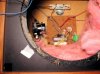
I see now that your crossover might not be original. I never opened my FMI-100s, but I do have a couple of pictures of the innards from someone else, which I've attached. These look quite different from yours.

It's hard to say what's going on here. These caps do look like the kinds of caps that Fulton used, but there appears to have been mods made and the result looks nothing like the other guy's 100s. I will ask a friend to respond here; he may have the answers.

Regarding the caps being in parallel or series:

...my logic may be flawed.

I think it may be on the cap theory. Probably you ever heard of "capacitor bypassing". You bypass a larger capacitor with a smaller one, sometimes with two others to reduce ESR and ESL. The smaller caps can have better high frequency characteristics than the larger one, but you still need the larger value for the correct chosen capacitance. The effective capacitance when these three are in parallel is the sum of their values: 6+1+0.27 = 7.27uF. If placed in series you'd have 1/(1/6+1/1+1/0.27) = 0.205uF, which is nowhere near 7.27uF. That would fix your "shrill" complaint for sure, but you wouldn't like the new muffled sound!

However, I cannot recall what the crossover cap value is supposed to be for the FMI-100. Let's see if my friend can help.

Yes, the falling out between Fulton and J Gordon Holt at Stereophile is famously known. Gordon had legitimate complaints here. Fulton would mod speakers on the spot to please some customer or to compensate for a system or room problem. When he had control of circumstances, he wouldn't make many mistakes in tone balance. Whether yours was a running mod like this or not, we don't know.

Don't know a thing about the Sansui 2000X. Many people have preferred to use tubes with Fultons, but Fulton himself was not stuck on tubes over solid-state. He used both where it pleased him. I drove my Fultons with Dynaco tube amps and then later an Audio Research SP-3A-1 and D75A from the seventies which were very synergistic.
 

Attachments

  • P7270001-1.JPG
    P7270001-1.JPG
    133.5 KB · Views: 83
  • P7270002-1.jpg
    P7270002-1.jpg
    30.2 KB · Views: 77
Whhooohhh !!

Hello,

Well......You guessed wrong to take paralleled caps and place them in series, without researching FIRST what other FMI-100s were running as crossovers. I have never heard of a cap failure in a FMI speaker in 35 years, so don't second guess Bob.

Gordon Holt , while adored by us all, was far from perfect in setting things up, and Robert always had better amps than Gordon. Robert's speaker designs "assumed" a GOOD front end and amplifier. He hated to compromise the speaker to run on garbage electronics. He often designed speakers by running his Crown Tape deck directly into a ARC (modified by him) amp, while listening to his own master tapes !! Bob often assumed state of the art electronics.

If your FMI 100s have been shrill "since you have had them", and the other constant has been the Sansui 2000X, I would question not the FMI -100 but rather, the San-Fooie !!

The 2.25 inch Peerless tweeters can sometimes go bad and get buzzy sounding and high in distortion, that is a fact.

In all of my 35 years of experience with Bob Fulton, and his FMI products, the single WORST problem was the crummy audio amplifiers, that were UNFIT for truly capturing the musical experience. Bob's speakers were in need of a GOOD amp, and it didn't exist to cover the whole musical range.

Brian's ARC D-75 gave you bits and pieces of glory in a few ranges. I had about six of them. A "hint" of the glory. How would a SanFooie 2000X compare to a ARC D-75 or a D-75A? I don't really know, and I have been in audio for 60 years, and until tonight, I never heard or even seen a 2000X.

I suggest you put the crossover back to stock FIRST, sweep the tweeter section for buzzes or IM distortion, is it audible? If not....then, find yourself a great amplifier that is synergistic to that speaker. That was always my problem....amps are the BIGGEST TURKEYS of all, and its NOT just your San-Fooie !!

Good luck. I don't have all the answers, but as Brian knows, I do have a LOT of FMI experience.

Jeff Medwin
 
First, glad that JM decided to stop in here on AudioKarma. Cool! Have read his contributions on other forums with great interest.

... crummy audio amplifiers, ...

Yes my Mod-Js and Mod-Es deserve my number one best amp--a Nelson Pass Threshold optical bias S/200. It drives the FMI-80 / RtR-6 while pro Yamaha & Peavey 'arc welders' push the bass modules.

On one set of my 80s I switched the tweeters back in phase with the 8" driver. That may be interesting. The Infinity Q-series wired the mids out of phase on purpose too; called it an 'acoustic coupler' which I don't pretend to understand.

... I have never heard of a cap failure in a FMI speaker in 35 years, so don't second guess Bob. ...

Got most of my gear used--no way to know how much torture and abuse they've suffered. :sigh:

More worried about drift than total failure. Drift can be insidious and hidden!

In general, I see many caps go out of spec after 35 yrs. Even a relatively minor drift shifts the xover frequency off by 200 Hz. (Check all your Advents and DQ-10s guys! Their xovers get hot.)

Easy to measure capacitance/ESR with a modern cap tester (friend of mine's meter can test without even taking the caps out of circuit!)

Problem is figuring out the original ESR values to replace them as closely as possible.

.
 
Last edited:
I heard that the harman kardon 430 twin sounds wonderful with Jmods :music:

Something to do with the components used in it makes it a good match for the J's. I have no personal experience with it, but I'm on the look out for one. :yes:
 
I heard that the harman kardon 430 twin sounds wonderful with Jmods ...

The HK 430 can sound good with just about any speaker. No special match for the Js, I assure you! The Klipsch community has been all gaga over the 430 for years. It's far more powerful-sounding than you'd expect with only 25 WPC. A buddy with a sweet Audio Research D-150 prefers his tweaked 430!

These old receivers were something special, better than the bigger HK 630 and 730 in fact. A fluke in audio history, although they can vary in sound quality these days - perhaps due to aging electrolytics or variations in transistor matching. The Elnas that are in the stock supply are pretty good, and replacing them with any new electrolytic caps might not work as well. Using Silmics or Cerafines is best, of course, but pricey.

They pop up on eBay almost daily. Fortunately a lot were made.
 
I read all kinds of posts about "cap bypassing" and "parallel caps", and just like lots of subjects in audiophildom, there doesn't seem to be any concrete evidence of these making a difference, yet there are those who claim to have heard a difference through listening evaluations, and others who state they were unable to hear a difference. This kind of reminds me of the decades-long and ongoing debate of the sonic advantages of "high end" speaker cable -- everyone's got an opinion based on their own experiences but there is no conclusive evidence one way or the other. It's apparent that Dr Bob believed in the theory of parallel caps since my 100s have this feature (I found no evidence that the speakers have ever been opened). As to the Sansui 2000X, I bought mine last fall from the same people who I bought my Sansui AS-100 and Boston AS-150 speakers from (they were moving out of state). Turns out that this receiver has quite a following based on the Ebay auctions I've seen. It's on the mid power scale build in '74, but quite well made and has a pleasing mellow sound, and IMO puts out its power very cleanly when pushed. I have a hard time believing that such a receiver could be the cause for harsh highs at low to medium volume levels (less than 5 watts output). Back in the day ('78) we listened to these with some high end amps (Bryston and Conrad Johnson as I recall), Linn turntable, huge speaker cables etc, and the harshness was apparent to all of us compared to FMI-80 and some other nice speakers we evaluated.
What is this I'm hearing about some FMI speakers having the woofers "out of phase" with the tweeters? Any time I've heard a speaker in one channel being out of phase with the speaker of another channel, the resulting music can be quite unpleasant, specifically the high frequencies. Could these speakers be "wired out of phase"?
 
Amps for high or low efficiency?

Sure my Khorn-clones did fine on larger Onks, Concepts, Parasounds. At 104db/1watt they probably never saw 20 wpc.

20 wpc won't get JMods out of the driveway.

With so many drivers, multi-amping is the ticket...think I need a 30A dedicated line. :scratch2:

Will have to pop open my FMI-100s and see what the heck is going on in there. Fuller-range but harsher than the 80s so maybe it needs new caps...
.
 
Last edited:
20 wpc won't get JMods out of the driveway

You must have a long driveway :D

Just because the J has a lot of drivers doesn't necessarily mean it is insensitive. In fact, with lightweight paper and Alnico the primary driver materials, the Fultons were actually fairly sensitive ("efficient"). By contrast a small two-way speaker like an LS3/5A can be much less sensitive than beasts such as the big Fultons. The irony there is that the LS3/5As need power but can't handle power. Just a couple of weeks ago I listened to a friend's Js and Premieres playing bombastic symphonic and organ music at surprisingly high levels, from a 430. You can overload the 430 with very high levels for sure, but it plays with a cohesive power that belies its 25 WPC. The Premieres, with more woofer drivers, actually goes louder with the 430 in the bass range than do the Js. As I said earlier, any newly acquired 430 may need fresh power supply caps after all these years.

Will have to pop open my FMI-100s and see what the heck is going on in there. Fuller-range but harsher than the 80s so maybe it needs new caps...

If you do that it would be most helpful to all of us. Could you kindly trace out the circuit and take ample pictures, even of the backs of the tweeters from the inside to see wiring polarities and connections? I don't have 100s in my speaker collection anymore and that data would be good for the future website. Thanks.
 
MY 100's - Still going strong!

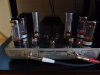
My FMI 100's and "correct" :music: amplification...

40 years old & still going strong - and yes those peerless tweeters can develop a buzz if over-driven - I've replaced a few over the years.

Marty
 

Attachments

  • P4190952.jpg
    P4190952.jpg
    59.8 KB · Views: 108
  • P4190954.jpg
    P4190954.jpg
    51.4 KB · Views: 105
  • P4190949.jpg
    P4190949.jpg
    81.6 KB · Views: 122
Last edited:
Back
Top Bottom