
• The move to the new server is done. There are some software and database maintenance updates in process. This has us passing the hat around to help out. We appreciate any donations. Seriously, even a dollar helps. The payment page may be found here - https://www.audiokarma.org/support.html

Gibson GA-50T Tube Amp What to Replace Debate...

Crumbs

Member
Debating how much to replace/recondition after realizing reality may not be as bad as thought on this 75 year old amp. After I opened up this vintage Gibson GA-50T guitar amp I realized the noise I thought was the sound of speaker surround decay was actually a half cup of used sunflower seeds sliding around when the amp was moved. Apparently a mouse decided it should dump them over the back of the amp plate to hide the evidence.

Now I wonder ... do I still do the rebuild, replacing all the paper caps, waxed caps, power caps, power tubes, rectifier tube, etc., or do I just put it back together and play?

Including picture of hidden circuit, which of these do I really want to replace?

Goal is not to cue theological argument though I guess I do wonder basis for why (safety, sound quality, tube life, etc) behind each answer.
 

Attachments
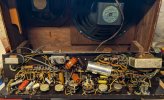
  • wiring.PXL_20240817_194107719.cropped.jpg
    wiring.PXL_20240817_194107719.cropped.jpg
    130.1 KB · Views: 93
Last edited:
Register to hide this ad
You gonna keep it forever and not worry about "vintage value"? If yes, then Lavane's suggestion is what I would do also.

You gonna sell it to someone looking for the "magical sound" of 75 year old caps & such? If yes, literally don't touch a thing, move it on to the next owner for the bucketload of $$$ that some will gleefully throw at ya ;)
 
If you really want to try leaving some of the "vintage mojo", you can probably leave the caps in the tone control section alone. They don't deal with any DC so leakage isn't a problem. I wouldn't be remotely surprised if they are way off value and skewing the tone control response, but the pots and resistors in that circuit are probably also well out to lunch and screwing it up anyway.

schematic

 
get rid of the sesame seeds, bring it up on a variac slowly, test the tubes for operations on a tube tester. If your a guitarist then once you find out if all the stuff is done break out the guitar and play through it. does it have a reverb ? if not a small reverb pedal will do .....sure looks great on the front of what i could find on the web. darn what a beauty of amp ....good luck and enjoy.
 
Last edited:
I corrected the post, they were sunflower not sesame seed hulls.

@Lavane I'd plugged it in before I set this project aside around February 2022, but I used a lamp short indicator when I did. My memory is it didn't sound awful but I don't know what is "supposed" to sound like anyway.

@init4fun I figure the "bucketload of $$$" I'd get would be about the same as trying to replace it. Reverb shows them in the $2k range, and about all I'd get that was different is something quieter or maybe marginally smaller but without the family history.

The debate the two of you raise is in part why I asked the question, and @gadget73 suggestion about tone controls is interesting. This is my first adventure into tube repair, so still learning how to read the schematics and separate out sections.
  1. Would you include the tremolo circuit in the tone controls?
  2. What is vintage sound anyway if the ESR of the cap won't even measure? that just seems broken to me.
  3. How do I know someone has not already changed it anyway? Or that it is complete? There is what seems to be newer braided shielded guitar cable, 3 black lines center, to the tremolo circuit, and the gray line to the tremolo pedal may also be new.
What I've Been Doing so Far

I've been slowly chronicling the investigation and potential rebuild with a spreadsheet build sheet. I'm marking up the schematic to provide R1, C1, S1 type references, which excepting the tubes were not numerated. Whatever I end up documenting will be posted to git just like the Sansui rebuild I did before.

I measured ESR for the cap parts I could get to. Stupidly described here because I haven't traced the circuit.
  • gray lower left, ceramic white behind inputs, far right black, and silver can all measure < 1
  • 2 odd silver boxes top left center, brown turd replacement?, orange replacement?, both center orange Sangamos, the left sealed paper measure < 20
  • the chromed yellow green and yellow brown waxed below the left top silver boxes < 30
  • everything else is either > 50, has no measurement, or I can not get the probes to it to measure
I need to trace each line and relate the parts to the schematic to figure out what is there, what has been modified, etc.
 
Some of those caps are not original anyway. See if you can find a pic of an unmolested one to figure it out. You can gut the old caps when you replace them to keep a more original look.
 
I agree with replacing all the carbon comp resistors also.
The question is, how valuable are these amps, and do you replace the carbon comps with the same, or with more reliable carbon film or metal film resistors? I could see maybe not wanting to change the overall tone that that amp may be known for.
 
That is what I don't understand. for arbitrary example 100 ohm = 100 ohm, except when the design is based on the expectation that 100 ohm decreases to 50 ohms changing the resonant frequency as the part temperature increases with use, which was the "intended design."

Also I suck at identifying/guessing whether old parts are a particular material base.

I appreciate the commentary, feedback and suggestions.
 
The debate the two of you raise is in part why I asked the question, and @gadget73 suggestion about tone controls is interesting. This is my first adventure into tube repair, so still learning how to read the schematics and separate out sections.
  1. Would you include the tremolo circuit in the tone controls?
  2. What is vintage sound anyway if the ESR of the cap won't even measure? that just seems broken to me.
  3. How do I know someone has not already changed it anyway? Or that it is complete? There is what seems to be newer braided shielded guitar cable, 3 black lines center, to the tremolo circuit, and the gray line to the tremolo pedal may also be new

These are great vintage guitar amps, especially for home and recording use. In terms of recapping the tone controls, if the amp is working it would be worth comparing the sound to some similar amps, or asking a guitar player/tech to listen and see if they are behaving as expected. If they are then leave it alone and all is good… but if the components are really out of spec then it might not sound great and I’d go ahead and replace the caps and maybe the carbon comp resisitors. Although in my experience those resistors are fine unless they’re really out of spec. I would replace them with new carbon comp because the circuit was designed with them in mind, including their variations and reactions. New carbon comp resistors will already be better than the old ones and are readily availably.

My guess is it has already been updated in some way over the years, as most amps like this have been. I can see a single orange drop style cap in the photo where it would have been something else originally matching all the others.

TBH this is a players amp, not a museum piece…. so if it sounds good when played then it’s good! :)
 
These are great vintage guitar amps, especially for home and recording use. In terms of recapping the tone controls, if the amp is working it would be worth comparing the sound to some similar amps, or asking a guitar player/tech to listen and see if they are behaving as expected. If they are then leave it alone and all is good… but if the components are really out of spec then it might not sound great and I’d go ahead and replace the caps and maybe the carbon comp resisitors. Although in my experience those resistors are fine unless they’re really out of spec. I would replace them with new carbon comp because the circuit was designed with them in mind, including their variations and reactions. New carbon comp resistors will already be better than the old ones and are readily availably.

My guess is it has already been updated in some way over the years, as most amps like this have been. I can see a single orange drop style cap in the photo where it would have been something else originally matching all the others.

TBH this is a players amp, not a museum piece…. so if it sounds good when played then it’s good! :)
I sort of agree except for the electrolytic capacitors. The paper ones should be replaced for sure. To be on the safe side all of the electrolytic caps should be replaced. The cap can may have been replaced at some point, but when? Even if those old electrolytic caps test ok it a crap shoot whether they will fail or not. I have an old console amp and the multi cap can tested ok, but one section soon shorted out and the choke cooked.
Staring out with fresh new carbon comp resistors of the same value and tolerances shouldn't change how the amp sounded when new though. Every piece of equipment I've run across with carbon comp resistors had several or more that were out of spec. And the question is how long will the others remain in spec?
You can always do a little research to find out what cap that orange drop replaced and see if it was an appropriate replacement.
 
I sort of agree except for the electrolytic capacitors. The paper ones should be replaced for sure. To be on the safe side all of the electrolytic caps should be replaced. The cap can may have been replaced at some point, but when? Even if those old electrolytic caps test ok it a crap shoot whether they will fail or not. I have an old console amp and the multi cap can tested ok, but one section soon shorted out and the choke cooked.
Staring out with fresh new carbon comp resistors of the same value and tolerances shouldn't change how the amp sounded when new though. Every piece of equipment I've run across with carbon comp resistors had several or more that were out of spec. And the question is how long will the others remain in spec?
You can always do a little research to find out what cap that orange drop replaced and see if it was an appropriate replacement.
Totally agreed. Any power supply capacitor should be replaced, especially any old electrolytics. For safety really.

I hear you about the resistors. In my experience they are often ok and stable, but eventually they will have to be replaced ... so if you’re doing the work now it is easy to just do it all at once to be safe rather than wait and have to open it back up again.
 
Totally agreed. Any power supply capacitor should be replaced, especially any old electrolytics. For safety really.

I hear you about the resistors. In my experience they are often ok and stable, but eventually they will have to be replaced ... so if you’re doing the work now it is easy to just do it all at once to be safe rather than wait and have to open it back up again.
That's always how I've felt about restores. I don't want to have to go back in again later.
 
I'm very new to rebuild/restore on equipment..
I've just taken it on to learn, for myself.. I don't look at things and wonder if I can get my money back, or more..
Most things I've taken on so far were simple clean and play items, maybe a part here and there..
And then I share em with someone..
You have a very nice piece of audio gear, nothing I'd use because I don't play guitar, but I'd love spending my time and some money making it fully functional again.. then I'd give it to someone that plays..

Can't help you with the repair, general lack of knowledge on my part, but theologically speaking you have to decide what you plan to do with it and proceed from there..
 
I think at least half those caps are non-original, and it doesn't look like a great job of installation.
@EastPoint: curious why you say it is not a great job. Other than large solder blobs and mismatch of wires what are you noticing?
Even better, what materials or process would you like to see in a quote "good job?"

also learning a lot from this discussion about pros-cons, alternate perspectives, why of parts replacement on old tube amp.
 
probably a case of one part replaced at a time whenever it had an ailment, not so much a single repair using whatever random components were hanging around.
 
Back
Top Bottom