• The move to the new server is done. There are some software and database maintenance updates in process. This has us passing the hat around to help out. We appreciate any donations. Seriously, even a dollar helps. The payment page may be found here - https://www.audiokarma.org/support.html

Good (usb?) Micro scope for inspecting styli?

TrevorBarten

Well-Known Member
I have a ton of cartridges, all of which are second hand. The condition of the styli is up in the air and I have no clue which are good and which aren't. I would like to know and I have been reading up on how to check for wear. I would like to try doing it myself and since I also sell cartridges from time to time I would like to be able to get high quality pictures. I did read nearly a dozen threads on what microscope would be good but the recommendations usually are either an old school microscope which wouldn't work due to lack of digital images, a cheap usb microscope which seems like a bit of a gamble with how much the magnification would actually be or an old microscope purpose made for the job, which would also not provide a digital image and is probably very hard to find. Not to mention that most of the threads I could find are nearly a decade old. So I figured I'd ask again. Ideally I'd want something I can also use for other things like SMD repairs. A real time digital image option would be fantastic. I would like to buy something secondhand if possible unless there is a very good new option available. I am willing to spend upwards of 400 usd though I have no idea if that is a decent amount to pay
 
Register to hide this ad
I ordered a pretty cheap one off Amazon a few years back (2021?). It's been great for my purposes of general stylus inspection. Claimed 50-1000x, 1080p. Now, this one is no longer sold so the issue has become the software. The app is no longer available/supported, so I had to find another USB microscope app to use it which somewhat limits functionality, but still lets me use it for my purposes.

As far as image quality goes, I can pretty clearly see the facets on the Shibata styli I have, and gauge the "sharpness" of a stylus tip, and see general cleanliness. I'm sure there's better scopes but if I can see all of that, this $40 scope is quite sufficient for me. I would imagine even the cheap ones have improved beyond this in the last few years as well.
 
USB microscopes are handy but don't have the magnification required to do serious stylus evaluation. Facets are visible but the wear spots on the stylus tips are out of reach. They are still useful though. I bought this one and added a stand with lights that can be used to show up the wear spots to some degree but it is no substitute for a true binocular stylus microscope.
 
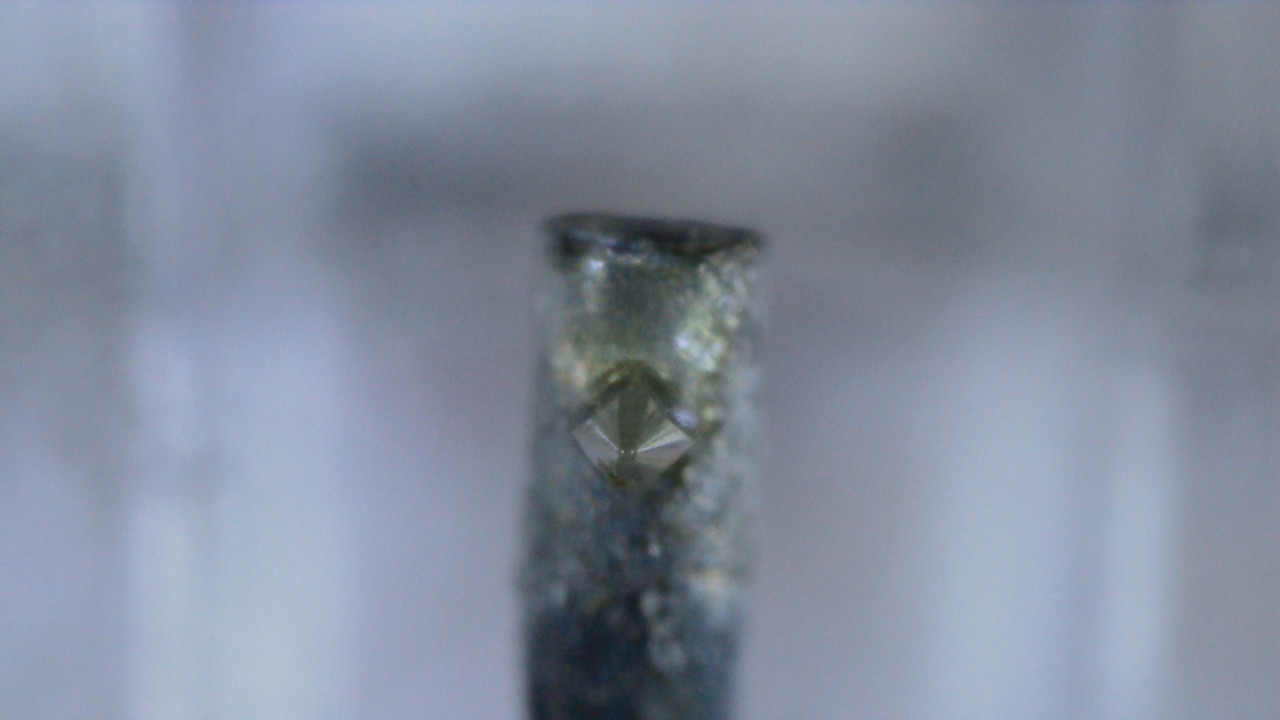
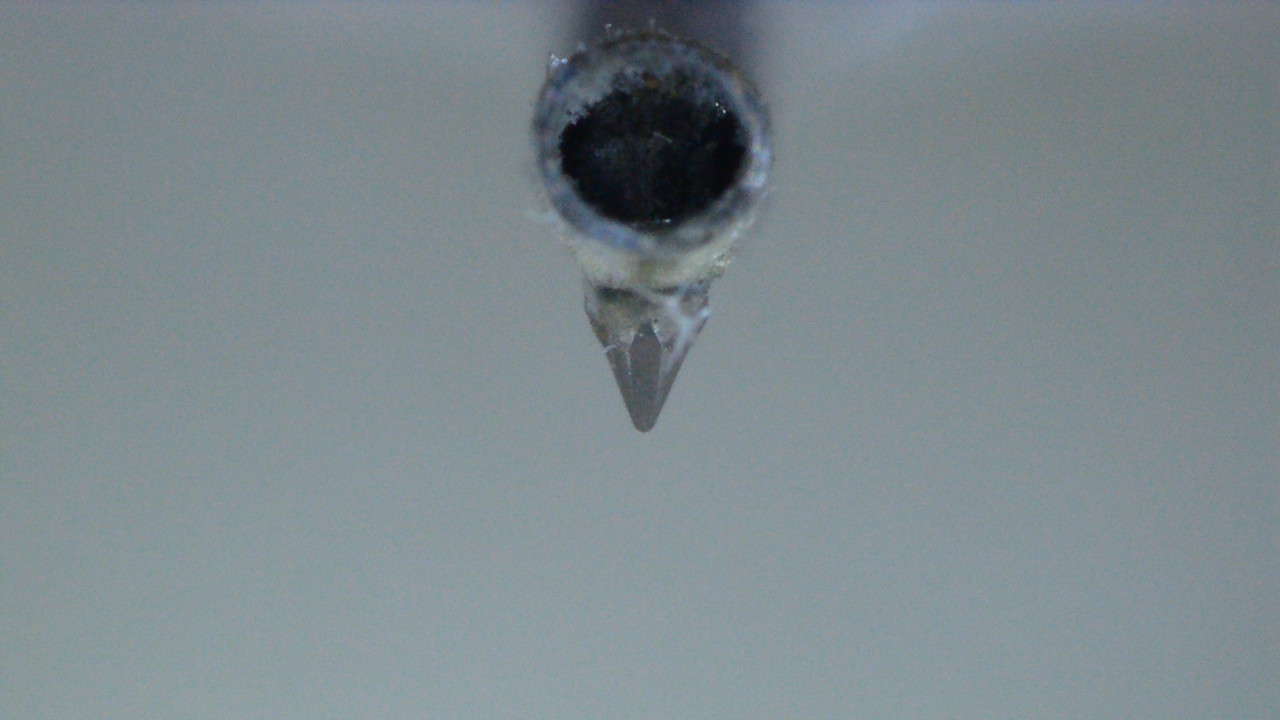
These are examples of what that microscope can do. Note the two little points of light on the tip of the stylus in the first picture. Those are reflections from the wear flats. This is a new Grace luminal trace stylus.
WIN-20231204-13-07-42-Pro.jpg


WIN-20231204-13-10-23-Pro.jpg
 
USB microscopes are handy but don't have the magnification required to do serious stylus evaluation. Facets are visible but the wear spots on the stylus tips are out of reach. They are still useful though. I bought this one and added a stand with lights that can be used to show up the wear spots to some degree but it is no substitute for a true binocular stylus microscope.
Is there no such thing as a binoculair microscope with a digital output? What microscope would you recommend?
 
I bought what I posted because it was the best option for my use, precisely the same as yours, at a price I was willing to pay. I tempered my expectations and learned how to take advantage of what it can do. There is no magic bullet.

You'd need to deal with a scientific supply house to find something capable of what you're looking for and from my point of view, what you are looking to use it for doesn't justify the sort of expense it will entail. It may be acceptable to you.
 
Is there no such thing as a binoculair microscope with a digital output? What microscope would you recommend?
Usb microscopes are crap, you need a light microscope with large magnification eyepieces and small objective to get good depth of field and most that have this are stereo microscopes which are used for circuit board examination and dissection so they ave a good working distance.
You need 200- 250x for looking at wear patches. Mine zooms to 100x then I add a Barlow lens which increases 2.5x which reduces working distance but depth of feld is still good.
Mt scope has a third eye for a camera which plugs into a laptop but taking a quick snap for a customer is just as easy to put my phone over one of the eyepieces which takes a good pic with my s24.
Look on ebay for closing labs selling these scopes you can get quite good ones cheap.
The good thing with stereo ones too is thry often come with zoom and the lower power is good for cleaning stylus and general examination.
Compound scopes can work too but you will need to get high power eyepieces and low objective and the stage may need moving.
Chris
 
Usb microscopes are crap, you need a light microscope with large magnification eyepieces and small objective to get good depth of field and most that have this are stereo microscopes which are used for circuit board examination and dissection so they ave a good working distance.
You need 200- 250x for looking at wear patches. Mine zooms to 100x then I add a Barlow lens which increases 2.5x which reduces working distance but depth of feld is still good.
Mt scope has a third eye for a camera which plugs into a laptop but taking a quick snap for a customer is just as easy to put my phone over one of the eyepieces which takes a good pic with my s24.
Look on ebay for closing labs selling these scopes you can get quite good ones cheap.
The good thing with stereo ones too is thry often come with zoom and the lower power is good for cleaning stylus and general examination.
Compound scopes can work too but you will need to get high power eyepieces and low objective and the stage may need moving.
Chris
Thank you for the detailed reply, that being said I don't know the first thing about microscopes except for what they do and that they work. I looked around a bit for stereo microscopes but most of the ones I could find only went up to +- 20x zoom. From what I understand for proper inspection of stylus wear I'd need around 200x like you suggest as well. I am pretty confused on how to even search for what I need. While a stereo microscope in general would be a useful tool for repairs like you mention I would prefer to buy an all in one solution. Do you have any tips on what to look for in terms of search terms and features?
 
I bought what I posted because it was the best option for my use, precisely the same as yours, at a price I was willing to pay. I tempered my expectations and learned how to take advantage of what it can do. There is no magic bullet.

You'd need to deal with a scientific supply house to find something capable of what you're looking for and from my point of view, what you are looking to use it for doesn't justify the sort of expense it will entail. It may be acceptable to you.
I'll order that usb microscope anyhow as it is cheap and seems like a quick solution, but longer term I'd like something a little more professional, even if it is just analog only.
 
Thank you for the detailed reply, that being said I don't know the first thing about microscopes except for what they do and that they work. I looked around a bit for stereo microscopes but most of the ones I could find only went up to +- 20x zoom. From what I understand for proper inspection of stylus wear I'd need around 200x like you suggest as well. I am pretty confused on how to even search for what I need. While a stereo microscope in general would be a useful tool for repairs like you mention I would prefer to buy an all in one solution. Do you have any tips on what to look for in terms of search terms and features?
Any scope you find, check for the availability of eyepieces and Barlow lenses.
If the scope is say 30x with 10x eyepieces and there are 25x eyepieces available for it then you are at 75x, add a 3x Barlow and it is 3x 75.
Look for something with maybe a 4.5x objective ( zoom if possible) thrn 20 or 25x eyepieces and a 2.5x Barlow
 
I'll order that usb microscope anyhow as it is cheap and seems like a quick solution, but longer term I'd like something a little more professional, even if it is just analog only.
They don't work trust me. They advertise huge magnification and they simply are not. Some say 5000x and they are not even 50x
 
They don't work trust me.
They might not work for your purposes but as indicated by the photos posted they do work within limits. As long as a person understands what those limits are and their purpose can be achieved within them, they are quite useful.
 
They don't work trust me. They advertise huge magnification and they simply are not. Some say 5000x and they are not even 50x
I found one for 15 euros shipped, cannot hurt to try atleast, worst case scenario I can add some better pictures of the cantilever to my listings for cartridges.
 
Almost any old microscope can have a camera attached with the right adapter(s). With a modern mirrorless or other camera with live view on the rear screen, just use that, as the camera replaces the eyepiece. IMHO, that's how you'll get the best quality and high magnification, but there is a bit of a learning curve. Note that direct view by eye will almost always be better than any image you can record.

Stereo microscopes are a special case of misery. Not usually enough magnification. Many have a central camera port, but it only looks through one side of the optical system, which is slightly tilted. Just makes getting the exact view and geometry you want more difficult. There are a bunch of inexpensive traditional stereo microscopes available, but quality is usually a bit iffy. If I were buying a stereo microscope I'd be looking for a good used Wild (they're Swiss so pronounce it "vilt").

There are inexpensive video inspection microscopes that are surprisingly good, but quality varies all over the place.

Illumination is the key to stylus inspection, as you're looking for facets. Do an image search on the old Shure SEK-2 stylus microscope and look at how they arranged the two lights on each side. If you can do something like that with small LED lights you'll be on your way to success.
 
Almost any old microscope can have a camera attached with the right adapter(s). With a modern mirrorless or other camera with live view on the rear screen, just use that, as the camera replaces the eyepiece. IMHO, that's how you'll get the best quality and high magnification, but there is a bit of a learning curve. Note that direct view by eye will almost always be better than any image you can record.

Stereo microscopes are a special case of misery. Not usually enough magnification. Many have a central camera port, but it only looks through one side of the optical system, which is slightly tilted. Just makes getting the exact view and geometry you want more difficult. There are a bunch of inexpensive traditional stereo microscopes available, but quality is usually a bit iffy. If I were buying a stereo microscope I'd be looking for a good used Wild (they're Swiss so pronounce it "vilt").

There are inexpensive video inspection microscopes that are surprisingly good, but quality varies all over the place.

Illumination is the key to stylus inspection, as you're looking for facets. Do an image search on the old Shure SEK-2 stylus microscope and look at how they arranged the two lights on each side. If you can do something like that with small LED lights you'll be on your way to success.
Stereo have enough magnification if you get one with 4 or 4.5 objective and then add good quality not ebay 20 or 25x eyepieces and a good quality Barlow lense.
I have several scopes, my first was a Meiji I got used, I bought ebay higher power eyepieces and the quality was horrible, I later gor genuine ones the difference was night and day.
You are correct re the camera port on some, but this can be overcome making a tilted bed for pictures.
The benefit (for me at least) with the stereo scope is huge working distance, and magnification from 10x all the way to 250x swapping eyepieces and adding a barlow.
I tend though to leave the bigger eyepieces in and do most things 25x to 100x and just add the Barlow when I inspect a stylus for wear.
Chris
 
Stereo have enough magnification if you get one with 4 or 4.5 objective and then add good quality not ebay 20 or 25x eyepieces and a good quality Barlow lense.
I have several scopes, my first was a Meiji I got used, I bought ebay higher power eyepieces and the quality was horrible, I later gor genuine ones the difference was night and day.
You are correct re the camera port on some, but this can be overcome making a tilted bed for pictures.
The benefit (for me at least) with the stereo scope is huge working distance, and magnification from 10x all the way to 250x swapping eyepieces and adding a barlow.
I tend though to leave the bigger eyepieces in and do most things 25x to 100x and just add the Barlow when I inspect a stylus for wear.
Chris
I found a euromex nexius zoom locally for 300 euros. Seems to be a good deal as solds on eBay are around 600... I believe it fulfills all the requirements that you mentioned. Just need to find the proper eyepieces and lenses to increase the maximum magnification now. That microscope has a slot for a camera so I will have to look into that as well.
 
I would prefer to buy an all in one solution.
Unless you get a dedicated microscope with proper side lighting, you will never be able to see if a stylus tip is worn, especially if you have no training or experience to do so. You will also need an unused stylus of the same model to compare it to.

Styli wear out, when they do you either replace them or have them re-tipped. You don't try to pass them off to someone else as "good" if you are not equipped to do a proper inspection.
 
I found a euromex nexius zoom locally for 300 euros. Seems to be a good deal as solds on eBay are around 600... I believe it fulfills all the requirements that you mentioned. Just need to find the proper eyepieces and lenses to increase the maximum magnification now. That microscope has a slot for a camera so I will have to look into that as well.
I wouldn't go for a stereo microscope, and not an expensive one.
Getting 200x magnification with a stereo microscope is really pushing it, and stereo isn't really necessairy.
Especially if your goal is to take pictures, stereo is not the way to go imo.
200x is the minimum to look at wear. And for pictures, you need to get a good depth of field in 1 shot, which is pretty much impossible at those magnifications. Most quality pictures you see on VE are made with stacking software. Focus on that
And I expect that it'll cost you quite a lot to convert that nexius zoom to 200x.

For a first try and get a feel for it, I'd get a normal, used, older microscope of decent quality from Marktplaats. Like an olympus, Elna breukhoven, some euromex'es. That doesn't have to cost more than €100.
Get a 10x, 20x and 40x objective (more is useless and is normally always oil immersion, so useless for this), 10x and 40x usually already comes with the microscope, and get either a smartphone fixture/holder for the oculair (you need a 5x, 10x (both are pretty standard), and if you can a 15x, or get a camera that is an oculair insert (there are good and bad ones, watch youtube reviews or google).
And get 2 led lights on goosenecks. They need to be single point led lights. I used a set that consists of more leds in a group, but you see the individual leds in the reflection on the stylus which is not good.

And definately get a microscope with a crosstable (kruistafel). to make a fixture for the cartridge that you can easily pinpoint.

The pictures posted above are imho not sufficient to judge stylus wear. They look great, but not enough magnification.
 
Last edited:
I wouldn't go for a stereo microscope, and not an expensive one.
Getting 200x magnification with a stereo microscope is really pushing it, and stereo isn't really necessairy.
Especially if your goal is to take pictures, stereo is not the way to go imo.
200x is the minimum to look at wear. And for pictures, you need to get a good depth of field in 1 shot, which is pretty much impossible at those magnifications. Most quality pictures you see on VE are made with stacking software. Focus on that
And I expect that it'll cost you quite a lot to convert that nexius zoom to 200x.

For a first try and get a feel for it, I'd get a normal, used, older microscope of decent quality from Marktplaats. Like an olympus, Elna breukhoven, some euromex'es. That doesn't have to cost more than €100.
Get a 10x, 20x and 40x objective (more is useless and is normally always oil immersion, so useless for this), 10x and 40x usually already comes with the microscope, and get either a smartphone fixture/holder for the oculair (you need a 5x, 10x (both are pretty standard), and if you can a 15x, or get a camera that is an oculair insert (there are good and bad ones, watch youtube reviews or google).
And get 2 led lights on goosenecks. They need to be single point led lights. I used a set that consists of more leds in a group, but you see the individual leds in the reflection on the stylus which is not good.

And definately get a microscope with a crosstable (kruistafel). to make a fixture for the cartridge that you can easily pinpoint.

The pictures posted above are imho not sufficient to judge stylus wear. They look great, but not enough magnification.
I am going to be buying that microscope anyway as worst case scenario if it is useless I can just resell it but I also want to be able to use the microscope for board repairs which, as I understand correctly, is hard to do due to lack of depth perception with a normal microscope.
 
Back
Top Bottom